

Rechargeable Magic Wand: The UK Buyer's Guide
Most rechargeable magic wand buying advice starts with vibration power and ends with waterproofing. That's backwards. A cordless wand is also a lithium-ion electrical appliance, and the details that protect you, your home and your privacy matter just as much as the motor.
A good UK purchase should offer body-safe materials, honest water-resistance information, a compatible charger, clear manufacturer details and a sensible end-of-life plan. Treat those points as essential rather than premium extras, and you'll make a far better choice than someone comparing mode counts alone.
Table of Contents
- The Evolution of the Rechargeable Magic Wand
- Key Features That Actually Matter
- Lithium-Ion Battery Safety and Charging Rules
- Understanding Waterproofing and IP Ratings
- Choosing the Right Model for Your Needs
- Discreet Delivery and Responsible UK Disposal
The Evolution of the Rechargeable Magic Wand
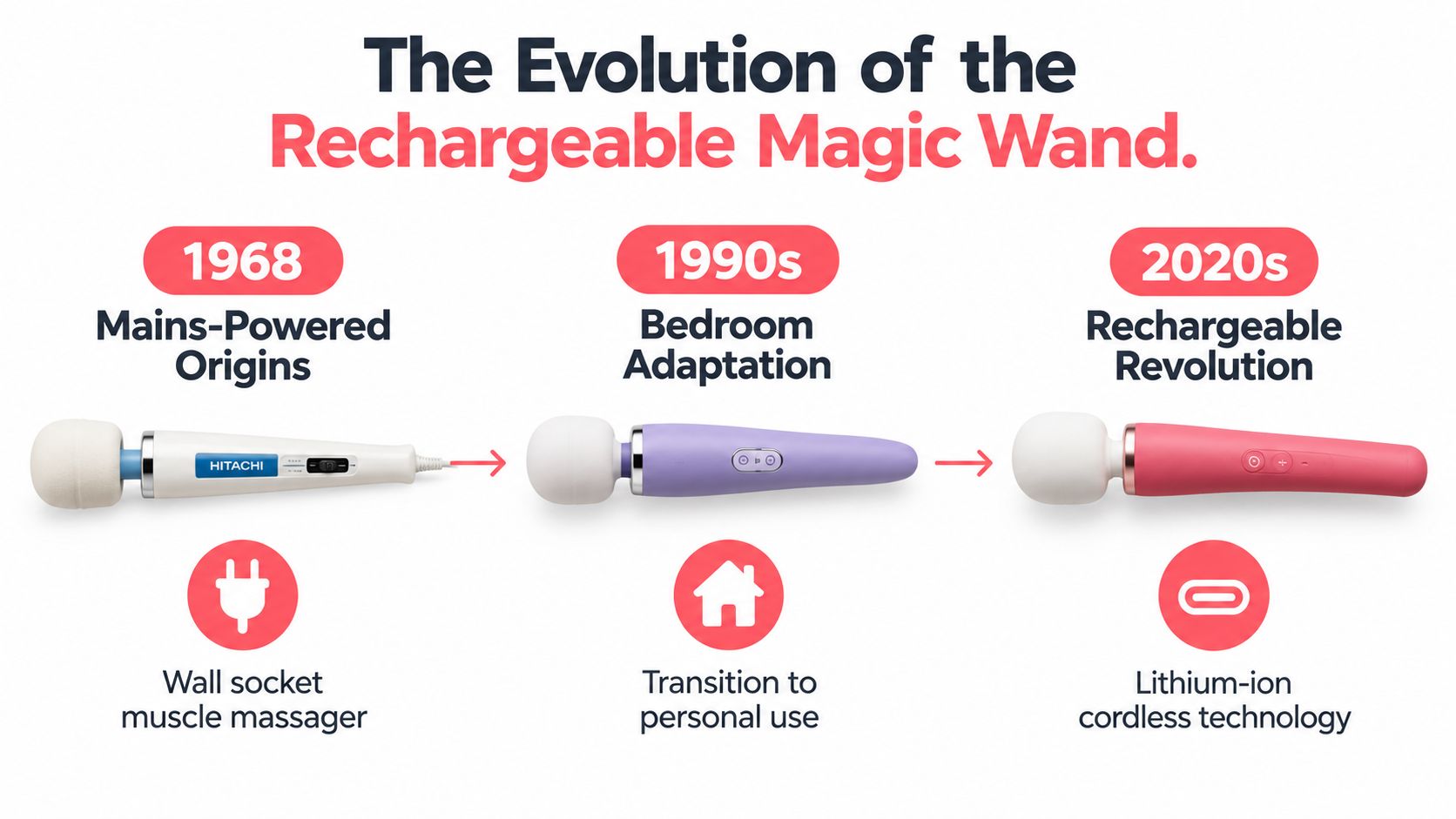
A rechargeable magic wand is not just a corded model with the cable removed. The design has evolved from a mains-powered muscle massager into a portable electrical device that must balance vibration, battery protection, sealed electronics and practical charging.
The original Hitachi Magic Wand launched in Japan in 1968 as a back and muscle massager, rather than explicitly as a sexual product. Its fixed cable delivered continuous power from a wall socket, helping establish the category's reputation for a strong, consistent motor. People later adopted the wand for sexual wellness, changing the product's public identity over time. UK-focused category coverage documents that shift from the original massager to newer cordless alternatives.
From wall socket to cordless design
The move to rechargeable models changed the product's engineering as well as its convenience. Doxy launched in the UK in 2014, while Le Wand entered the market in 2017, according to their respective UK product histories. By 2020, rechargeable wands had become a clear market direction in UK retail reporting, rather than a specialist variation.
Cordless operation removes cable management, makes packing easier and allows use away from a convenient wall socket. It also adds a lithium-ion battery, charging circuit, sealed port and heat-management requirements. Those components affect reliability and safe ownership, so a rechargeable wand deserves separate consideration from a corded classic.
The useful question isn't “How powerful is it?” It's “How safely and consistently does it deliver the power?”
Modern buyers also expect smooth external materials, easier cleaning and clearer controls. Those improvements matter, but they do not replace checks on the charger, IP rating or manufacturer information. Rechargeability is a practical design achievement, not proof that every model is well made. For UK shoppers, the better choice is the wand with transparent specifications and a sensible plan for battery care and eventual disposal.
Key Features That Actually Matter
Mode counts make easy marketing copy, but they don't tell you whether a rechargeable magic wand will feel comfortable, discreet or reliable. Start with the surface and motor, then examine the practical engineering.
Body-safe silicone should be your baseline. Smooth, non-porous silicone is easier to clean and doesn't absorb residue in the way porous materials can. Avoid vague material descriptions such as “soft touch” when the retailer doesn't identify the actual surface. A useful product page should state what contacts your skin and explain how to clean it. For broader guidance on construction and product quality, see this overview of what defines a premium intimate product.
Rumble, control and household discretion
A deep, steady vibration usually feels different from a sharp, surface-level buzz. You can't determine that experience from a mode count alone, so look for descriptions that explain the motor character, intensity range and control method. A beginner may prefer gradual adjustment, while an experienced user may want a stronger output that remains controllable.
Noise matters too, especially in shared housing. “Quiet” is useful only if the product description gives enough context to make a realistic decision. A motor that sounds acceptable in an empty room may be much less discreet through a wall or door.
Multiple patterns can add variety, but they're valuable only when the controls are intuitive. You should be able to lower intensity quickly without cycling through a long sequence of settings.
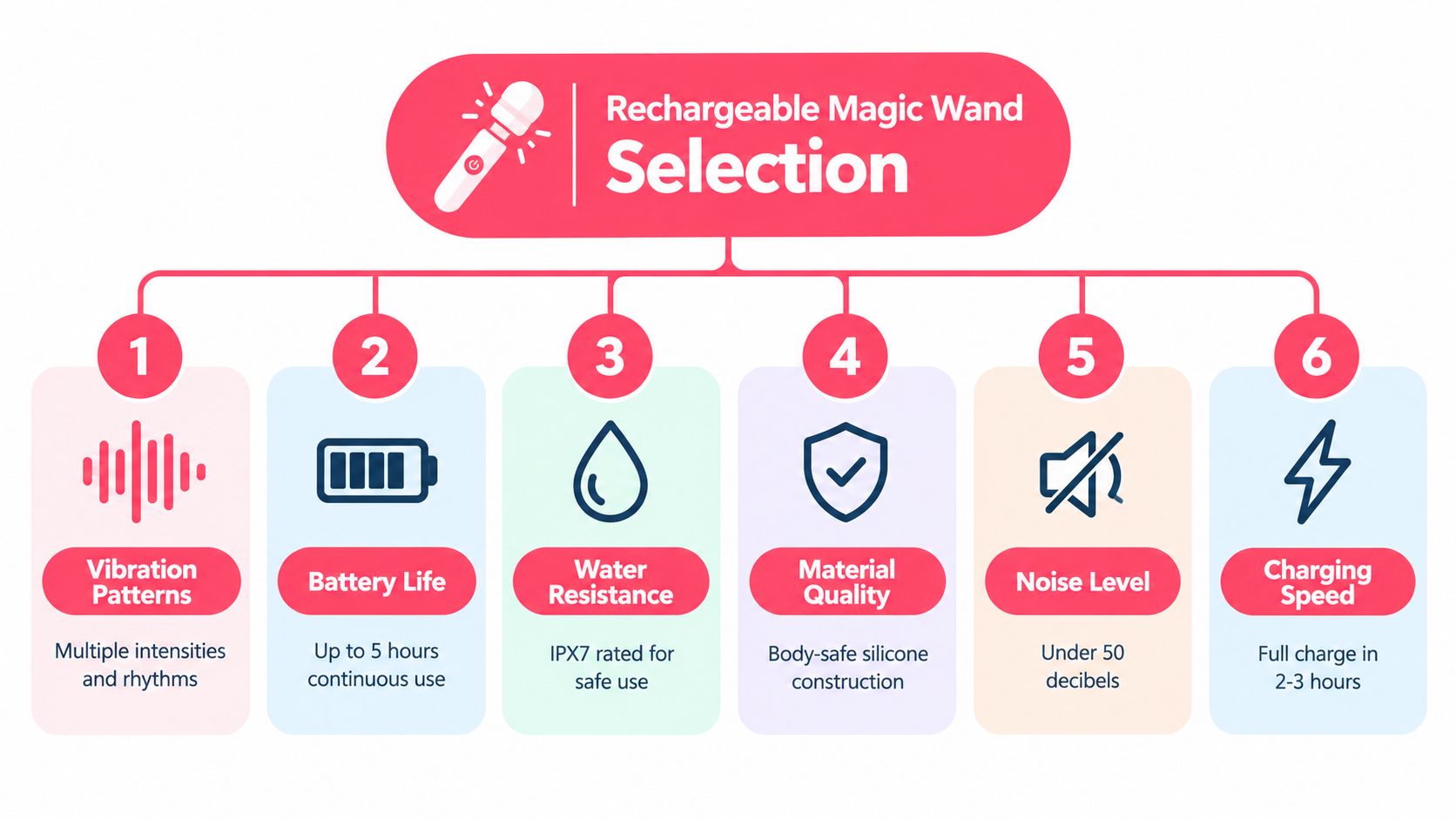
The Rechargeable Wand Vibrator is a compact option whose catalogue description lists 20 modes, 7 speed levels, smooth body-safe silicone, USB charging, a quiet design and waterproof construction. Those are useful specifications to compare, but you should still check the product's formal IP information and charging instructions before assuming how it can be cleaned or used around water.
Here's a practical specification checklist:
- Material: Identify the body-contact material, not just the finish.
- Controls: Check whether intensity changes are simple and responsive.
- Motor: Look for meaningful descriptions of vibration depth rather than empty power language.
- Sound: Treat “quiet” as a comfort claim, not a guarantee of complete silence.
- Charging: Confirm the supplied cable or charger and the stated input requirements.
- Documentation: Prefer a retailer that names the model and responsible manufacturer or importer.
Lithium-Ion Battery Safety and Charging Rules
A rechargeable magic wand contains the same type of battery system that demands care in other portable electronics. UK guidance identifies thermal runaway as the principal lithium-ion battery hazard. That means uncontrolled self-heating can develop when a cell or charging system is damaged, stressed or poorly protected. UK Government lithium-ion battery guidance recommends safety mechanisms that prevent this during normal use and reasonably foreseeable misuse.
Charge it like an appliance
Use the manufacturer-supplied charger or an explicitly approved replacement. Don't grab an unbranded cable or adapter just because the connector fits. Voltage, current and charging protocols can differ, and a mismatch can place unnecessary stress on the battery.
Charge on a hard, non-flammable surface in a dry, ventilated area while you're awake and nearby. Disconnect the wand when charging is complete, and never charge it unattended overnight. A waterproof device must still be completely dry around its charging port before you connect it.
If the port is wet, the wand isn't ready to charge. Dry it first, then inspect the connector and surrounding seal.
Look for clear retailer information about the battery type, charging input, approximate charge time and whether the charger is included. If those details are missing, contact the retailer before buying rather than guessing.
Recognise failure signs early
Stop charging and stop using the wand if it becomes unusually hot, swells, leaks, changes shape, develops an abnormal smell or starts charging substantially more slowly. Those signs indicate a possible battery or charger fault, not a normal change in performance. Don't open an integrated battery compartment, modify the device or attempt a cell replacement unless the manufacturer explicitly permits it.
For long periods without use, follow the manufacturer's storage instructions. Keep the wand cool, dry and away from direct heat or flammable materials. Store the charger separately if that helps prevent cable damage, and inspect the device before charging it again.
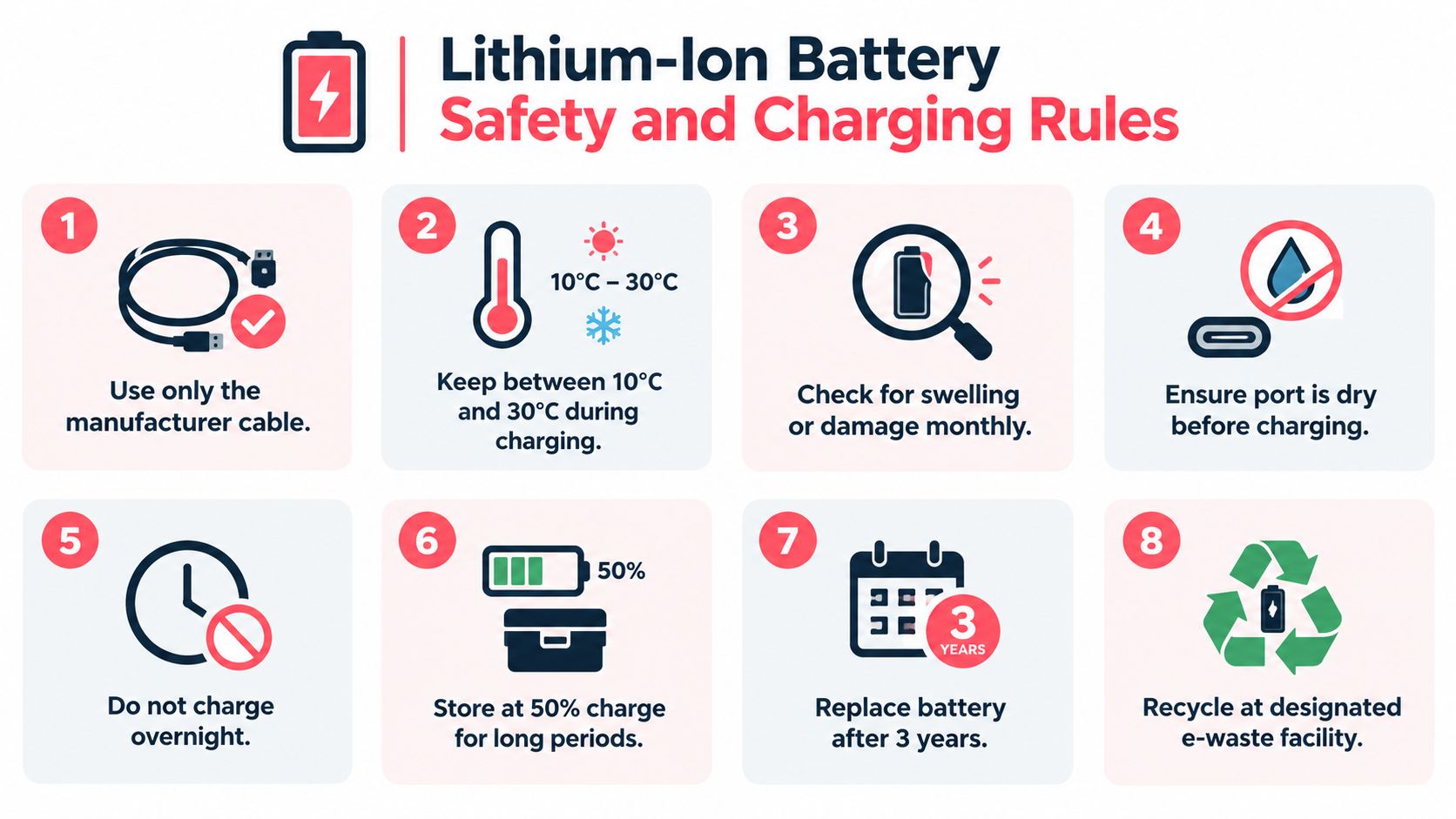
For a damaged or swollen wand, don't place it in a drawer, parcel or household bin. Keep it away from heat and seek instructions from the manufacturer, retailer, local authority or an appropriate recycling service. Battery protection is part of product quality, so UK buyers should expect proper documentation rather than treating charging as an afterthought.
Understanding Waterproofing and IP Ratings
“Waterproof” is a marketing label, while an IP rating is a technical classification. Treat them differently when choosing a rechargeable magic wand.
IP codes describe an electrical enclosure's protection against solids and water. Splash resistance does not automatically make a product suitable for immersion, and any water-ingress rating applies only under the manufacturer's stated conditions. The BEAMA guide to IP codes explains why the formal rating matters more than casual retailer wording.
Read the rating, not the headline
Before rinsing or submerging a wand, find its exact IP code in the manual or product specification. Check whether the rating applies with the charging cover closed, whether immersion is permitted and which cleaning method the manufacturer allows. If the page only says “waterproof” without a formal rating or instructions, treat the claim cautiously. For a practical walkthrough of what water resistance means for intimate devices, see our guide to waterproof sex toys.
Pay close attention to the charging port. Liquid around or inside the connector can cause corrosion, leakage paths or short circuits. Magnetic connectors and sealed covers still need inspection, since residue, hair or cleaning product can interfere with the seal.
Clean simply and dry thoroughly
Smooth silicone is usually straightforward to clean, but follow the product's instructions rather than assuming every wand tolerates the same treatment. Use the recommended water temperature and cleaner, keep liquid away from buttons and seams, and dry the device fully before storage.
Never charge in the bath, shower or beside a wet sink. Water resistance covers specified exposure during use. It does not make a connected charging point safe near water.
Use this buying rule: if you can't find the exact rating and charging-port instructions, choose another product or ask the retailer before purchase. Clear guidance reflects responsible design.
Choosing the Right Model for Your Needs
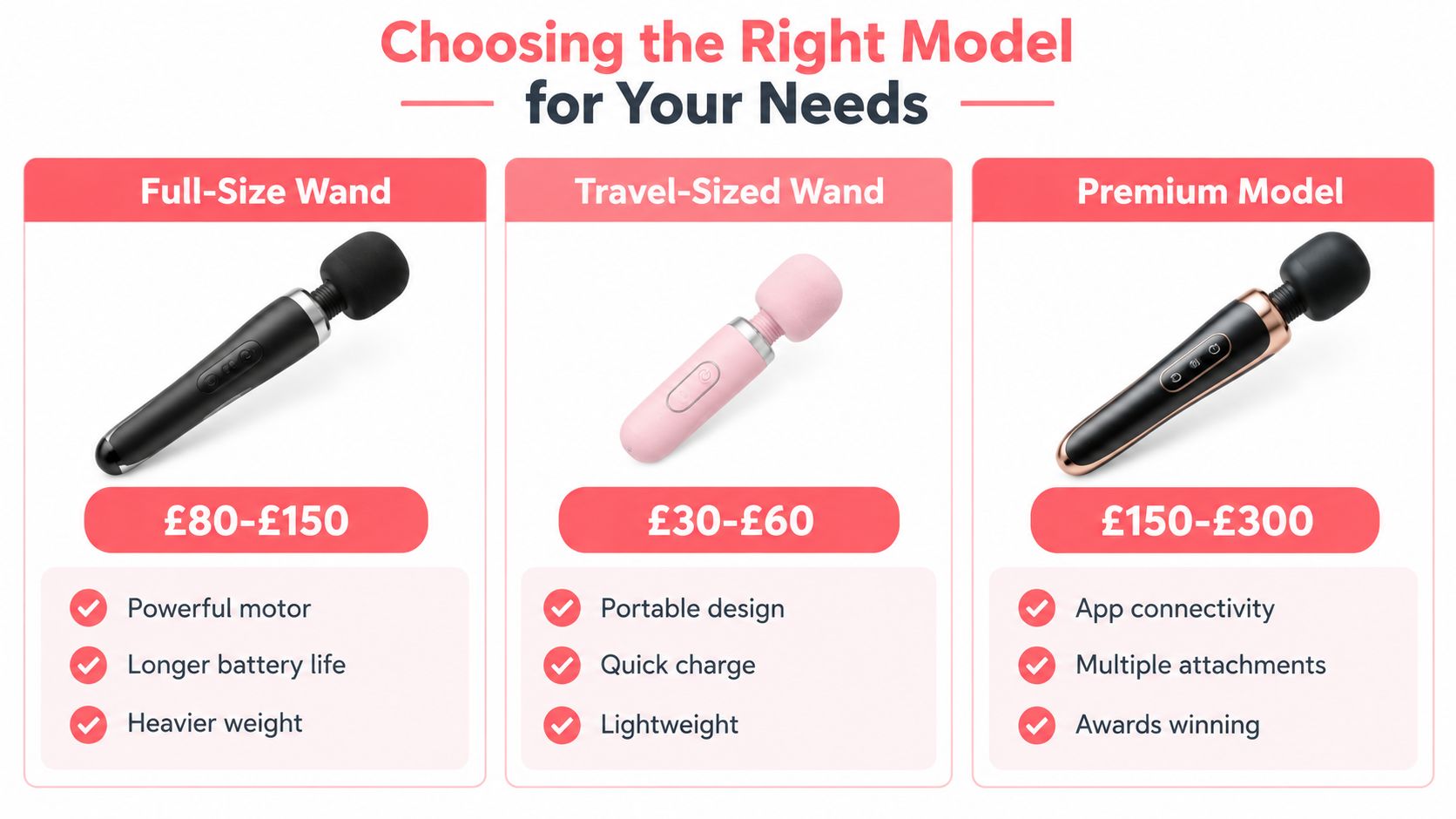
The right rechargeable magic wand depends on where you'll use it, how much weight you're comfortable holding and whether you want a broad external massage or a compact travel device. Bigger isn't automatically better, and smaller isn't automatically weaker.
| Model type | Best suited to | Main compromise |
|---|---|---|
| Full-size wand | Strong external stimulation and muscle massage | More weight and less discreet packing |
| Compact wand | Travel, smaller hands and easy storage | May offer less physical mass and reach |
| Feature-rich model | Users who value varied controls or attachments | More components to clean and understand |
Full-size strength versus portable convenience
A full-size wand gives you a larger handle and head, which can make positioning easier during external use. It may also feel more substantial for shoulders, thighs or back muscles. The trade-off is practical: it takes up more space and can become tiring if you're holding it for a long session.
A compact model slips into a wash bag or drawer more easily. That makes it attractive for travel and shared homes, particularly when discreet storage matters. The smaller body may suit beginners who want controlled contact, although you should inspect the control range rather than assuming compact means gentle.
Decide which extras earn their place
Interchangeable attachments can provide targeted sensations, but they also add cleaning and storage requirements. App connectivity can be useful for some couples, while other buyers prefer physical buttons that work without a phone, account or connection.
Think through your actual routine:
- For a first wand: Choose clear controls, a gradual intensity range and an easy-clean surface.
- For travel: Prioritise compact size, secure charging and a formal water-resistance rating.
- For muscle massage: Look for a comfortable handle, stable head and a motor that doesn't require maximum output immediately.
- For shared use: Choose a non-porous surface and establish a cleaning routine between users.
- For discreet homes: Consider storage, operating sound and whether the packaging reveals anything about the contents.
The best specification is the one you'll use confidently. A technically advanced model that stays in a drawer is a poor purchase, while a simpler device with reliable controls can become part of your regular routine.
Discreet Delivery and Responsible UK Disposal
Privacy continues after payment. Check the product page, billing descriptor, parcel, returns process and disposal route before ordering. A retailer's discreet delivery information should state what appears on the outer packaging and how customer details are handled. This matters if you share an address, payment account or delivery location.
Store the wand, charging cable and instructions together in a dry, private place. Keep it away from children and visitors, and avoid leaving it connected to power when it is unattended. If the device uses an app, delete personal information and disconnect the account before returning or disposing of it.
Don't put a rechargeable wand in general rubbish
A rechargeable wand contains electronic components and a lithium-ion battery, so ordinary household waste is the wrong disposal route. Recycling access differs between UK areas. Research cited in Somerset Council's battery and waste-fire guidance found that only 100 of 391 councils offered kerbside collection for small mixed electrical items, covering about 23% of UK households.
The same guidance reported more than 1,200 serious battery fires in UK waste facilities or vehicles in 2023, alongside a 70% year-on-year increase. A damaged or incorrectly discarded battery can create a fire risk during collection, sorting or transport.
Use your local authority's recycling finder, a suitable electrical-waste collection point or a retailer take-back service. Confirm that the site accepts small electrical devices containing integrated lithium-ion batteries. If the wand is swollen, leaking or otherwise damaged, do not place it in a public collection point without first describing its condition and following the operator's instructions.
Protect privacy during returns and recycling
Clean the exterior, remove detachable accessories where appropriate and delete app data before handing the device over. Pack a return discreetly, but never hide battery damage from a carrier, retailer or recycling operator. Clear information allows them to handle the item safely.
For buyers considering another intimate device, the Anal Prostate Massager with Penis Ring for Men is listed as in stock at £19.99. Apply the same ownership principles: follow the cleaning instructions, store it securely and arrange responsible disposal rather than putting it in ordinary rubbish.
Rechargeability reduces reliance on disposable batteries, but it does not remove end-of-life responsibility. Choose retailers that publish clear specifications, provide discreet fulfilment and explain returns, recycling and battery safety.
Immerse Creations lists rechargeable wand vibrators, body-safe intimate products and other targeted devices. Visit Immerse Creations to compare options and check care, charging and privacy details before buying.

