Realistic Silicone Dildo: A Complete UK Buyer's Guide
You've opened three product pages, each promising a realistic silicone dildo, and somehow you're less certain than when you started. One listing shows lifelike veins, another highlights “body-safe” material, and a third gives a dramatic total length without making the usable length obvious. You want something comfortable, hygienic, and suitable for how you plan to use it, without having to decode vague marketing language.
The practical answer is to treat the purchase as a specification decision first and a pleasure decision second. Shape matters, but so do the polymer details, lubricant instructions, dimensions, construction, cleaning limits, and the retailer's customer policies. This guide brings those points together for UK buyers, in plain language and without assuming you already know the terminology.
Table of Contents
- What a Realistic Silicone Dildo Actually Is
- Material and Safety Basics for UK Buyers
- Sizing, Firmness, and Realistic Features
- Lubricant Compatibility and Verifying Material Claims
- Cleaning, Drying, and Storage Routine
- Shared Use, Site Switching, and Condom Decisions
- Buying a Realistic Silicone Dildo Online in the UK
- Quick Reference and Final Checks
What a Realistic Silicone Dildo Actually Is
A first-time shopper might read “realistic silicone dildo” as one complete product description. On a product page, though, it usually combines three separate ideas: realistic, silicone, and dildo.
“Realistic” generally describes the design. You may see an anatomically familiar outline, a defined glans, visible veins, skin-like folds, testicle details, or a textured surface intended to resemble a body. Some products focus heavily on appearance, while others use a simpler shape with only a few lifelike details. A realistic finish can make the product feel more immersive, but it doesn't tell you whether the dimensions or firmness will suit you.
“Silicone” describes the construction material, or at least the material the retailer says has been used. That distinction matters. A product can look soft and skin-like while being made from a different elastomer, a coated material, or an unclear “silicone blend”. The word on the front of the listing isn't enough by itself. You need the full material description and the care instructions.
Finally, “dildo” identifies the product category. It usually means a non-vibrating insertable toy, although some modern designs combine dildo-like shapes with motors, thrusting mechanisms, suction bases, or rechargeable electronics. A plain dildo and a motorised realistic product may look similar in photographs but require very different cleaning and storage routines.
Read the listing in three passes
When you open a product page, separate the information into these questions:
- What does it look like? Check the shape, texture, colour, anatomical details, and any curves.
- What is it made from? Look for the exact polymer, whether the surface is non-porous, and any stated exclusions.
- How does it function? Note whether it is insertable, vibrating, thrusting, waterproof, suction-mounted, or compatible with a harness or machine.
This way of reading makes comparison much easier. A guide to life-like dildos can help you think about visual design, but the product page still needs to answer the material and care questions directly.
A realistic appearance is a preference, not a safety certificate. Treat “body-safe” as a prompt to look for evidence rather than as a complete technical specification. The most reassuring listing is the one that tells you what the product is made from, how to clean it, which lubricant to use, and what limitations apply.
Material and Safety Basics for UK Buyers
Material verification is the foundation of the purchase. A realistic shape can be appealing, but the material affects cleaning, lubricant compatibility, durability, and what happens when the surface becomes damaged.
Look for an explicit polymer description rather than a loose phrase such as “rubber-like” or “silicone blend”. A useful product page should identify silicone clearly, state whether the surface is non-porous, and explain whether the product contains PVC or phthalate plasticisers. If the retailer can provide supplier or batch documentation, that gives you more confidence than a lifestyle photograph or an unexplained badge.
For products placed on the GB market, UK REACH guidance applies to chemical substances and articles. Manufacturers and importers are responsible for understanding and managing chemical risks. REACH compliance is not the same as medical-device biocompatibility certification, so neither claim should be used as a substitute for the other.
Compare the material language
| Material | Porous? | Lubricant safe | Cleaning notes |
|---|---|---|---|
| Explicitly identified non-porous silicone | Generally treated as non-porous | Water-based lubricant is the conservative choice. Check the manufacturer's instructions | Wash according to the care instructions and dry completely |
| Jelly rubber | May be porous or contain unclear softening ingredients | Check carefully. Don't assume compatibility | Requires cautious cleaning and close inspection |
| TPE or TPR | Commonly porous or less straightforward to sanitise fully | Follow the manufacturer's directions | Clean carefully, avoid assuming that washing makes it equivalent to non-porous silicone |
| “Silicone blend” without a full specification | Unclear | Unclear until the composition is confirmed | Ask the retailer for the complete material details |
This table isn't a substitute for the manufacturer's instructions. It shows why vague language deserves a question before you buy. A realistic texture, soft feel, or natural colour doesn't prove that the entire product is made from non-porous silicone.
Ask for information you can act on
A retailer should be able to tell you:
- The exact material or polymer description.
- Whether the product is coated, mixed, or made from more than one material.
- Whether phthalates and PVC are absent.
- Whether the item is motorised or contains inaccessible cavities.
- Which cleaning method and lubricant the manufacturer recommends.
For a comparison of silicone terminology and product construction, the guide to medical-grade silicone is a useful starting point. It's also sensible to distinguish a material label from a certification claim. If a listing uses “medical-grade” without explaining what has been assessed, ask for clarification.
The 8.6" Thrusting Realistic Dildo illustrates why construction details matter. Its listing describes a realistic textured design, a suction base, waterproof construction, rechargeable operation, and separate total, insertable, and telescopic measurements. Those details should be assessed together, because a motorised product needs different care from a plain, non-motorised silicone dildo.
Practical rule: If you can't establish what the surface is made from and how the manufacturer expects you to clean it, pause the purchase rather than filling in the gaps yourself.
Sizing, Firmness, and Realistic Features
A listing can show a realistic silicone dildo at a flattering angle, but the photograph cannot tell you how much of the product is usable. Start with the measurements, then compare them with the intended use.
Total length covers the entire item. Insertable length covers the portion designed for insertion, while a base, handle, connector, or thrusting mechanism may make up the remainder. Diameter describes width at a particular point. Circumference gives a clearer indication of how much material surrounds the shaft, especially when the shape varies along its length. If the listing provides only one width, check where that measurement was taken.
Firmness affects pressure, flexibility, and control as much as size does. A firmer dildo keeps its shape and delivers more direct pressure. A softer one compresses and bends more readily. A soft outer layer around a firmer core, often called dual-density construction, creates a different feel from a single-density design. Treat firmness as a specification to confirm, rather than something to guess from a photograph or the word “realistic”.
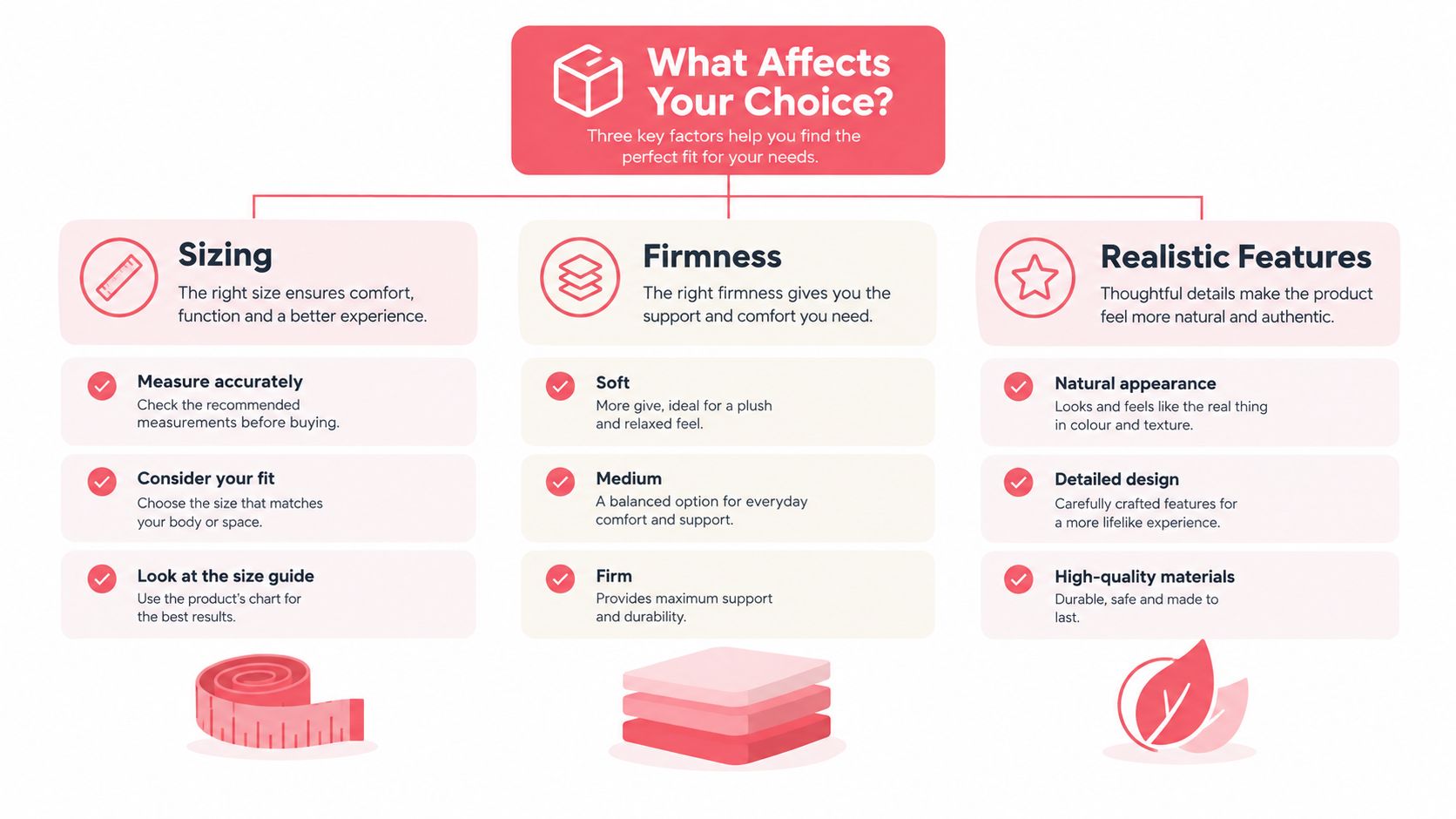
Texture also affects the decision. Veins, glans definition, folds, ridges, and contours change both tactile stimulation and cleaning effort. Pronounced details may suit someone seeking more surface variation, while a smooth finish may be easier to clean and more comfortable for another user. A tapered head creates a different sensation from a broad or sharply defined head, particularly when the angle of use changes.
Check the base separately. A flared base can help provide a safety feature for anal use. A suction cup is intended to attach to a smooth surface. It does not automatically indicate compatibility with a thrusting machine, harness, or connector system. Confirm the accessory's dimensions and attachment method before buying on the assumption that the parts will fit.
For powered positioning, the Sex Machine with 5 Dildo Attachments listing specifies adjustable rotation, multiple speed settings, four suction cups, five realistic attachments, and a stated connector type. These describe that machine and its supplied attachments. They do not establish that another realistic dildo will fit it.
Use this final comparison:
- Will the insertable length and width suit the intended user?
- Does the firmness match the planned use?
- Does the base offer the support or attachment required?
- Will the texture be comfortable and practical to clean?
- Are the dimensions measured clearly rather than suggested by the photograph?
Choose the size you can use comfortably, not the one that looks most dramatic in a listing.
Lubricant Compatibility and Verifying Material Claims
A realistic finish does not tell you which lubricant to use. The safest purchase decision starts with the material, then checks how that material reacts to the formula you plan to apply. Silicone-based lubricant can damage silicone toy surfaces, leaving them tacky, swollen, softened, cloudy, or otherwise changed. An NHS-linked sexual-health resource advises checking product guidance for this compatibility issue.
For most realistic silicone dildos, water-based lubricant is the cautious default. It is generally easier to rinse away and avoids the specific concern linked with silicone lubricant. Hybrid formulas require product-level checking because their ingredients differ. The word “hybrid” alone does not confirm compatibility.
| Lubricant base | Safe with silicone | Practical check |
|---|---|---|
| Water-based | Generally the cautious choice | Reapply as needed, then wash the toy |
| Silicone-based | Do not assume it is safe | Check the toy manufacturer's guidance first |
| Hybrid | Depends on the formula | Patch-test a discreet area before wider use |
| Oil-based | Depends on the toy and condom | Check compatibility with both |
A patch test is a useful safeguard, not a substitute for clear instructions. Put a small amount of lubricant on an inconspicuous area and follow the manufacturer's recommended waiting period. If no period is given, inspect the area cautiously before use. Stop if you notice tackiness, swelling, cloudiness, softening, or surface changes. Treat the toy as incompatible if its finish changes.
Material claims deserve the same careful reading. Look for:
- The full material, rather than only “silicone blend”.
- Any coating or surface layer stated by the retailer.
- Care instructions that identify suitable lubricants.
- A supplier able to answer specific material questions.
- Technical information beyond “body-safe”.
A guide to material certification explains why certification wording needs context. Clear documentation is more useful than a reassuring label. If the listing leaves the material or coating uncertain, choose another product rather than guessing.
Cleaning, Drying, and Storage Routine
Cleaning starts with construction, not colour or appearance. A non-motorised silicone dildo with no internal mechanism can usually be washed with warm water and mild, fragrance-free soap, rinsed thoroughly, and dried completely. Follow the product instructions if they differ.
Textured veins, skin folds, seams, and suction bases deserve deliberate attention. Use your fingers or a soft clean cloth to work through grooves, then check around the base and any joins. Rinsing quickly may leave lubricant or bodily fluid in the parts of the design that make the toy look realistic.
Motorised or rechargeable products need more restraint. Don't boil, submerge, or expose them to excessive heat unless the manufacturer explicitly says those conditions are safe. Water can enter a charging port or electronics compartment, while heat can affect seals, adhesives, batteries, and bonded components.
A practical after-use routine
- Clean promptly. Use the method stated by the manufacturer. UK infection-control guidance says reusable equipment should be decontaminated according to the manufacturer's instructions and current best practice, which is a sensible standard for reusable intimate products. The UK infection-control code of practice provides that wider principle.
- Rinse thoroughly. Remove soap and lubricant from textured areas.
- Dry every surface. Pat it dry with a clean towel, then allow it to air-dry fully before storage.
- Store separately. Use a clean storage bag or dust cover, and keep products from touching if the manufacturer warns that materials can react.
- Inspect before the next use. Look for cracks, swelling, persistent odour, tackiness, or a changed surface.
A persistent smell or sticky finish may indicate degradation or an incompatible lubricant. Cracks and tears can trap residue and make the item harder to clean reliably. Replace a product when the surface has deteriorated rather than trying to restore it with stronger chemicals.
Shared Use, Site Switching, and Condom Decisions
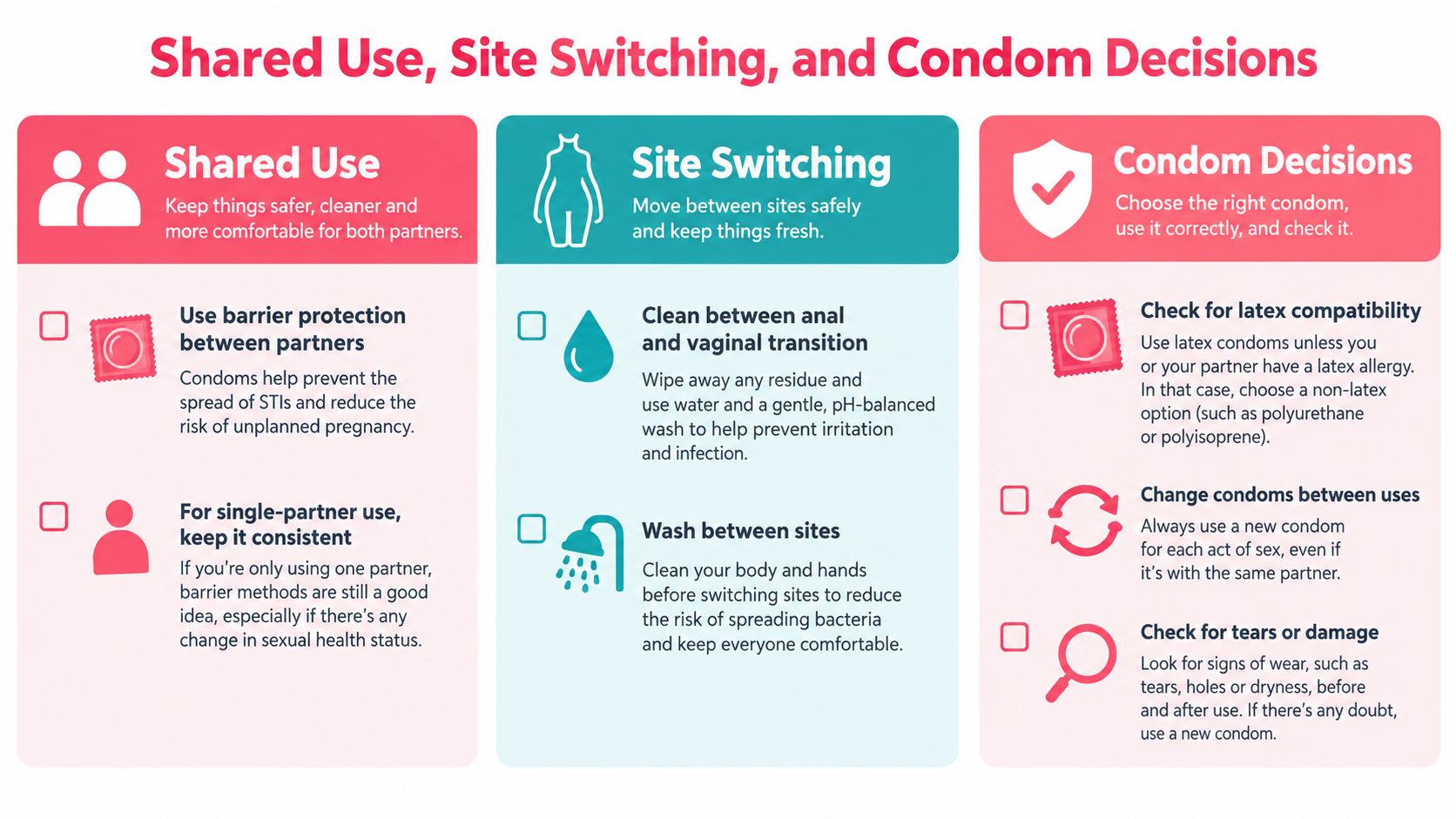
“Non-porous” means a surface is less likely to absorb fluids than a porous material. It doesn't mean that a textured, damaged, or complicated product becomes risk-free. Grooves, seams, cavities, and inaccessible parts can still retain residue, which is why shared use needs a specific plan.
For solo use, clean the toy after every session and inspect it before storing. For partner sharing, a new condom over the toy provides an additional barrier, and the condom should be changed before another person uses it. Condoms don't remove the need to clean the product or wash hands.
Site switching needs a firm rule. If a toy moves from anal use to vaginal use, change the condom first or clean the toy thoroughly according to its instructions. Don't rely on a quick wipe, particularly when the surface has deep realistic texture. SH:24 guidance on cleaning sex toys recommends cleaning after every use, following manufacturer instructions, and avoiding submersion for battery-operated toys.
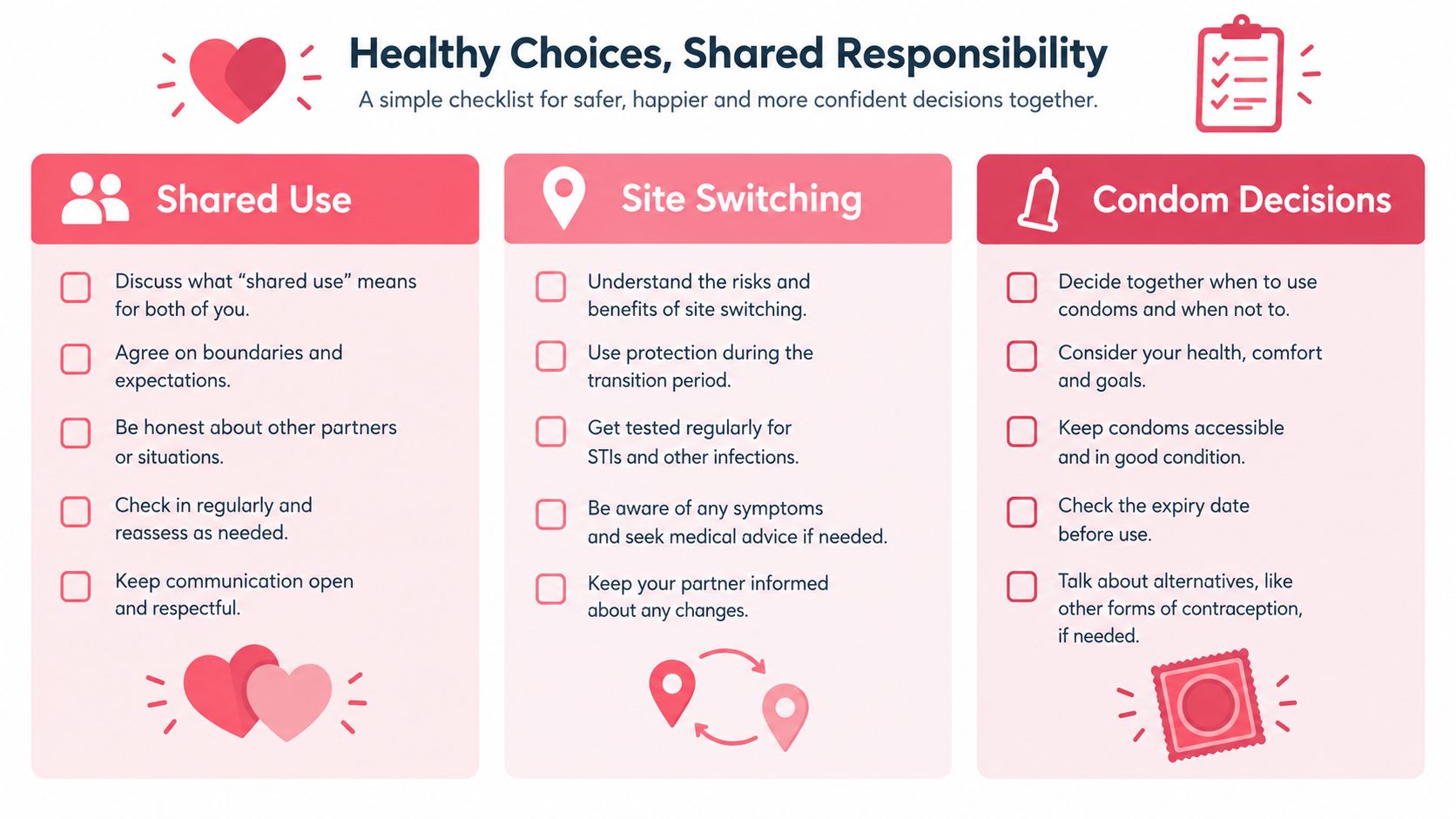
Use this decision path
- Solo and one body site: Clean after use, dry fully, and inspect the surface.
- Shared between partners: Use a fresh condom for each person, then clean the toy.
- Moving between vaginal and anal use: Change the condom before switching sites, or clean the product thoroughly before the transition.
- Using a battery-operated model: Keep it out of water unless its instructions explicitly allow immersion.
- Finding damage: Stop using it. Cracks, tears, swelling, or persistent tackiness are reasons to replace the product.
Boiling isn't a universal answer. It may be unsuitable for a powered toy, a sealed electronics compartment, bonded components, or a product whose manufacturer hasn't approved high heat. The care instructions take priority over broad internet advice.
Talk with a partner about condom changes, site switching, comfort, and stopping. A clear agreement makes the practical decisions easier and avoids relying on memory in the moment.
Buying a Realistic Silicone Dildo Online in the UK
A product page can show a convincing shape while leaving the important questions unanswered. Before ordering, treat the listing like a specification sheet. Confirm the material, total and insertable dimensions, cleaning method, compatible lubricant, delivery terms, returns policy, and a clear way to contact the retailer.

Assess the shop as well as the toy
Look for an 18+ access gate, a readable privacy policy, and a straightforward explanation of how customer information is handled. UK age-assurance rules have developed through several stages. The Digital Economy Act 2017 created an intended framework, its planned July 2019 start was delayed, the relevant provisions were not commenced in October 2019, and the Online Safety Act 2023 introduced a different model. Ofcom set 25 July 2025 as the implementation date reported for certain pornography age-assurance requirements under the newer regime, as described in the UK Parliament briefing on age verification and online safety.
Those rules concern regulated online pornography, not the sale of every legal adult product. They still provide a useful reason to expect a UK retailer to explain age access, privacy, and customer policies clearly, while distinguishing product sales from pornographic publishing.
Discreet packaging and neutral billing may matter to you. Check the retailer's wording rather than assuming every shop uses the same process. If the delivered item has a different material, missing specifications, visible damage, or dimensions that conflict with the listing, photograph the problem, retain the packaging, and contact the retailer promptly. Review the returns terms before opening or using the product, since intimate items may be subject to hygiene conditions.
A non-motorised dildo may suit one buyer, while another may need a rechargeable model or an attachment compatible with a machine. The retailer should state those limitations plainly. Vague wording leaves you to guess whether the product, accessory, or lubricant will work as intended.
Use the product page to answer these questions:
- Material: Is the polymer explicitly identified, rather than described only as soft or realistic?
- Dimensions: Are total length, insertable length, diameter, or circumference listed separately?
- Use: Does the base suit your intended position or accessory?
- Lubricant: Does the manufacturer identify compatible formulas?
- Care: Can you clean and dry the product safely?
- Support: Are delivery, returns, privacy, and contact details easy to find?
The product demonstration below shows the kind of construction and specification details worth examining before checkout.
Quick Reference and Final Checks
A confident purchase usually comes down to a few unglamorous checks. Start with the material, not the photograph. Confirm the product is explicitly identified as silicone, ask about coatings or blends, and choose a lubricant that the manufacturer says is compatible.
Then check the fit. Compare insertable length, diameter, circumference where available, firmness, texture, and base design. If the product is powered, confirm its waterproof limits and cleaning method before treating it like a plain silicone dildo.
Keep these rules nearby:
- Before use: Read the material and care instructions, then patch-test an unfamiliar lubricant.
- After use: Clean according to the manufacturer's directions, rinse thoroughly, and dry completely.
- For sharing: Use a fresh condom for each partner and clean the toy afterwards.
- For site switching: Change the condom or clean the toy before moving between sites.
- For storage: Keep the dry product protected and separated from incompatible materials.
- For replacement: Stop using it if you find cracks, tears, swelling, persistent odour, tackiness, or an unexplained surface change.
- For online orders: Check the listing against the delivered product and contact the retailer if the specifications don't match.
A cross-national survey of 3,000 respondents in the UK, United States, and Australia reported that 63% of women and 54% of men said they used sex toys to enhance their sex lives, but those figures aren't UK-only statistics and shouldn't be presented that way. The wider lesson is simpler: people have different preferences, so the useful choice is the one whose material, measurements, firmness, care requirements, and intended use make sense for you. The 2019 sexual happiness survey provides that context without turning a cross-national result into a UK market claim.
Immerse Creations offers realistic dildos, intimate accessories, and hands-free machines with product specifications designed to support comparison, alongside UK delivery and customer information on care, returns, and order tracking. Visit Immerse Creations to compare materials, dimensions, functions, and cleaning requirements before choosing your product.