Discreet Delivery in the UK: Your Privacy Guide
Discreet delivery means plain outer packaging with no product names, a neutral billing descriptor such as IC Wellness on your bank statement, and an optional next-day tracked service where available. Each layer is designed to prevent someone handling your parcel, reading a notification, or seeing your statement from identifying what you bought.
You may be ordering from a shared flat, working from home, or keeping intimate purchases private. The parcel arrives at the communal entrance, a flatmate asks who it's from, and suddenly plain packaging alone doesn't feel like enough. A private purchase needs privacy from checkout to doorstep, including the payment record, courier messages, collection choice, and returns trail.
Table of Contents
- What Discreet Delivery Actually Means for UK Customers
- How Immerse Creations Implements Discreet UK Delivery
- Delivery Privacy Meets UK GDPR Data Minimisation
- Choosing the Most Private UK Delivery Option
- Discreet Delivery Best Practices for UK Shoppers
- Why Discreet Delivery Matters Beyond the Parcel
What Discreet Delivery Actually Means for UK Customers
A brown box on the doormat is only the visible part of discreet delivery. The true test comes when somebody else sees the sender name, a bank statement, a courier notification, or a proof-of-delivery image. If any of those reveal the product category, the delivery system has left a gap.
Online shopping is already routine in the UK. Citizens Advice reports that 84% of UK consumers with internet access bought goods online for postal delivery during the previous three months. The same report found that 84% correctly understood that online retailers must provide delivery information, so customers have every right to expect clear terms, accurate tracking, and a workable returns process alongside privacy.
The privacy trail is longer than the parcel
Consider three common situations. A partner sees a courier email containing a descriptive retailer name. A housemate spots an adult-products logo on the outer box. A bank statement displays a product-related merchant descriptor. None of these problems involve the item being opened, but each can expose the purchase.
A proper discreet delivery system protects several points:
- Packaging: The outer box or mailer is opaque, secure, and free from product names, category descriptions, and promotional graphics.
- Billing: The statement descriptor is neutral, so the transaction doesn't identify an intimate product.
- Communication: Order confirmations, tracking emails, and delivery alerts avoid unnecessary product terminology.
- Handover: The customer can choose a delivery location that suits their living arrangements, rather than relying on a doorstep drop.
- Aftercare: Returns and refunds don't force the customer to expose the product unnecessarily.
Practical rule: If a stranger can identify the product from the parcel, label, statement, or delivery message, the service isn't fully discreet.
Royal Mail's guidance on data protection and postal confidentiality supports a useful distinction. Transport information must remain available for sorting and delivery, but product identity doesn't need to travel visibly with the parcel. The label needs the recipient and address details required for routing, while the exterior should exclude unnecessary semantic clues.
The delivery chain also has to remain functional. A label that is unclear, incorrectly attached, or difficult to scan can delay delivery or remove tracking, so privacy shouldn't come at the expense of accurate fulfilment. The strongest approach is simple: minimise what the outside reveals, while keeping the information needed to deliver the parcel correctly.
The customer should also have control over timing and location. A next-day option can reduce the period a parcel spends in transit, but speed isn't automatically the most private choice. Someone in a shared home may prefer a locker or parcel shop, even if collection takes more effort.
Privacy works best when the retailer treats every contact point as part of fulfilment. Discreet delivery is not an add-on applied to a box at the warehouse. It's a customer-facing privacy system.
How Immerse Creations Implements Discreet UK Delivery
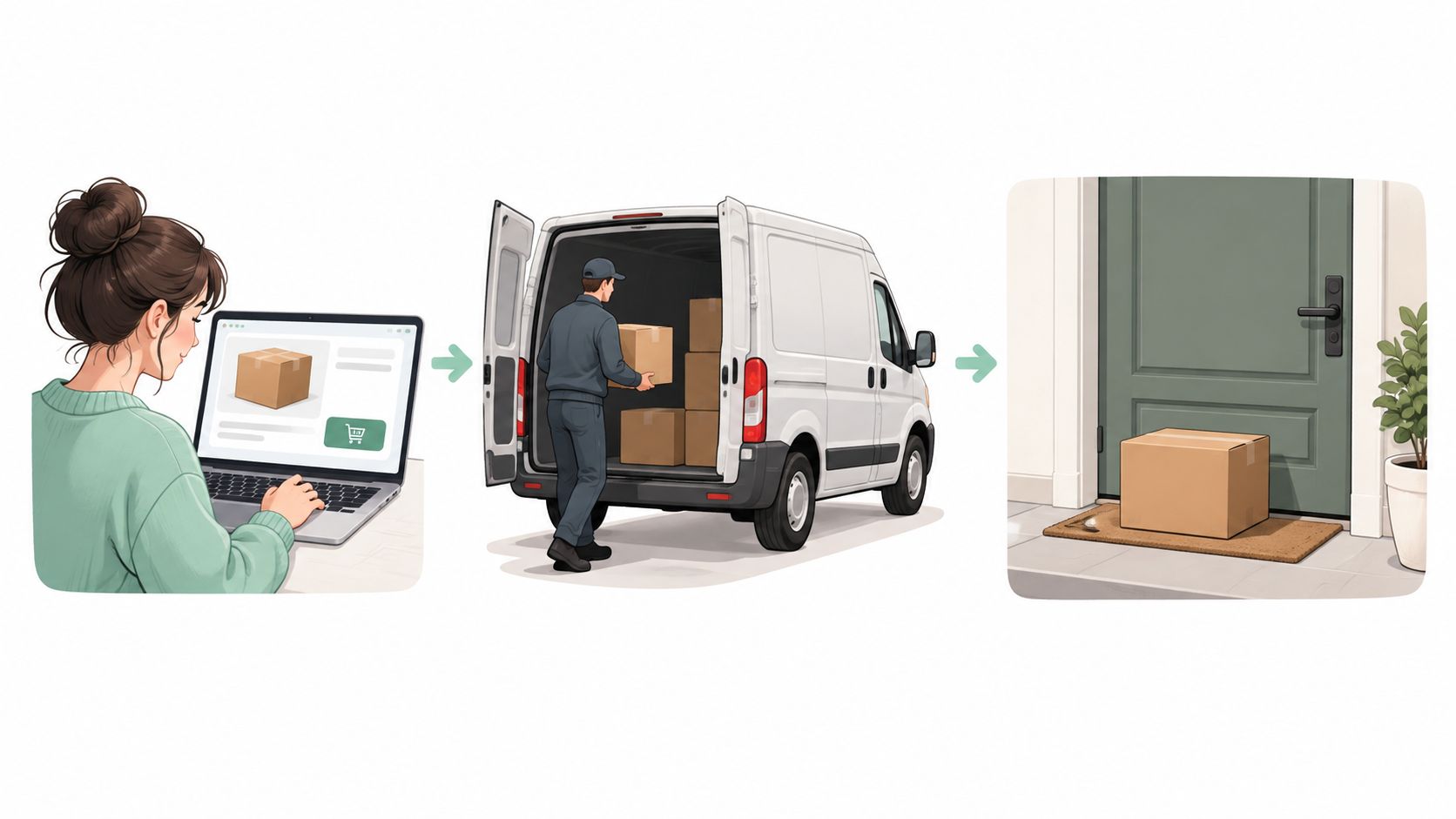
Immerse Creations uses several separate safeguards rather than asking customers to trust one vague promise. The process starts when you choose a product and continues through payment, dispatch, tracking, and receipt.
Plain packaging keeps the product identity outside the box
The external packaging carries no product names, category labels, or promotional graphics. That matters because parcels pass through sorting centres, courier vehicles, communal entrances, reception desks, and shared hallways. A plain outer surface gives those people no useful clue about what's inside.
The shipping label still contains the operational details required for delivery. This is the right balance. Removing the recipient, address, or scannable postage information would create a delivery problem, while adding product terminology would create a privacy problem.
The same principle applies to products ranging from a prostate massager to a thrusting machine. The item inside may be specific and personal, but the exterior should communicate only what the carrier needs.
Neutral billing prevents a second privacy leak
Packaging can be completely plain and still leave an unwanted clue on a shared banking app. Immerse Creations uses the neutral statement descriptor IC Wellness, rather than a product-related name. That separates the transaction record from the intimate item selected on the site.
This distinction is easy to miss. Delivery privacy protects what people see around the home, while billing privacy protects what people see in banking notifications, statements, and shared financial accounts. Customers should check both before ordering.
Tracking and checkout reduce avoidable exposure
Where available, next-day delivery gives customers a faster route from dispatch to receipt, and tracked shipping helps them follow the parcel without guessing when it will arrive. The practical advantage is control. You can arrange to be present, choose a suitable handover, or collect the package before somebody else finds it.
Checkout runs through Shopify with HTTPS encryption, and payment details aren't stored by the retailer. That reduces the amount of sensitive payment information held in the shop's own systems. It doesn't make the customer anonymous, and no retailer should promise absolute anonymity, but it does limit unnecessary exposure.
The checkout stage still deserves attention. Use a private device where possible, avoid saving payment details on a shared browser, and review the email address and delivery phone number before submitting the order. A secure checkout can't correct a notification sent to an account other household members can access.
Keep the layers separate: plain packaging protects the doorstep, IC Wellness protects the statement, and controlled tracking protects the delivery window.
Delivery Privacy Meets UK GDPR Data Minimisation
A discreet parcel can still sit inside an over-detailed customer record. If an order-management system sends product descriptions to a courier, stores unnecessary notes indefinitely, or gives broad internal access to intimate purchase data, the physical packaging is doing only half the job.
The ICO's UK GDPR guidance on data minimisation says personal information should be adequate, relevant, and limited to what is necessary for the stated purpose. For delivery, that means a retailer should identify what the carrier needs and avoid passing along anything that adds exposure without helping fulfilment.
Necessary information is not the same as every available field
A delivery provider may need the recipient name, delivery address, and a contact channel for an exception. The retailer may also need an order reference and payment or fraud-control information. The product's full name, category, personal browsing history, and marketing preferences don't belong on a carrier-facing label.
A practical data-minimisation review asks four questions about every field:
- Purpose: Why is this information collected?
- Recipient: Who receives or can access it?
- Retention: How long does the business need to keep it?
- Deletion: What event removes it from the system?
This approach applies to order confirmation emails, courier notifications, returns forms, customer-service tickets, and account histories. A returns process may need enough information to identify the order and manage the refund, but it shouldn't expose more product detail than necessary to the people handling the return.
Access controls matter after checkout
Role-based permissions restrict sensitive records to staff who need them. Encryption protects data in transit and storage, while security monitoring can help identify suspicious access. These controls don't replace plain packaging, but they reduce the impact of a compromised account, a misdirected notification, or an internal lookup by someone without a fulfilment reason.
Customers can also ask direct questions. Check whether payment details are stored, what information goes to the courier, how long order records are retained, and whether marketing cookies are optional. For example, someone researching an app-controlled vibrator may want product information for their decision, but that browsing activity shouldn't automatically become a visible delivery description.
The useful standard is not “nothing is recorded”. A retailer needs enough information to take payment, prevent fraud, dispatch the order, provide support, and handle returns. The standard is purposeful, restricted, and reviewed information, with deletion when the business no longer needs it.
Choosing the Most Private UK Delivery Option
Plain packaging helps at every destination, but the destination determines who might see the parcel. The right choice depends on whether you share a home, work from home, use a communal entrance, or can collect privately.
DHL's 2025 UK shopper research found that three in four shoppers abandon baskets when preferred delivery or returns options aren't available. The same research recorded preferences for redirecting an absent-delivery parcel to a safe place, a neighbour, or another delivery day. For intimate purchases, those choices need a privacy assessment, not just a convenience assessment.
Match the option to your living situation
| Delivery choice | Privacy advantage | Main privacy risk | Sensible choice when |
|---|---|---|---|
| Home delivery | You can receive the parcel directly and avoid an extra collection trip. | A housemate, partner, receptionist, or neighbour may see it first. | You're confident someone suitable will answer the door. |
| Neighbour handover | The parcel may be safer than an unattended doorstep. | The neighbour knows a delivery arrived and may handle the package personally. | You trust that neighbour and value security over maximum confidentiality. |
| Safe place | The courier can avoid a direct handover. | A visible doorstep, bin area, porch, or proof-of-delivery photo may expose the parcel. | The location is genuinely private and protected from shared access. |
| Parcel shop | The parcel leaves your home and can be collected away from household members. | Collection staff or labels may see the recipient details, and collection requires planning. | You want to separate delivery from your home address. |
| Locker | A private collection code can reduce doorstep visibility. | The locker location, collection alerts, or nearby people may still reveal that a parcel is waiting. | You can collect promptly and keep the notification private. |
A neighbour is not automatically more discreet than a safe place. A locked locker may offer stronger control than either, but only if your email, app notification, and collection journey remain private. Check whether the courier sends a product-related sender name or displays a retailer name in the collection message.
Speed, control, and confidentiality can pull in different directions
Next-day delivery can shorten the time spent waiting, while a parcel shop or locker may require an additional journey. If nobody is home, fast home delivery may create a missed-delivery card or an automatic redirection that another person notices. In that situation, a slower but controlled collection option can be the better decision.
You can compare delivery arrangements alongside product research in this guide to next-day delivery toys. The practical question is simple: who is most likely to see the parcel, and can you control that moment?
Before choosing, check the delivery window, tracking behaviour, safe-place instructions, proof-of-delivery photos, and collection-point labelling. Privacy isn't achieved by selecting the fastest button. It's achieved by selecting the route with the fewest unwanted observers.
Discreet Delivery Best Practices for UK Shoppers
Treat checkout like a short privacy check, not a race to the payment screen. A few deliberate choices can prevent the most common leaks.
Before you order
- Verify the packaging promise: Look for plain outer packaging, no product terminology on labels, and a neutral sender description.
- Check the statement descriptor: Confirm what appears on a bank statement or card notification. A product-related merchant name defeats an otherwise discreet parcel.
- Review the privacy policy: Look for information about payment storage, courier sharing, cookies, marketing consent, retention, and deletion.
- Choose a private contact route: Use an email address and phone number that other household members don't routinely monitor.
- Plan the destination: Decide whether home delivery, a locker, a parcel shop, or a trusted neighbour gives you the strongest control.
At checkout
Don't use a public computer or a shared browser with saved passwords and payment details. Confirm the address carefully, select tracked delivery if you need arrival visibility, and read the wording used for delivery notifications.
A tracking link is useful, but it can also sit in a shared inbox or appear on a lock-screen notification. Turn off message previews on shared devices, and don't forward order confirmations to an account that other people can access.
If you want a practical storage plan after receiving a product, these toy storage containers can help keep intimate items away from visitors and household clutter. Storage is part of privacy too, especially in shared homes.
After dispatch and delivery
Watch the courier updates without leaving them visible on a shared screen. Check whether proof-of-delivery photos show the parcel location, and collect the package promptly if it has been redirected. If the box arrives damaged or appears tampered with, photograph the exterior privately and contact the retailer before opening it.
Returns deserve the same attention as delivery. Find out what information the retailer needs, whether the return label is neutral, how refunds appear on the statement, and whether product packaging must be retained. Break down or remove labels from discarded outer packaging before recycling.
Your checklist should cover the statement, inbox, doorstep, collection point, and returns label.
Finally, review marketing settings after ordering. Transactional updates may be necessary for fulfilment, but promotional messages shouldn't expose product interests to anyone who can access your email account.
Why Discreet Delivery Matters Beyond the Parcel
A customer may feel comfortable ordering a personal item online, then abandon the purchase after noticing an unclear billing name or an exposed delivery option. That reaction isn't excessive. It reflects a sensible concern about who can see the transaction and how much information the retailer keeps.
UK research found that 61% of people are concerned about privacy when shopping online, while 40% worry that shopping data could be used by AI to target or influence them, according to reporting on recent UK digital-privacy research. The same source reports that 55% feared their personal data had already been compromised, 78% wanted greater transparency about data protection, and 23% intended to shop only with brands they completely trusted.
Those concerns extend beyond intimate products, but intimate purchases make the consequences more personal. A plain parcel, neutral statement, restrained notification, controlled delivery choice, and sensible retention policy tell the customer that the retailer understands the whole journey.
That confidence affects whether someone completes an order, asks for help, returns an item, or shops with the retailer again. Discreet delivery is therefore a practical expression of consumer rights and data-protection principles, not a decorative promise on a product page.
The customer should leave checkout knowing what will appear on the box, statement, email, courier screen, and return label. If a retailer can't answer those questions clearly, choose one that can.
Immerse Creations offers intimate products for adults aged 18 and over, with plain external packaging, the neutral IC Wellness billing descriptor, secure Shopify checkout, and UK delivery options including next-day services where available. Visit Immerse Creations and check the delivery, billing, privacy, and returns details before placing your order.