Gender Neutral Toy: The Adult Shopper’s Complete Guide
A gender-neutral toy for adults is purpose-built through its design, marketing, and material choices for any body, without relying on gendered stereotypes or assumptions. Research on children's toys found a more balanced pattern for gender-neutral toys, with girls showing only a small greater preference than boys, measured at d = 0.29.
You may have opened an adult toy page and immediately felt that it wasn't written for you. The product is described as “for him” or “for her”, the photographs suggest one narrow kind of body, and the feature list assumes you already know which anatomy or relationship role applies. You're left trying to work out whether the device will fit your body, your boundaries, and the way you want to use it.
That experience has a useful connection with children's toy research. A gender neutral toy is not just one without pink or blue packaging. It should offer a clear function, flexible use, inclusive representation, and enough information for people to choose based on comfort and interest. The same principle works for adult pleasure aids, whether you're considering a vibrator, a dildo, a prostate massager, a couples device, or a hands-free machine.
The practical question is simple: does the product help you understand what it does, what it's made from, how it fits, and how it can be used, without telling you who you're supposed to be?
Table of Contents
- What Is a Gender Neutral Toy for Adults
- The History of Gendered Marketing in Toys
- Key Features of Truly Inclusive Design
- Real-World Use Cases for Solo and Couples
- Buying Guide and Safety Considerations
- Why Inclusive Language and Packaging Matter
What Is a Gender Neutral Toy for Adults
Inclusion is more than colour
Suppose you find a compact massage tool in a soft neutral colour. The page looks modern, but the description repeatedly calls it a “women's product”, shows only one body type, and gives no information about grip size or pressure control. The colour is neutral, yet the buying experience isn't. You still have to decide whether the product was designed with your body in mind.
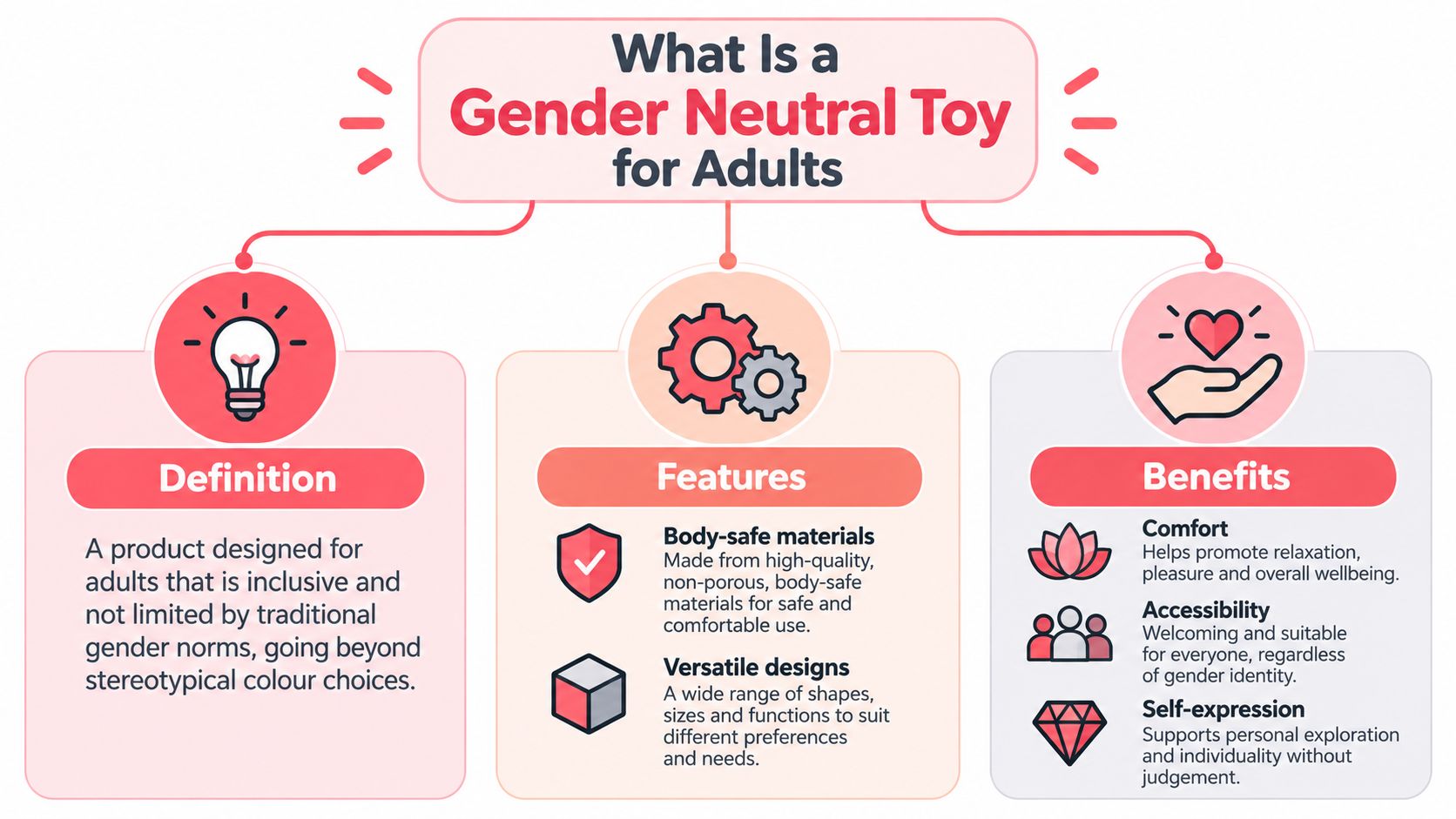
For adults, a gender-neutral toy is better understood as a function-led intimate product. Its shape, controls, materials, and instructions should focus on what the device does rather than assign it to a gender category. A wand can be useful to anyone seeking external massage. A wearable couples toy can support different bodies and relationship arrangements. A prostate massager can be selected for its curve, reach, and movement, not because a retailer has placed it in a “for men” collection.
Look for usability across bodies
Inclusive design doesn't mean every product must suit every person. Bodies differ, and a product with a specific purpose may have practical limits. The important point is that those limits should be explained plainly, without treating one identity as the default user.
Check whether the page gives useful details about:
- Shape and flexibility, including how the product bends, rests, or moves.
- Controls, such as whether buttons are easy to reach and whether intensity can be adjusted.
- Materials, with clear information about the surface and cleaning requirements.
- Use cases, described by stimulation, position, or function rather than assumed gender.
- Boundaries, including whether an anal product has a suitable base or handle.
Language matters because it affects who feels invited to continue reading. A page that says “designed for external stimulation” gives you a usable starting point. A page that assumes your gender, partner, or anatomy may make you work harder for the same information.
Practical rule: Choose by the sensation, fit, control, and material you need. Treat gender labels as optional merchandising, not proof of suitability.
A gender-neutral approach also leaves room for self-expression. You don't have to avoid traditionally gendered colours, shapes, or product names if you like them. The point is that those features shouldn't decide who is allowed to use the toy.
The History of Gendered Marketing in Toys
A child walks into a toy shop, sees pink boxes on one side and darker, action-focused boxes on the other, and gets a quiet lesson about who each product is supposedly for before touching anything. That retail logic matters because categories do more than sort stock. They shape expectations.
A 2020 systematic review and meta-analysis examined 75 studies involving 113 effect sizes and found sizeable preferences for toys culturally associated with a child's own gender, with gender-typical versus gender-atypical effects reaching at least d = 1.20. The same review found a more balanced pattern for gender-neutral toys, where girls showed a small but measurable greater preference than boys, at d = 0.29 (Cambridge repository review).
Those findings need careful handling. A preference shown in studies is not proof that taste is fixed at birth. It works more like a path worn into carpet. The more often children see certain colours, activities, and characters linked to one gender, the more natural that route can feel. Parents, peers, advertising, product placement, and the social meaning attached to play all help build that pattern.
From labelled shelves to broader categories
UK retail changed visibly during the 2010s. In 2012, more than half of the shops surveyed by Let Toys Be Toys used “boys' toys” and “girls' toys” labels on shelves. By 2016, the follow-up survey found no explicit gender signage in the shops examined, while gendered navigation on toy-retailer websites had fallen by 70% between 2012 and 2016. The campaign also reported that 85% of UK young women aged 11–21 believed advertising should stop using gender stereotypes to sell toys (Let Toys Be Toys catalogue research).
That shift helped, but it did not erase the old cues. A shelf sign can disappear while the pictures, colours, and wording still steer shoppers in the same direction. Catalogues continued to connect construction, transport, caring, and combat play with particular genders even after explicit labels were removed.
Adult retail often repeats the same pattern in a more polished form. A product may appear in a broad collection, or in a curated category such as for-her intimate products, while the photography and copy still imply a narrow user. The reverse can also happen. A toy may sit in a gendered category but describe its mechanics clearly enough to be useful to a wider range of shoppers. For example, the Anal Prostate Massager with Penis Ring for Men is explained through its curved shaft, cock ring, telescoping motion, soft flexible material, dual motors, 9 vibration modes, and 9 thrusting speeds. Those details tell you how it works. The category name tells you far less.
Why labels aren't the whole story
A University of London review of 16 studies, involving 787 boys and 813 girls, found that children's play patterns changed when gender-neutral toys were included in study materials. UK nursery observations also found sex-typed preferences among children as young as 9 months, with preferences remaining evident across later age groups (City St George's summary of the nursery study).
For adult shoppers, the practical lesson is simple. Inclusive design is not just neutral packaging or softer wording. It is a product page that shows what the toy does, how it fits, and which sensations or body positions it supports, without treating one type of body or one kind of couple as the default.
Key Features of Truly Inclusive Design
A useful adult gender-neutral toy should earn its inclusivity through engineering. Start with the product, not the colour palette.
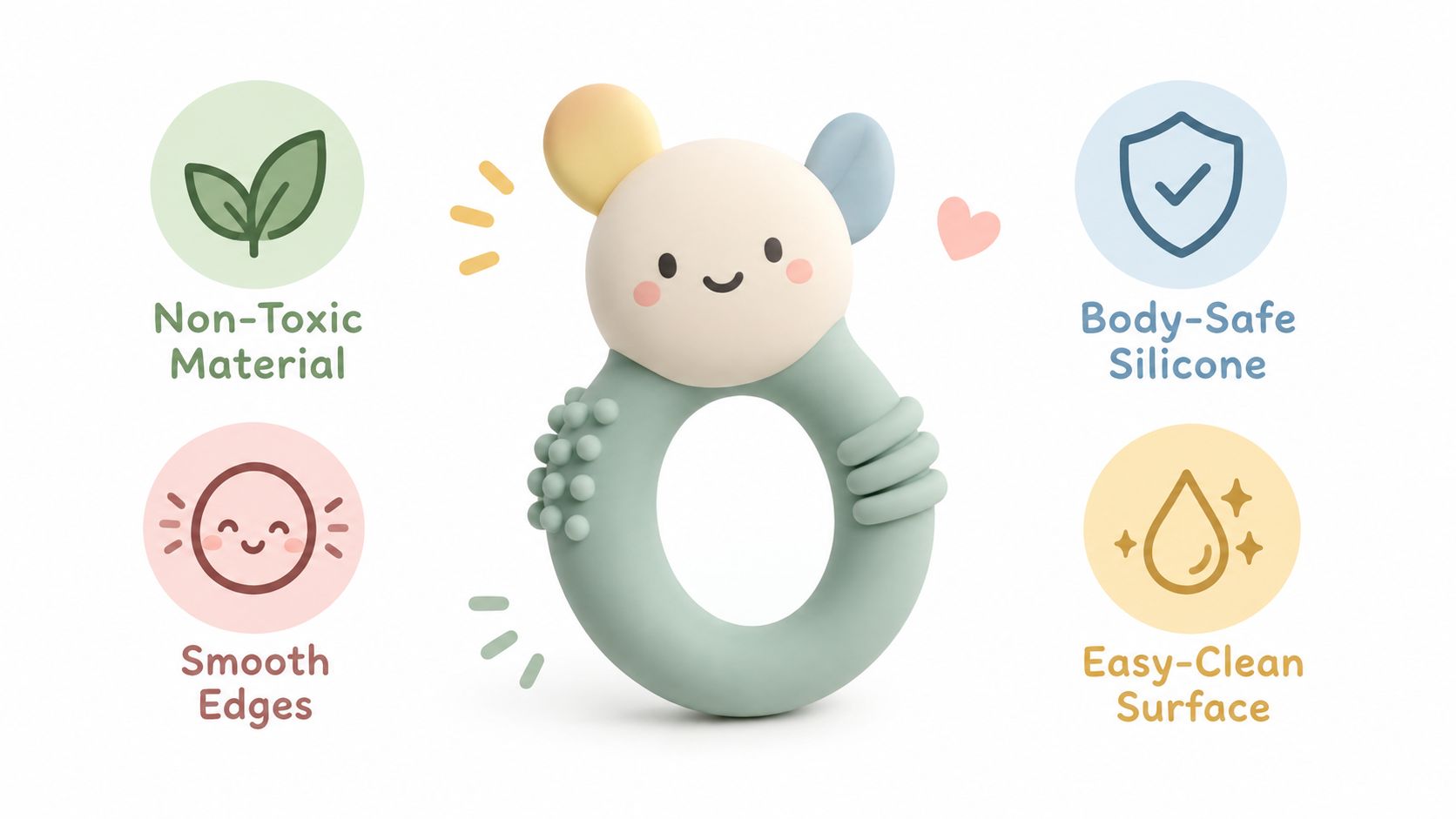
The image above is a reminder that neutral design can combine warmth, texture, and personality without assigning a narrow user. For adult products, the equivalent is a device whose surface, controls, and proportions communicate purpose rather than identity.
Start with the material
Look for a clearly identified, non-porous body-safe material, such as medical-grade silicone where the product specifies it. A smooth surface is easier to clean, while flexible silicone can adapt more comfortably to different contact points. Avoid listings that use vague phrases such as “skin-friendly” without explaining the material or care instructions.
A retailer's material guidance should help you answer practical questions:
- Is the surface porous or non-porous?
- Can the toy be washed, and how?
- Does it need a condom or barrier for shared use?
- Are compatible lubricants identified?
- Are the internal electronic parts protected from water?
For a fuller explanation of what material certification should communicate, see this guide to material certification. Clear documentation won't tell you whether a shape feels good, but it helps you make a safer, more informed choice.
Check the mechanics
Ergonomics is where inclusive design becomes tangible. A handle should be usable without requiring one particular grip strength. Buttons should be distinguishable by touch when possible. A flexible neck may make a product easier to position, while a stable base can support hands-free use.
Adjustable controls also matter. Different users may want different speeds, rhythms, pressure, or contact areas. A product that offers several settings gives you room to experiment without assuming that one intensity or movement suits everyone.
The 8.6" Thrusting Realistic Dildo illustrates why specifications need careful reading. Its listing describes a suction cup base, waterproof construction, USB charging, a total length of 8.4 inches, 6.1 inches insertable, and 1.1 inches of telescopic thrust, while also stating that it can be used as a dildo for women or an anal toy for men. Those details let you assess positioning, reach, cleaning, and compatibility rather than relying on the product title.
Here's a simple comparison to use while browsing:
| Detail | More inclusive information | Less useful information |
|---|---|---|
| Shape | Explains curves, flexibility, base, and contact areas | Assumes one anatomy |
| Controls | Gives modes, speeds, charging, and button layout | Uses only words such as “powerful” |
| Materials | Names the surface and cleaning method | Says only “premium” or “soft” |
| Imagery | Shows varied users or focuses on the device | Suggests one default body |
| Use | Describes positions and functions | Assigns a fixed gendered role |
You can also use this short video as a visual example of how product presentation and design cues affect understanding:
Water resistance, interchangeable attachments, and remote controls can increase flexibility, but they aren't automatically inclusive. The deciding question remains whether the feature solves a real usability problem for different bodies and preferences.
Real-World Use Cases for Solo and Couples
Inclusive design becomes easiest to judge when you imagine using the product rather than viewing it in a category page.
A solo shopper might want hands-free stimulation but not know which position will feel comfortable. A suction base can stabilise a device on a smooth surface, while adjustable thrust or vibration lets the user begin gently and change the pattern gradually. The useful product information is about surface compatibility, movement, controls, cleaning, and body position. Gendered labels add little to that decision.
A person exploring prostate stimulation may prioritise a curved shaft, a secure base, flexible material, and a control system that can be changed without awkward repositioning. Those needs don't depend on a person's gender identity. They depend on comfort, reach, pressure, and the ability to stop quickly.
Couples need adaptable roles
Couples often make the mistake of searching for a product that assigns one person as the giver and the other as the receiver. A more flexible approach looks at what each person wants to feel and control. Wearable vibrators, remote-controlled devices, and external massagers can support shared use without requiring a binary script.
Discuss the practical questions before buying:
- Who controls the device? One person, both people, or a remote?
- Can either partner pause it quickly?
- Will the shape stay comfortable during movement?
- Can it be used externally, internally, or both, if the design allows it?
- Can it be cleaned safely between users?
A couples product doesn't need to be marketed with a particular gender pairing to be useful. It needs accessible controls, honest dimensions, suitable materials, and a form that doesn't force either person into an assumed role. Guidance on comparing shared devices can be found in this couples vibrator guide.
Furniture and accessories count too
Sex furniture demonstrates the same principle on a larger scale. A position-enhancing chair should communicate weight support, dimensions, stability, and the kinds of positions it accommodates. The useful measure is physical support, not whether the product is presented as masculine or feminine.
The broader insight is that versatility is not the same as universality. No product will suit every body or every preference. An inclusive listing makes those boundaries visible, so you can decide whether the design matches your needs.
Buying Guide and Safety Considerations
A discreet purchase should still be a well-documented purchase. Before you add an intimate product to your basket, check the retailer's material information, safety guidance, delivery terms, and returns policy. Privacy matters, but it shouldn't replace product transparency.
Read the specification like a technician
Ignore broad claims until you can connect them to a measurable feature. “Powerful” is less helpful than a stated speed range or operating mode. “Flexible” should be accompanied by a description of the material and the part that bends. “Waterproof” needs a clear explanation of intended cleaning or bath and shower use.
Use this checklist:
- Confirm the material. Look for a named, body-safe surface and avoid vague listings that don't identify what touches the skin.
- Check the construction. Anal products need a flared base, handle, or another suitable retention feature. Never use an insertable product without an appropriate stopping mechanism.
- Review cleaning instructions. Follow the manufacturer's guidance and use a compatible lubricant.
- Assess the controls. A pause function, low starting setting, and reachable buttons make gradual use easier.
- Check water information. Don't infer full immersion from the word “water-resistant”.
- Read charging details. Keep charging equipment dry unless the manufacturer explicitly says otherwise.
Retailers that publish clear specifications make comparison easier and reduce guesswork. Immerse Creations states that its catalogue uses medical-grade silicone attachments, ABS and coated-metal machine bodies, and excludes jelly rubber, phthalates, and porous TPE. It also describes secure checkout, GDPR-compliant policies, an 18+ age-verification gate, and plain external packaging for UK orders. Treat those statements as information to check against the specific product page and current policies.
Privacy is part of the service
Discreet delivery can make online shopping more comfortable, particularly if you share a home or don't want intimate product names visible on a parcel. Check whether the retailer explains external packaging, billing descriptors, tracking, and customer support before ordering.
A trustworthy UK retailer should also make it easy to find returns and refunds information. Intimate products may have hygiene-related return restrictions, so read the policy before opening the packaging. Secure payment handling matters too, but don't treat a secure checkout as evidence that a product is suitable for your body.
Before buying: verify the material, dimensions, control method, cleaning instructions, delivery privacy, and returns conditions. If any of those are missing, pause rather than guessing.
Why Inclusive Language and Packaging Matter
You open a product page that looks calm and modern. The box is plain, the colours are neutral, and the menu avoids labels like “for him” or “for her”. Then the copy starts narrowing the choice again by pairing one shape with one gender, one kind of body, or one role in sex. That is where many adult products still lose people. Packaging can lower the temperature. Language decides whether a shopper actually feels included.
The same lesson appears in children's retail research, but the useful part here is not the old shop timeline. It is the pattern. Let Toys Be Toys catalogue research (2017) showed that removing obvious labels did not automatically remove stereotypes from presentation. Adult product pages can do the same thing. Neutral navigation may sit beside photos that show only one body type, or descriptions that assume every buyer wants the same kind of stimulation.
Clear copy works like a good fitting-room mirror. It helps you judge the product itself, rather than telling you who you are supposed to be.
Describe capability, not identity
A shopper usually needs practical answers in plain English:
- What area does the toy stimulate?
- How does it stay in place?
- Which controls can the user adjust?
- What material touches the body?
- Which positions or kinds of play does the shape support?
- What limits or comfort issues should the shopper know before buying?
That approach matters for adult pleasure aids because inclusive design is not just about tone. It is about access to information. A person comparing a wand, a prostate massager, or a hands-free machine needs enough detail to match the product to their body, curiosity, and boundaries. “Discreet”, “luxury”, or “for adventurous couples” does not answer those questions. Measurements, materials, pressure style, control options, and cleaning guidance do.
Representation still has a role. A study of children aged 4 to 7 found that seeing peers use counter-stereotypical toys increased flexibility about what other children could play with and encouraged playmate choices based more on play style than gender, while not fully changing the children's own preferences (Kent study on peer toy play). The adult parallel is modest but useful. Broader imagery will not erase every preference, yet it can reduce the feeling that a product belongs to somebody else before a shopper has even checked the specifications.
Inclusive packaging and copy should give adults room to choose without pressure. That means respectful wording, varied representation, and concrete information that explains how a product works. A gender-neutral toy for adults is defined less by a bland look than by whether the design and description leave space for different bodies and different forms of pleasure.
Immerse Creations offers adult pleasure aids, hands-free machines, prostate massagers, wand vibrators, couples toys, and intimate accessories with product specifications, discreet UK delivery, and privacy-focused purchasing information. Visit Immerse Creations to compare products by material, controls, shape, and intended use rather than by gendered assumptions.