Stainless Steel Cock Rings: A Practical Buyer's Guide
For UK buyers, a stainless steel cock ring should meet a nickel-release limit of no more than 0.5 micrograms per square centimetre per week for prolonged skin contact. These rings are rigid, weighty constriction rings made from corrosion-resistant steel alloys, most commonly 316L, and their safety depends on alloy grade and surface performance, not the word “stainless” alone.
The popular advice is simple: buy stainless steel because it's body-safe. That advice is incomplete. Stainless steel is a family of alloys, not a safety certification, and a rigid ring creates a more serious removal problem than a stretchy silicone loop. The right purchase depends on three checks: what metal the ring contains, what the finished surface releases, and whether you can remove it calmly if swelling changes the fit.
Table of Contents
- Why “Stainless Steel” Is Not the Whole Safety Story
- What a Stainless Steel Cock Ring Actually Is
- Styles, Finishes, and What They Change in Use
- Sizing, Fit, and Why Rigid Steel Is Different
- Safe Use, Time Limits, and When to Remove a Ring
- Cleaning, Lubricants, and Toy Compatibility
- Buying in the UK - What to Check Before You Check Out
- FAQ and Quick Takeaways
Why “Stainless Steel” Is Not the Whole Safety Story
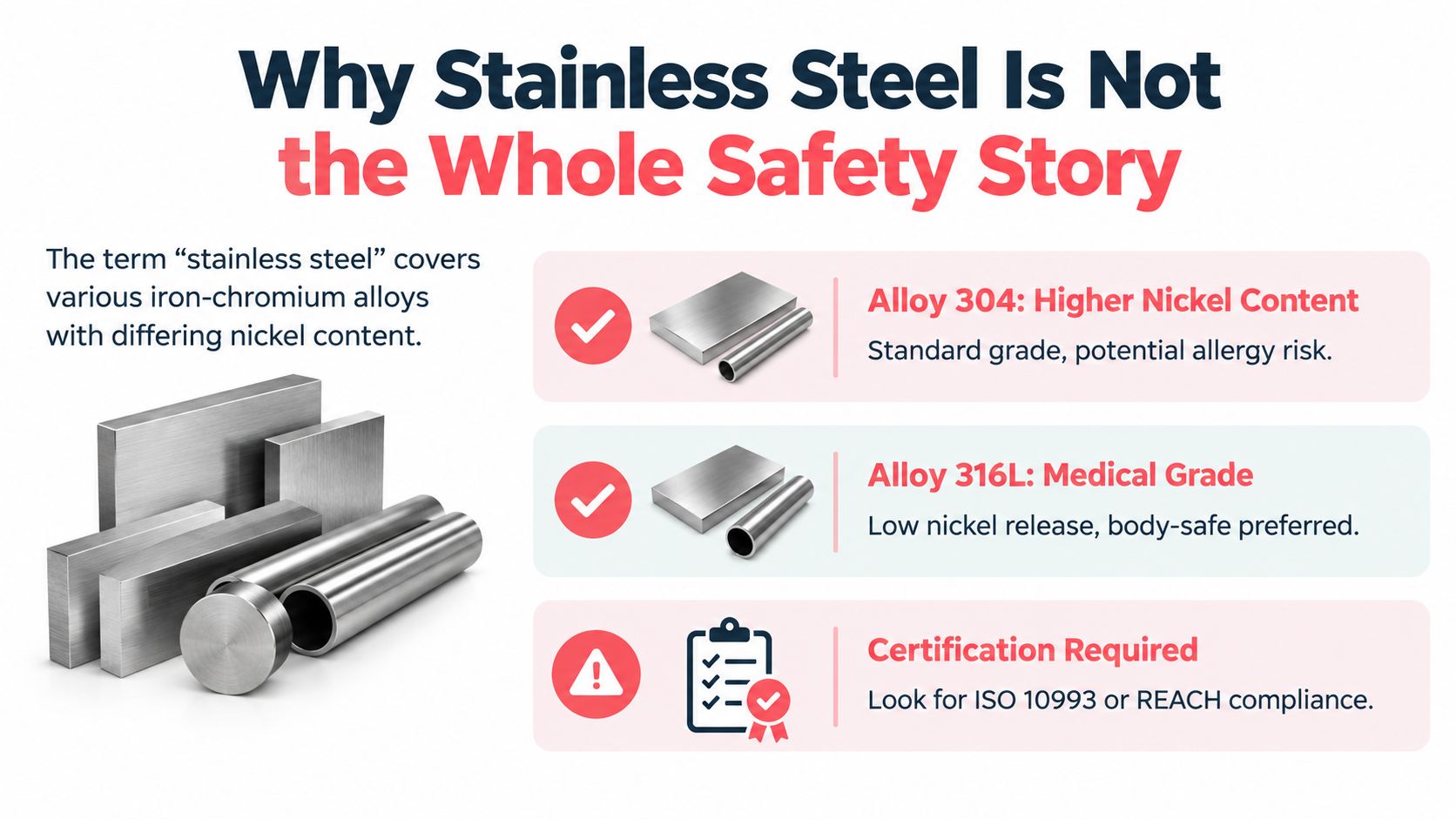
“Stainless steel” tells you that the product resists corrosion. It doesn't tell you the exact grade, the nickel-release behaviour, the quality of the polish, or whether the manufacturer has controlled contamination during production. A cheap ring with an undocumented alloy can carry a more meaningful risk than a clearly specified 316L ring with a smooth, well-finished surface.
UK product-safety guidance focuses on what the finished article releases during contact. For jewellery and comparable products intended for direct and prolonged skin contact, the nickel-release limit is 0.5 micrograms per square centimetre per week, while components inserted into a piercing have a stricter limit of 0.2 micrograms per square centimetre per week. A cock ring ordinarily belongs in the prolonged skin-contact category, not the piercing category. The rule concerns migration from the surface, not the total percentage of nickel in the alloy. See the UK jewellery safety guidance on nickel release for the regulatory distinction.
That matters because 316L contains nickel. UK technical information identifies 316L as containing approximately 10% to 14% nickel, alongside chromium and molybdenum. That doesn't automatically make it unsuitable. It means buyers should distinguish between nickel content and nickel release from the completed product. Chromium helps form the corrosion-resistant passive layer, while molybdenum improves resistance to pitting and crevice corrosion, but neither replaces proper manufacturing and testing.
What to ask before buying
A product page deserves more scrutiny than its lifestyle photographs. Look for:
- Exact grade: Prefer a declared 316L or 1.4404 specification over “surgical steel”.
- Release evidence: Ask whether the finished ring has EN 1811 or equivalent nickel-release evidence.
- Surface details: Check whether the inner edge is polished, rounded, and free from visible machining marks.
- Construction: Treat unknown plating, rough welds, mixed-metal closures, and unexplained coatings cautiously.
- Retailer answers: If support can't identify the alloy, don't assume the ring is safe because it looks expensive.
A useful companion resource is this guide to choosing safe intimate products with confidence. Buyers with a known nickel reaction should be particularly strict. A European study found nickel was the most common tested allergen, with a positive reaction in 14.5% of participants, while a clinical review places nickel-allergy prevalence across European adults at approximately 8% to 19%. These figures don't measure cock-ring users or the UK population alone, but they show why “hypoallergenic” is not enough.
What a Stainless Steel Cock Ring Actually Is
A stainless steel cock ring is a non-stretching metal loop worn around the base of the penis, around the base and behind the testicles, or in a design that accommodates both. Think of it less like elastic underwear and more like a steel signet ring or a watch case. It has a fixed shape, a noticeable mass, and no forgiving stretch when your body changes during arousal.
Most designs use a corrosion-resistant steel alloy, commonly 316L. The ring creates constriction at the base, which slows the return of blood from an erection. Blood can still enter the erectile tissue, while the ring makes outflow less immediate. The result can feel like a fuller, firmer erection, and some users notice stronger pressure or altered sensation. It isn't magic, and it isn't a treatment for every erection difficulty.
The category includes several very different objects:
- A simple constriction ring focuses on a fixed fit and steady pressure.
- A cock-and-ball ring sits around the shaft and behind the testicles, changing the position of the pressure.
- A hinged or closure design makes fitting easier, but introduces a mechanism that needs careful inspection.
- A vibrating ring adds a motor and may direct stimulation towards a partner or the wearer.
A sex-toy ring isn't the same as a medical vacuum erection device. Vacuum equipment uses a chamber and a constriction band as part of a different system, often with clinical instructions. Don't transfer advice for one device to the other, and don't improvise a rigid substitute from hardware, jewellery, or household objects.
The contrast with silicone is straightforward. Silicone stretches and can accommodate small sizing mistakes. Steel doesn't. A product such as the Anal Prostate Massager with Penis Ring for Men combines a soft, flexible anal toy with a penis ring, prostate stimulation, dual motors, nine vibration modes, and nine thrusting speeds. That makes it a different proposition from a plain steel constriction band, particularly because the flexible material changes how the device sits against the body.
Styles, Finishes, and What They Change in Use
The product page's shape photograph tells you only half the story. Closure method, internal diameter, edge treatment, and surface finish decide whether a ring feels controlled or awkward.
A solid fixed-diameter band gives the most consistent pressure and usually the clearest sense of weight. It has fewer moving parts, but it also offers no fitting adjustment once it's on. Ball-closure rings are easier to position because the captive ball creates a defined opening and contact point. That same ball can become a pressure point if the design sits poorly.
Hinged rings are more practical for people who struggle with grip or cannot comfortably stretch tissue over a closed circle. They still demand care around the hinge and clasp. A double ring changes the tension pattern by placing one loop around the shaft and another behind the testicles. That can feel more secure, but it also makes the removal route more complicated.
| Style | Fit method | Typical weight | What changes in use |
|---|---|---|---|
| Solid band | Slide on while fully soft | Retailer should state the figure in grams | Constant pressure and a heavy, fixed feel |
| Ball closure | Position around the body and close the ring | Retailer should state the figure in grams | Easier placement, with a defined contact point |
| Hinged design | Open, position, then secure the clasp | Retailer should state the figure in grams | More accessible fitting, with a mechanism to inspect |
| Double ring | Position around shaft and behind the testicles | Retailer should state the figure in grams | Tension spreads across two contact areas |
A polished mirror finish looks clean and feels smooth when properly made, but it shows scratches and surface damage readily. Brushed or matte steel hides wear better and can feel less startling when first applied. Neither finish proves safety. A poor polish can leave sharp edges, while a coating can wear through and expose the underlying alloy.
Weight deserves a proper product-page figure. “Heavy” is not a specification, and a larger internal diameter doesn't automatically tell you how much metal the ring contains. Ask for the weight in grams, the internal diameter in millimetres, and a close photograph of the inner surface. If the seller omits all three, you're buying blind.
Sizing, Fit, and Why Rigid Steel Is Different
Sizing a steel ring starts with girth, not guesswork. Measure around the base of the penis while soft or partly aroused. If the design is intended to sit behind the testicles, measure the route the ring will take, because that circumference can differ from the shaft base.
Use a flexible tape or a strip of paper, keep it against the skin without pulling it tight, and record the circumference. Convert that measurement into the internal diameter requested by the retailer, or ask the retailer which diameter corresponds to your measured girth. Don't rely on a generic “small”, “medium”, or “large” label when the seller could provide millimetres.
| Measured girth | Tight-fit internal diameter | Comfort-fit internal diameter | Adjustment note |
|---|---|---|---|
| Your measured circumference | Ask the retailer for the matching diameter | Ask for the next more forgiving diameter | Choose conservatively if between sizes |
| Shaft-base measurement | Confirm whether the ring sits on the shaft only | Check whether the body changes noticeably during arousal | Don't use a behind-the-testicles size by mistake |
| Shaft-and-scrotum route | Request the exact internal opening | Confirm the ring's removal path | A double ring needs more than a shaft measurement |
The ideal fit is snug, present, and never painful. You should not feel numbness, sharp pressure, burning, coldness, or a change in colour. If the ring feels restrictive before sexual activity has properly started, it's already too tight.
Steel changes the removal question. A silicone ring can stretch or peel away as the body settles. A steel ring keeps the same opening while the penis and surrounding tissue change during arousal. That's why I'd rather see a buyer choose a slightly more forgiving diameter than chase the strongest possible squeeze.
Practical rule: If the product page doesn't show the internal diameter, don't try to reverse-engineer the size from an external photograph.
Put a rigid ring on while fully soft, with a little lubricant, and remove it before you reach a point where swelling makes the fit uncertain. If you're new to constriction rings, flexible silicone is the more forgiving starting material. Steel makes sense after you understand your measurements and your body's warning signs.
Safe Use, Time Limits, and When to Remove a Ring
A rigid ring demands active supervision. Put it on, set a mental timer, and stay aware of what your body is telling you. Don't lose track of time, fall asleep, or keep going because a partner wants to finish. The wearer owns the responsibility for checking sensation, colour, temperature, and comfort throughout.
As a conservative house rule, remove a constriction ring after no more than 30 minutes. Treat that as a ceiling, not a target. An erection lasting more than four hours is a medical emergency requiring immediate attention. Stop well before either limit if your body sends a warning signal.
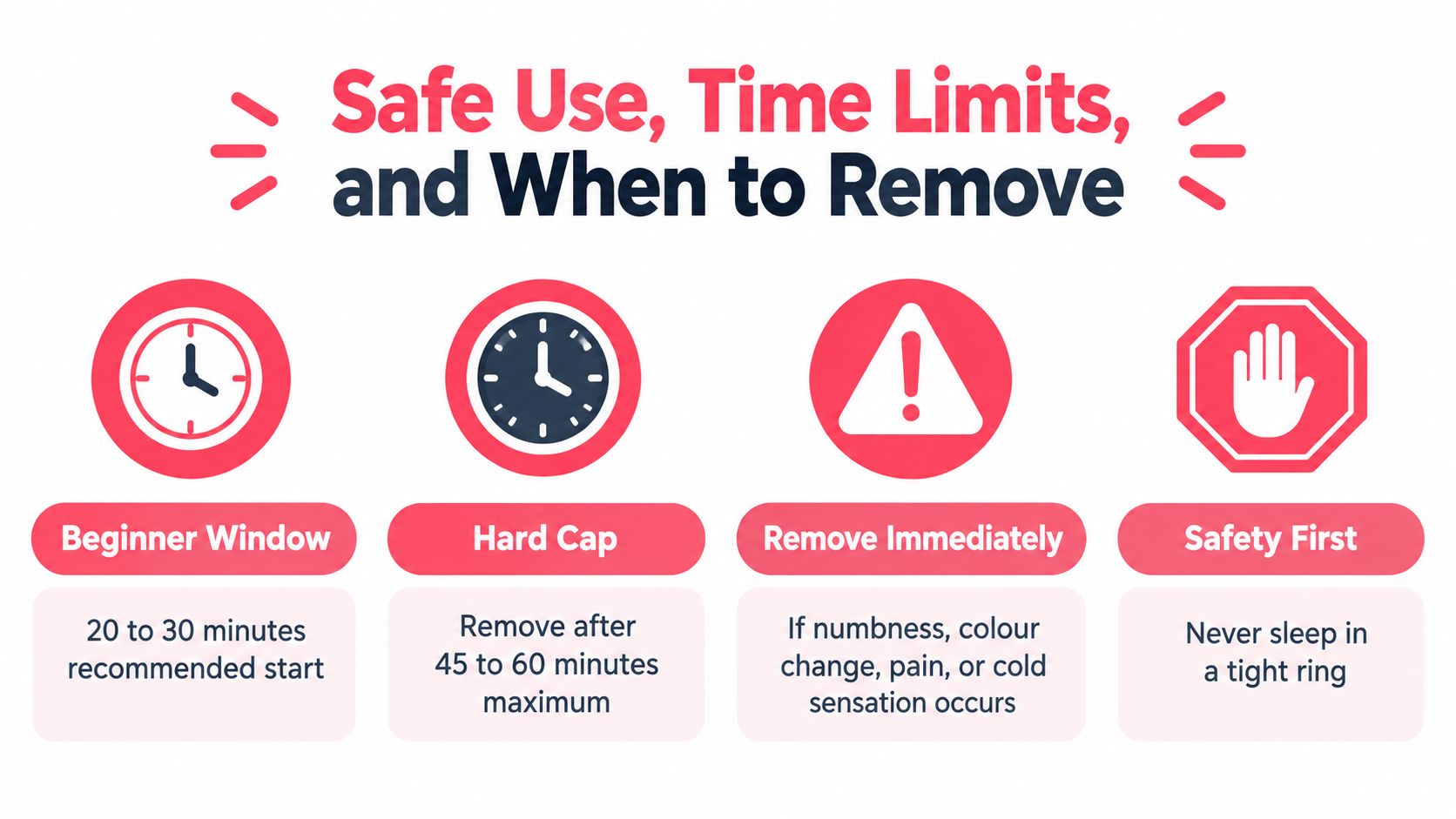
Remove the ring immediately if you notice:
- Numbness or tingling: Reduced sensation means you may miss worsening pressure.
- Colour change: Pale, blue, grey, or unusually dark skin needs attention.
- Pain or burning: Pressure should never become sharp or painful.
- Coldness: A cold penis is a stop signal, not a sensation to push through.
- Swelling around the ring: Swelling can turn a tolerable fit into a removal problem.
The UK-facing cock-ring safety guidance also highlights chafing, bruising, numbness, colour change, and temporary restriction of blood flow. It recommends urgent help when a ring cannot be removed. In the UK, call NHS 111 for urgent advice, or 999 for an emergency. Don't wait for embarrassment to pass.
Certain health situations justify speaking to a clinician before using a constriction ring. That includes known circulation problems, reduced genital sensation, relevant cardiovascular conditions, blood-thinning medication, erectile-dysfunction medication, or recent injury. Don't combine a ring with anything that makes it harder to notice pain or numbness.
If a rigid ring feels stuck, stop sexual activity, stay calm, and don't yank or twist it aggressively. Cool the area, avoid adding more swelling, and seek medical help if it doesn't come off promptly. Never use improvised cutting tools against the skin. For more on rigid-ring fit and glans pressure, see our guide to penis glans rings, which covers how a fixed-diameter ring interacts with sensitive tissue during arousal.
Cleaning, Lubricants, and Toy Compatibility
Steel is straightforward to clean, but “corrosion-resistant” doesn't mean “ignore it”. After every use, wash the ring with warm water and mild, unscented soap. Rinse away lubricant and body fluids, then dry the entire surface, especially around a hinge, ball closure, seam, or recessed detail.
Inspect the ring before reuse. Look for pitting, hairline corrosion, plating failure, rough edges, scratches, or a seam that catches a fingertip. Retire the ring if the surface becomes damaged. A close-fitting product can trap sweat, lubricant, and bodily fluids against the skin, so drying is part of the hygiene routine rather than an optional finishing touch.
Stainless steel can be sanitised more aggressively than many porous or soft toy materials, but follow the manufacturer's care instructions before using heat, a dishwasher, or a diluted disinfectant. If the seller hasn't identified the alloy or explained the finish, stick to gentle cleaning instead of assuming every treatment is suitable.
Water-based lubricant is the sensible default because it's easy to rinse away. Silicone-based and oil-based lubricants are generally compatible with steel, unlike with many silicone toys. Use enough to reduce dragging, but don't leave a thick film under the ring after play.
Metal plugs, glass toys, and other non-porous accessories can be paired with a steel ring when the fit remains comfortable and each item can be removed independently. Don't stack multiple rigid steel rings. The combined weight and fixed openings make pressure harder to judge and removal harder to manage.
A separate accessory such as the Rechargeable Wand Vibrator can add external stimulation without changing the ring's fit. This wand has a smooth body-safe silicone surface, waterproof construction, twenty modes, seven speed levels, and rechargeable operation. Keep silicone accessories clean according to their own instructions, and don't assume care advice for the steel ring applies to the wand.
Buying in the UK - What to Check Before You Check Out
A good UK product page should answer practical questions before you reach the basket. If it only says “premium stainless steel” beside a polished photograph, it hasn't given you enough information.
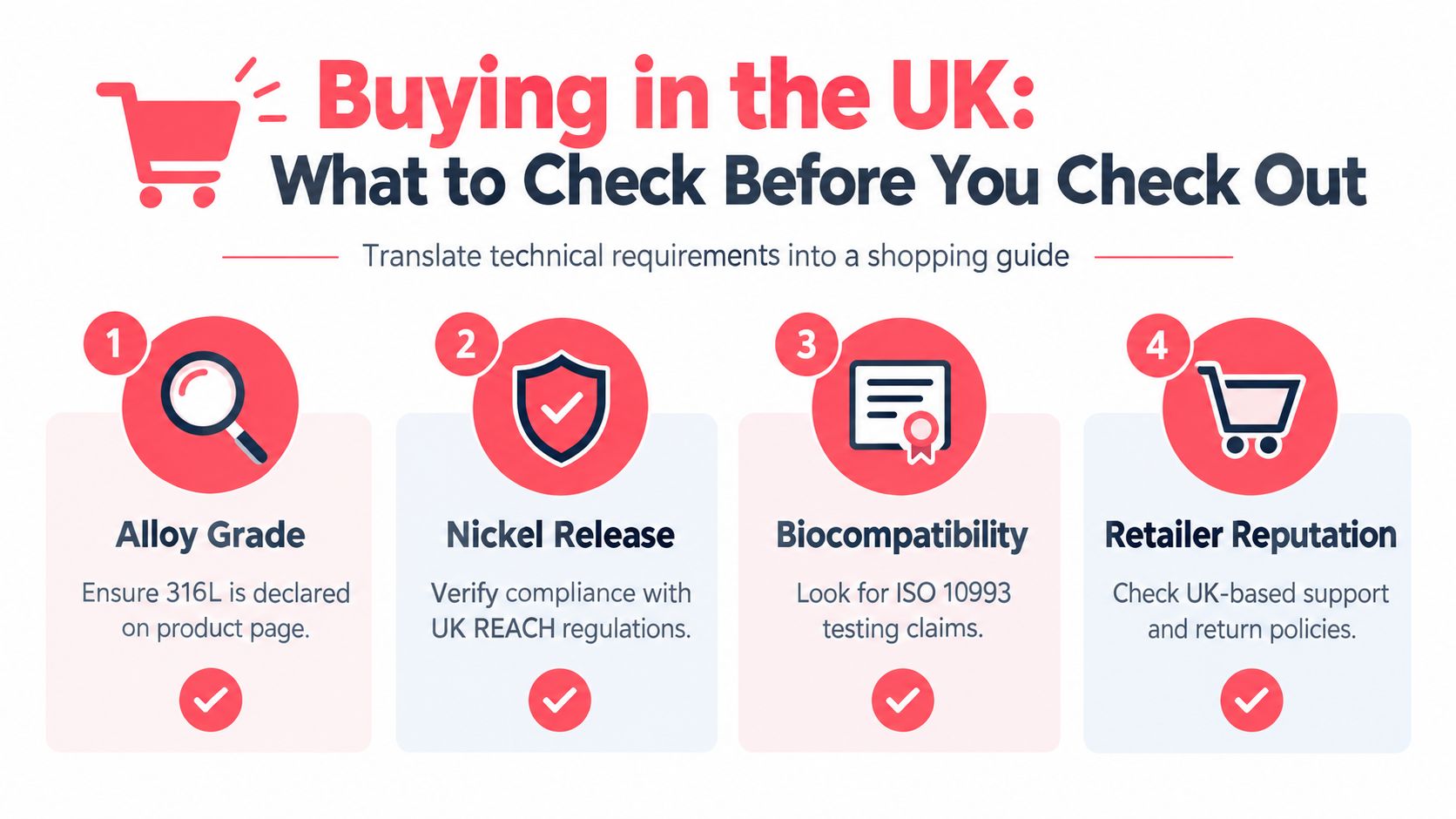
Start with the metal. 316L or 1.4404 should be declared clearly, not implied by the phrase “medical” or “surgical steel”. Then look for nickel-release information referring to EN 1811 or an equivalent test. UK rules focus on release from the finished surface, so a generic alloy percentage isn't a substitute for compliance evidence.
The product-page checklist
- Alloy grade: Look for a precise designation, preferably 316L, rather than an unqualified steel label.
- Nickel release: Ask for EN 1811 or equivalent evidence for the finished item.
- Dimensions: Check the internal diameter in millimetres, not only a size name.
- Weight: Require a figure in grams so you know what “heavy” means.
- Finish: Read whether the surface is polished, brushed, plated, coated, hinged, or welded.
- Edges: Look for a smooth inner edge and clear photographs of joins and closures.
- Retailer identity: Check for a UK trading address, reachable support, and a clear returns policy.
The material certification guidance is useful when a seller makes broad claims but doesn't explain what was tested. A retailer should also state how it handles non-faulty intimate-item returns, since hygiene restrictions may apply once packaging or seals are opened.
Discreet delivery is a reasonable expectation for intimate products. Look for plain outer packaging, neutral billing, tracked delivery options, and support that can discuss materials without sending vague template replies. A UK-oriented retailer should make its privacy, returns, and delivery information easy to find.
Before paying, run this sequence: confirm the exact grade, ask about nickel-release evidence, record the internal diameter, check the weight, inspect the finish photographs, and read the returns and shipping terms. If one of those answers is missing, move on rather than filling the gap with optimism.
FAQ and Quick Takeaways
Are stainless steel cock rings safe for long wear?
They're not a product I'd recommend for unattended or extended wear. The relevant risk isn't just the steel. It's the fixed opening, changing swelling, pressure on tissue, and the possibility that numbness or colour change develops before the wearer reacts. Remove the ring as soon as sensation changes, the skin discolours, pain appears, or the area feels cold.
How can I check nickel information when the listing is vague?
Ask for the exact alloy grade and a supplier declaration. For a ring intended for prolonged skin contact, ask specifically for nickel-release evidence referring to EN 1811 or equivalent testing. “Nickel-free”, “hypoallergenic”, and “surgical steel” are not interchangeable terms. If you've reacted to jewellery before, don't assume 316L is automatically risk-free because it contains nickel, even though a properly finished product may release very little.
Can I use a steel ring in water or with temperature play?
Follow the product's care instructions and inspect the surface afterwards. Water, sweat, lubricant, and bodily fluids can remain around seams and closures, while salts can contribute to pitting or crevice corrosion. Avoid extreme temperature play with a metal ring unless you have a clear, safety-led reason and can control the temperature precisely. Steel can feel unexpectedly cold or hot and won't provide the forgiving contact of silicone.
What should I do if it feels stuck?
Stop immediately and don't force it. End sexual activity, stay calm, cool the area, and seek urgent medical help if swelling prevents removal. If there's severe pain, injury, significant colour change, or an erection that lasts beyond four hours, treat it as an emergency. NHS 111 can advise on urgent care, while 999 is appropriate for an emergency.
The buying decision comes down to correct internal diameter, verified alloy grade, and a retailer that discloses both. Weight and finish then determine how the ring feels in real use. The safety rule overrides every preference: remove it immediately if sensation changes or the skin discolours.
If you're comparing intimate accessories in the UK, Immerse Creations offers discreet online purchasing, product specifications, cleaning guidance, and support for items including prostate massagers, wand vibrators, and couples' toys. Check the material, size, delivery, and returns information before ordering, and choose the product that gives you clear answers rather than the one with the loudest safety label.