Pink Anal Plugs: A Complete UK Buyer and Safety Guide
You're scrolling through a row of pink anal plugs from a UK retailer, trying to decide whether the colour is just a cute preference or whether it tells you anything useful. Perhaps you're buying your first plug, replacing one that's become tacky, or choosing something for a partner while checking material, size, delivery, and privacy details in separate tabs.
Pink can make a product feel approachable, but colour isn't the safety feature. The important decisions are the insertable shape, maximum diameter, base design, material, lubricant compatibility, cleaning method, and retailer information. In the UK, that practical checklist matters within a wider sexual-wellness market. PwC's UK analysis says at least 25% of consumers use sexual wellness devices, and it specifically tracks an “anal toy / butt plug” category within that market (PwC's sexual wellness devices report).
This guide takes you through ownership in the order you'll experience it, from choosing a pink plug and checking its construction to sizing, preparation, use, cleaning, storage, and discreet UK delivery.
Table of Contents
- Why Choose Pink Anal Plugs in the First Place
- Body-Safe Materials and What to Avoid
- Sizing and Shape from Beginner to Advanced
- Lubricant Choices That Actually Work
- Safe Preparation, Insertion, and Removal
- Cleaning, Storage, and Sharing Safely
- Warning Signs and When to Stop
- Buying Pink Anal Plugs in the UK
Why Choose Pink Anal Plugs in the First Place
Colour is a perfectly reasonable filter. If you're comparing several otherwise similar pink anal plugs, the shade may help you choose something that feels more personal, less intimidating, or easier to recognise in a shared drawer. It doesn't make a plug safer, but it can make the buying decision feel more comfortable.
Lighter colours can also offer a practical visual advantage. A pale pink surface contrasts with many skin tones, which may make the insertable section easier to see while applying lubricant and checking its condition. Dirt, dried lubricant, scratches, or changes in texture can also be more apparent on a lighter finish than on a black or very dark product. That doesn't replace proper washing, but it can make a quick pre-use inspection easier.
Retailers often place pink products in beginner-friendly ranges because shoppers actively look for approachable colours and simple shapes. That means a pink collection may include small teardrop plugs, short decorative designs, and flexible silicone models alongside more advanced products. Don't assume every pink plug is small, though. The product page still needs to state the insertable length, widest diameter, base width, and material.
Colour can be part of the experience
Some people choose pink because they like it. Others want a plug that matches lingerie, a harness, or a partner's preferred aesthetic. A pink plug can also make a thoughtful adult gift when you already know the recipient's boundaries and size preferences. The colour may signal playfulness, softness, or a particular style, but those meanings are personal rather than technical.
UK buyers have a useful market context here. One UK market estimate placed sex-toy revenue at USD 1,826.6 million in 2022 and projected USD 3,514.9 million by 2030, with a projected compound annual growth rate of 8.5% (Grand View Research's UK sex-toys market outlook). The same source reported that e-commerce represented 58.38% of UK revenue in 2022, so comparing pink anal plugs online is not an unusual route. It's the dominant purchasing channel in that market estimate.
Practical rule: Choose the colour that makes you feel relaxed, then judge the product by its construction and specifications.
The easy decision is pink or another colour. Safety begins with what the plug is made from and whether its base can reliably prevent the product from travelling inside the body.
Body-Safe Materials and What to Avoid
A product can look polished and still give you too little information about the surface contacting your body. For an anal plug, prioritise a named, non-porous material and a clearly described cleaning method. UK safety guidance commonly points buyers towards platinum-cured silicone, glass, and stainless steel because these materials are easier to clean effectively than porous compounds (Bondage Box's UK butt-plug safety guide).
The three useful material families
Platinum-cured medical-grade silicone is the usual flexible option. It has a soft, slightly yielding feel and is non-porous when properly manufactured. Non-vibrating silicone may tolerate high-temperature cleaning, but follow the maker's instructions rather than assuming every silicone product can be boiled. A silicone plug is often the most forgiving choice for a beginner who wants some flexibility.
Borosilicate glass is rigid, smooth, and non-porous. It can offer a more direct insertion feel and is useful for temperature play when warmed or cooled carefully. Glass has no motor or battery to protect, but you should inspect it before every use and discard it if you find a chip, crack, or sharp edge.
304 or 316 stainless steel is also rigid and non-porous. It feels heavier than silicone or glass, cleans readily, and can provide a strong sense of presence. Weight is a genuine trade-off, especially for someone new to anal play or planning to wear a plug while moving around.
The broader material explanation in this guide to medical-grade silicone is useful when a product page uses “silicone” without describing its grade or curing process. Treat vague material wording as a reason to ask questions, not as proof of safety.
| Material | Firmness | Sterilisable | Porosity | Typical lifespan |
|---|---|---|---|---|
| Platinum-cured medical-grade silicone | Flexible to firm | Follow manufacturer instructions, non-vibrating products may tolerate high heat | Non-porous | Long-term with correct care |
| Borosilicate glass | Rigid | Usually suitable for thorough high-temperature cleaning when instructions allow | Non-porous | Long-term if undamaged |
| 304 or 316 stainless steel | Rigid and heavy | Usually easy to sterilise, follow product instructions | Non-porous | Long-term if undamaged |
| Jelly rubber, PVC, TPE, or TPR-like compounds | Soft to variable | Not reliably sterilised | Porous or uncertain | Limited and difficult to verify |
What the label should make clear
Jelly rubber, PVC, TPE, TPR, and unspecified “blends” can hold residue in microscopic pores or provide too little information about additives. UK safety guidance warns that porous materials can trap bacteria and may contain phthalates, while ABS is more appropriate as a rigid outer casing than as the main insertable surface. Avoid novelty products with electronics unless the manufacturer clearly states that the entire body-contact surface is sealed and washable.
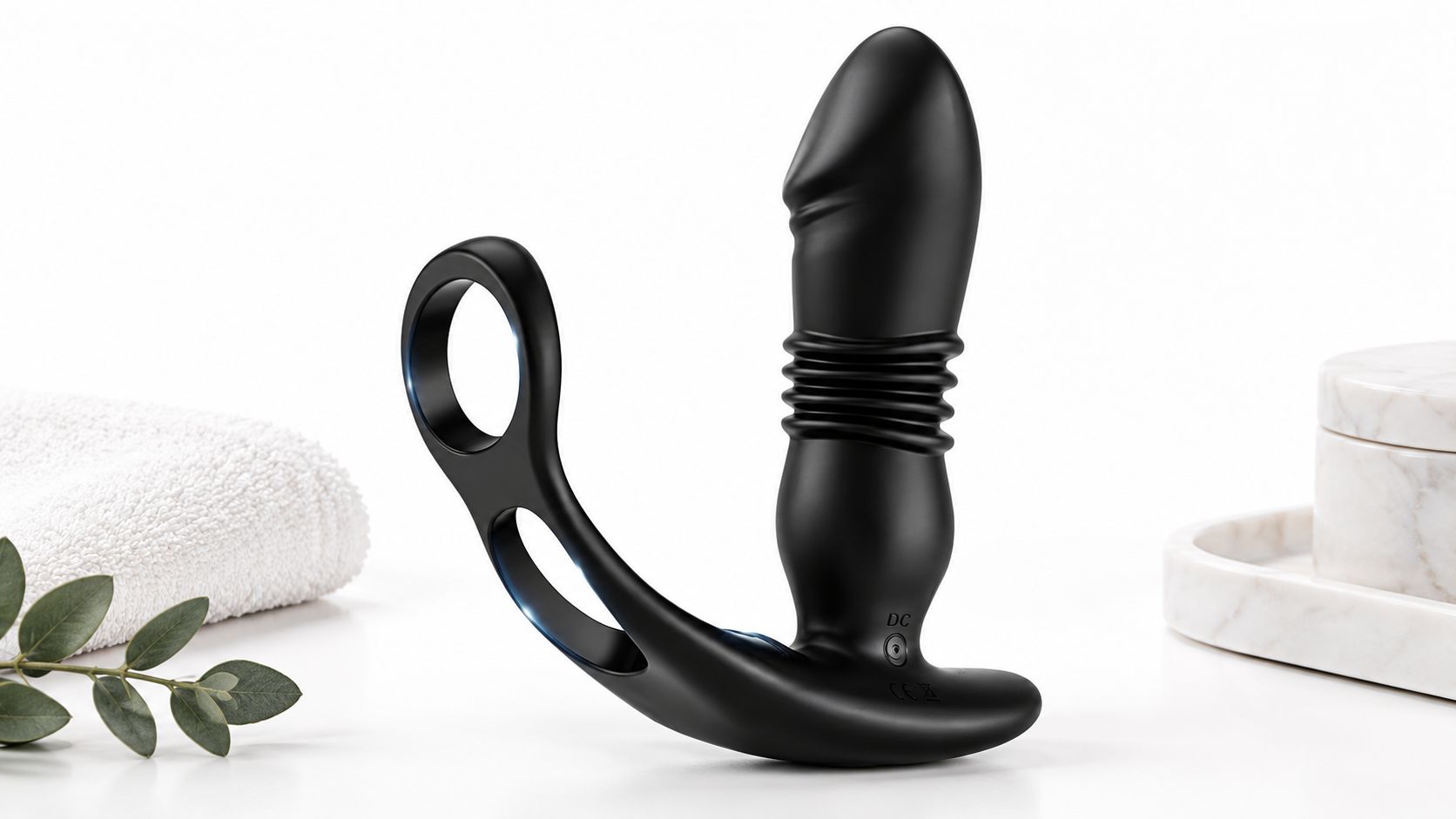
If you're comparing a plug with a more complex device, the Anal Prostate Massager with Penis Ring for Men is described by its catalogue as a curved, flexible prostate massager with a penis ring, dual motors, nine vibration modes, and nine thrusting speeds. Those features make it a different product category from a simple pink plug, so its material and waterproofing instructions deserve particular attention.
The rule is simple: if the material isn't named, isn't non-porous, and isn't supported by clear UK retailer information, leave it on the shelf.
Sizing and Shape from Beginner to Advanced
Most sizing mistakes happen because product pages mix up total length and insertable length. You need three measurements before buying: insertable length, the shaft that goes inside; maximum bulb diameter, the widest internal point; and base width, the part that remains outside and prevents the plug from travelling inward.
A useful beginner reference is an insertable length under 2.5 inches, a maximum bulb under 1 inch, and a neck under 0.75 inches when the product is intended for comfortable wear. Intermediate designs may sit around 3 to 3.5 inches insertable with a 1 to 1.4 inch bulb. Advanced products may reach 4 inches or more, with bulbs over 1.5 inches. These are selection benchmarks, not targets. Your body doesn't need to progress through every category.
Read the measurements in the right order
Start with the maximum diameter because girth usually determines the stretching demand. A narrower neck doesn't cancel out a wide bulb. In fact, a plug with a slim neck and a sharply expanding bulb can feel more challenging than its headline diameter suggests.
A UK survey summarised by Fetish.com found that when toy girth increased by one inch, sales halved for men and fell by two-thirds for women (Fetish.com's UK survey summary via Salience). That finding describes buying behaviour rather than anatomy, but it highlights a common retail problem: size strongly affects willingness to purchase, while product pages often explain it poorly.
Classic shapes tend to be easiest to understand. A teardrop has a gradual taper and a flared base. A long, thin tapered design prioritises length while keeping the initial entry narrow. A round bulb creates a more noticeable change in girth as it passes through the opening. Princess and jewel styles are often shorter and more decorative, which can suit brief wear, but the decorative top must still provide a secure retention feature.
Change one variable at a time
If you're moving up, increase either length or girth, not both simultaneously. A beginner who chooses a longer shaft, wider bulb, and heavier material in one purchase won't know which change caused discomfort. A smaller pink plug with a gradual taper gives you more useful feedback than an ambitious design that looks attractive but offers no manageable starting point.
Check that the base is wider than the largest insertable diameter and that it can't pass inside. UK sexual-health guidance specifically recommends a cord or plug that cannot migrate beyond reach (Sexual Health Bromley's guidance on sex toys). The base is not decoration. It's the retention-control feature.
Lubricant Choices That Actually Work
The safest default for many pink anal plugs is a water-based lubricant, particularly when the plug is silicone. It rinses away easily, works with glass and metal, and is generally compatible with condoms. The trade-off is that it can dry during a longer session, so you may need to reapply rather than pushing through friction.
Silicone lubricant usually lasts longer and provides a slicker glide, but it may damage a silicone plug's surface over time. Use it with glass or stainless steel unless the plug manufacturer explicitly approves compatibility. Don't rely on the label “body-safe” to answer a material-compatibility question.
Match the formula to the plug
Hybrid lubricants combine water and silicone characteristics. They may last longer than a basic water-based formula, but they still carry a silicone-compatibility risk. Oil-based lubricant can work with glass and stainless steel, yet it can weaken latex condoms, so it's a poor choice when barrier contraception or infection protection matters.
Anal tissue can be sensitive to irritating formulas. Look for a thicker lubricant designed for anal use, and consider glycerin-free options if standard products cause discomfort. If a lubricant burns, stings, or leaves irritation, wash it away and stop using it.
For a separate explanation of lubricant and barrier compatibility, see this guide to lubricant with condoms.
| Plug material | Water-based | Silicone-based | Hybrid | Oil-based |
|---|---|---|---|---|
| Silicone | Usually suitable | Avoid unless manufacturer approves | Check manufacturer guidance | Usually avoid |
| Borosilicate glass | Suitable | Suitable | Suitable | Suitable, but check condom compatibility |
| Stainless steel | Suitable | Suitable | Suitable | Suitable, but check condom compatibility |
| Unspecified porous material | Not a safety solution | Not a safety solution | Not a safety solution | Not a safety solution |
Apply lubricant to both the plug and the body. Keep more nearby, because adding lubricant is safer than continuing when the surface starts to drag.
Safe Preparation, Insertion, and Removal
Choose a time when you can stop without feeling watched or hurried. Wash your hands, trim and file your fingernails, and let your bowels empty naturally if needed. Put down a clean towel or waterproof sheet, keep lubricant within reach, and check that the plug is intact before use.
Begin outside the body. Gentle massage can show whether the pelvic floor is relaxing. A small amount of water-based lubricant around the opening may help, followed by a clean finger or slim plug if that remains comfortable. Resistance is information. Pause, add lubricant, or stop rather than pushing through it.
Use a slow insertion sequence
- Lubricate generously. Cover the insertable surface and the opening. Reapply as soon as the plug begins to drag.
- Choose a comfortable angle. Guide it slightly towards the navel instead of pushing straight upwards.
- Breathe out. Pause at the entrance while the muscles adjust. Relaxation matters more than force.
- Advance gradually. Move a small distance, pause, and assess the pressure. Continue only while it feels comfortable.
- Seat the neck. The narrow section should rest inside, with the flared base lying flush against the skin.
For a first attempt, use the plug for five to ten minutes. If your body responds well, increase the time gradually on later occasions. For non-metal plugs, limit wear to two to four hours at most, and never sleep while wearing one. Longer wear can increase pressure and irritation, while making warning signals harder to notice.
Remove without rushing
Relax the pelvic floor, bear down gently as though having a bowel movement, and pull steadily on the base. The base gives you control. Do not pull the shaft, yank the plug, or use another object to lever it out.
Stop signal: Sharp pain, numbness, bleeding, or a plug that will not move with gentle traction means you should stop. If safe removal is not possible, seek medical help instead of applying more force.
UK sexual-health guidance recommends washing toys with warm water and soap after each use, including when moving between the anus and another body area, as explained in Sexual Health Bromley's sex-toy guidance. Cleaning prevents residue from transferring between body areas.
Cleaning, Storage, and Sharing Safely
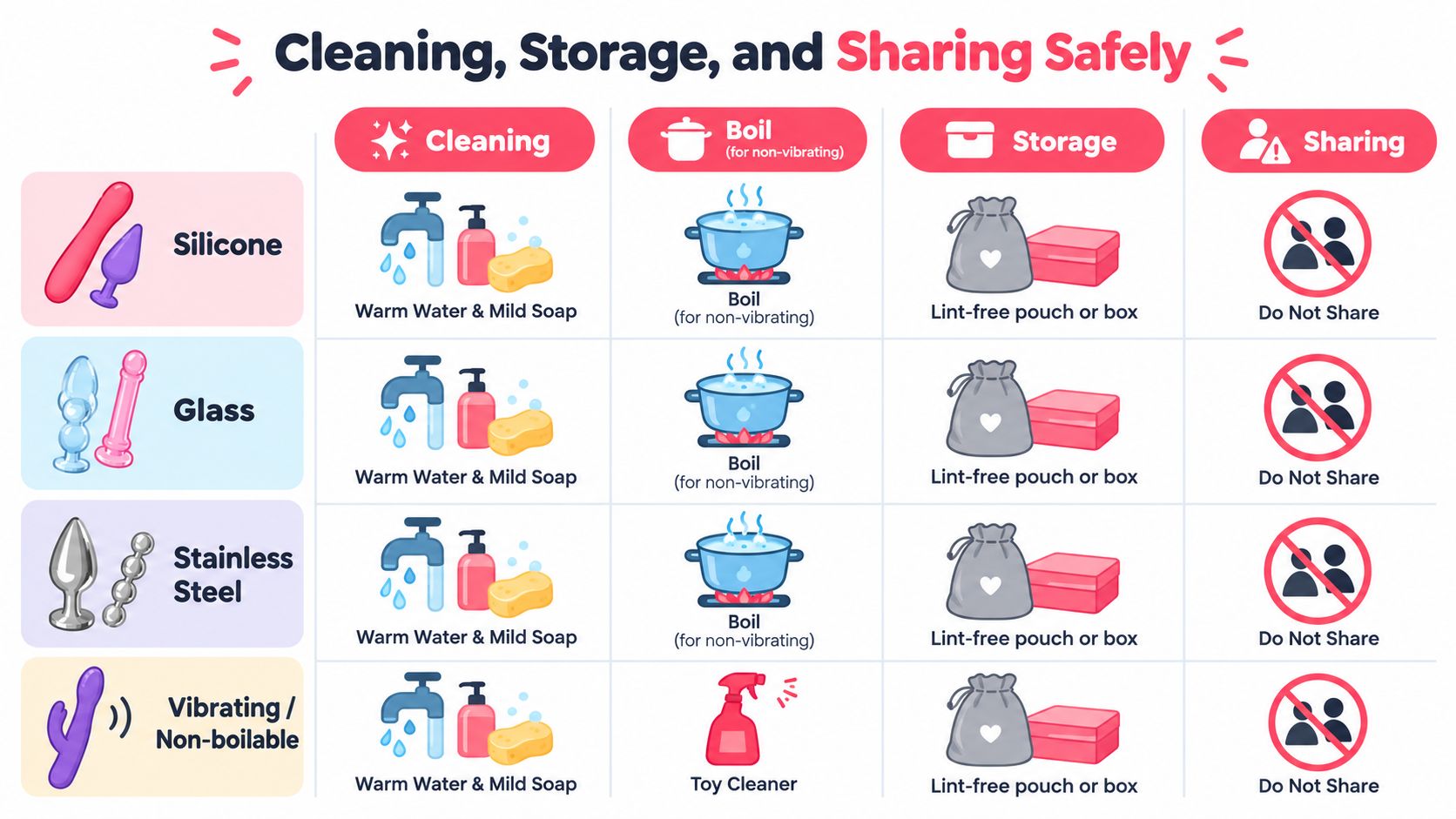
Clean the plug soon after removal, while lubricant and residue are still easy to wash away. For silicone, glass, and stainless steel, use warm water and mild, unscented soap or a dedicated toy cleaner. Rinse thoroughly so cleanser doesn't remain on the surface.
Non-vibrating silicone and glass may be suitable for boiling or dishwasher cleaning, but only if the manufacturer permits it. Batteries, motors, seals, coatings, and decorative components can change the instructions. A vibrating plug should never be boiled unless the maker specifically says it can be.
Dry, store, and inspect
Let the plug air-dry on a clean, lint-free cloth. Towel-drying can transfer fibres into seams or textured areas. Once dry, store it in its own breathable pouch or cotton bag, away from direct sunlight and heat. Keep silicone items separated from one another, since prolonged contact can cause material reactions or surface changes.
Sharing needs a clear hygiene plan. Use a condom over the plug and change it between users, or share only a non-porous product that can be fully sterilised between uses. Never move a toy from the anus to the vagina without washing it thoroughly or changing the condom.
A product such as the 8.6" Thrusting Realistic Dildo has moving parts, a suction base, waterproof construction, and a rechargeable motor, so its cleaning routine must follow the manufacturer's instructions rather than a simple boiling assumption.
Know when replacement is sensible
Discard a plug if it develops persistent odour, tackiness, colour transfer, a crack, a chip, or another visible surface defect. Porous products are especially difficult to clean completely and should not be treated as permanent equipment. If you can't identify the material or determine whether the surface is intact, replacement is safer than guessing.
Warning Signs and When to Stop
Avoid anal plugs during active haemorrhoids, an anal fissure, a flare-up of inflammatory bowel disease, recent colorectal surgery, or unexplained rectal bleeding. Pregnancy also calls for clinician advice before anal play, particularly if there are complications or any bleeding or pain. A healthcare professional can give advice based on your circumstances without making assumptions about your sex life.
Mild pressure, fullness, or a brief urge to defecate can occur as the body adjusts. Those sensations should settle rather than intensify. Sharp, tearing, burning, escalating pain, severe cramping, numbness, light-headedness, nausea, or uncontrolled bleeding are reasons to stop immediately.
A plug that won't shift with gentle traction needs medical attention. Don't use household tools, don't push another object behind it, and don't keep pulling harder.
Seek medical review for any bleeding beyond a streak on tissue, pain that persists after removal, or fever within 48 hours. If bleeding is heavy, pain is severe, or you feel faint, seek urgent care.
Before first use, save this short checklist:
- No active symptoms: No unexplained bleeding, fissure, haemorrhoid flare, or recent relevant surgery.
- Safe product: Named non-porous material and a flared base.
- Adequate lubricant: More is available before you begin.
- Easy removal: You're calm, unhurried, and can reach the base.
- Clear stop rule: Pain means stop, not push through.
Buying Pink Anal Plugs in the UK
A reliable product page should answer basic questions before you reach checkout. Look for platinum-cured medical-grade silicone, borosilicate glass, or 304/316 stainless steel when appropriate. UK retailers may also discuss REACH compliance or relevant product conformity, but a CE mark alone doesn't tell you the plug's size, porosity, or cleaning method. Material disclosure still matters.
Online buying also makes discretion part of product quality. Check for plain outer packaging, a discreet billing descriptor, a published returns policy, and clear age verification for adults aged 18 and over. If the product page hides the retailer's location, returns process, or delivery terms, pause before paying.
| Check | What to look for | Red flag |
|---|---|---|
| Material | Named non-porous material and care instructions | “Soft blend” or material omitted |
| Shape | Insertable length, maximum diameter, and flared base width | Only total length shown |
| Hygiene | Washable surface and clear cleaning guidance | No cleaning instructions |
| Retailer | UK contact details and published returns policy | No clear returns route |
| Packaging | Plain outer parcel and discreet billing | Product name on parcel or statement |
| Checkout | Clear 18+ age verification and secure payment | Unclear privacy or payment terms |
UK retailers vary in whether they support BFPO delivery, so check the delivery page before ordering rather than assuming. Delivery times also depend on stock location and the service selected. If a plug arrives unsealed, damaged, tacky, or with an unusual odour, don't insert it. Photograph the packaging and product, keep your order details, and contact the retailer through its returns process.
You can also review UK toy safety standards and buying guidance before comparing listings. Clear specifications help you separate a suitable pink plug from a product that only looks appealing in a photograph.
Immerse Creations offers UK shoppers a discreet online catalogue with body-safe material information, intimate accessories, cleaning guidance, secure checkout, and plain delivery options. Visit Immerse Creations to compare products privately, check specifications, and choose an option that fits your experience and safety requirements.