Foxtail Butt Plug Guide for Safer, Comfortable Use
You're browsing a listing, and the fluffy tail catches your eye. Then you reach the practical details: an unclear size description, a material label that says little beyond “body-safe”, and no explanation of how the tail attaches. Before choosing a colour, you need to know whether the whole item is suitable for you, not just whether you like its appearance.
Table of Contents
- Why Foxtail Design Needs a Safety First Look
- Understanding What a Foxtail Butt Plug Is
- Choosing Body-Safe Materials and Construction
- Finding the Right Size and Flared Base
- Preparing for Comfortable and Responsible Use
- Cleaning, Drying and Storing Every Component
- Selecting a Discreet UK Purchase
- A Final Check Before You Buy and Use
Why Foxtail Design Needs a Safety First Look
A foxtail butt plug needs a different buying mindset from a purely decorative accessory. The tail is the feature you notice first, but it shouldn't be the feature that decides the purchase. Dimensions, surface quality, attachment security and care instructions deserve your attention before appearance.
Consider a listing with attractive photographs but no view of the underside. You can see the tail's colour and fullness, yet you can't judge the base or understand how the joint works. That's a reason to ask for more information, not to fill in the gaps yourself.
Treat the whole item as a product
In Great Britain, consumer goods fall under the General Product Safety Regulations 2005 framework. Producers and importers must ensure products are safe, explain non-obvious risks, provide appropriate traceability and respond to safety problems. For this design, construction and instructions aren't optional extras.
That framework covers England, Scotland and Wales. Northern Ireland has a separate regulatory position following the replacement of the former regime by EU General Product Safety Regulation 2023/988 on 13 December 2024, as explained in the same government guidance.
You don't need to become a compliance specialist to shop thoughtfully. Instead, look for evidence that the seller can explain what the product is, how it's assembled and how you're meant to maintain it.
Practical rule: If the seller can describe the tail's appearance but can't explain its attachment or cleaning method, pause before buying.
This is educational guidance for adults, not a product ranking or a promise of risk-free use. A sensible purchase starts with understanding the design, then checking materials, fit, preparation, care and privacy. You're allowed to take your time, and you don't need to buy anything while important questions remain unanswered.
Understanding What a Foxtail Butt Plug Is
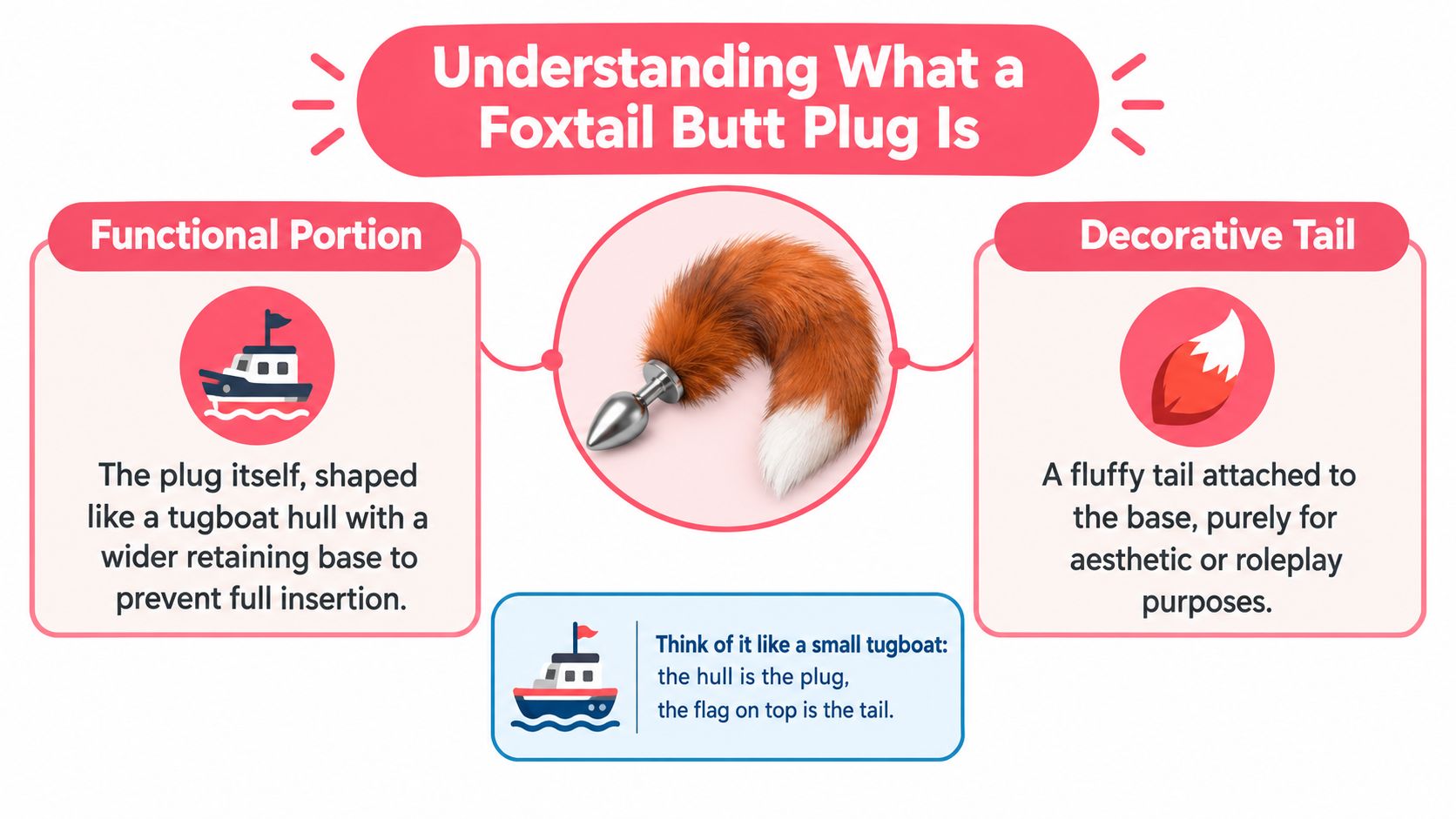
A foxtail butt plug combines an insertable plug, a wider retaining base and an attached decorative tail. Think of a small tugboat: the hull does the functional work, while a flag provides the distinctive appearance. The flag shouldn't interfere with how the boat operates.
The same distinction matters here. The plug and base need to function properly regardless of how long, fluffy or visually appealing the tail is. The decorative section isn't a substitute for a retaining base or a dependable way to remove the item.
This diagram helps separate the functional portion from the decoration.
Identify the parts before judging the design
Look at the product as connected components rather than a single object:
- Insertable section: Identify the portion intended for internal use and inspect its surface.
- Retaining base: Find the broad section intended to remain outside the body.
- Attachment point: Look for the connection between the base and decorative tail.
- Removal feature: Check what you can securely hold without pulling on the decoration.
A broad, secure flared base has a functional safety role. The anal canal doesn't provide dependable retention, and the rectal lining is thin and easily damaged. NHS Tayside's anal-sex safety guidance provides the health context for careful handling, including the risks associated with small tears and grazes.
The tail creates an additional handling problem: it can snag or apply force when it moves. Do not assume that a connection is secure because it looks neat in a photograph. A loose joint or detachable seam deserves attention before the item comes anywhere near use.
Also, don't assume every visible part is insertable. Treat the textile or fur-like section as external decoration unless clear product instructions establish its intended use. Being attached to an intimate product doesn't make every component suitable for internal contact.
Choosing Body-Safe Materials and Construction
A listing that says “silicone” may describe only the insert, not the entire assembly. The base, connecting hardware, adhesive and decorative tail may use different materials. Your task is to understand the construction rather than accept a single reassuring label.
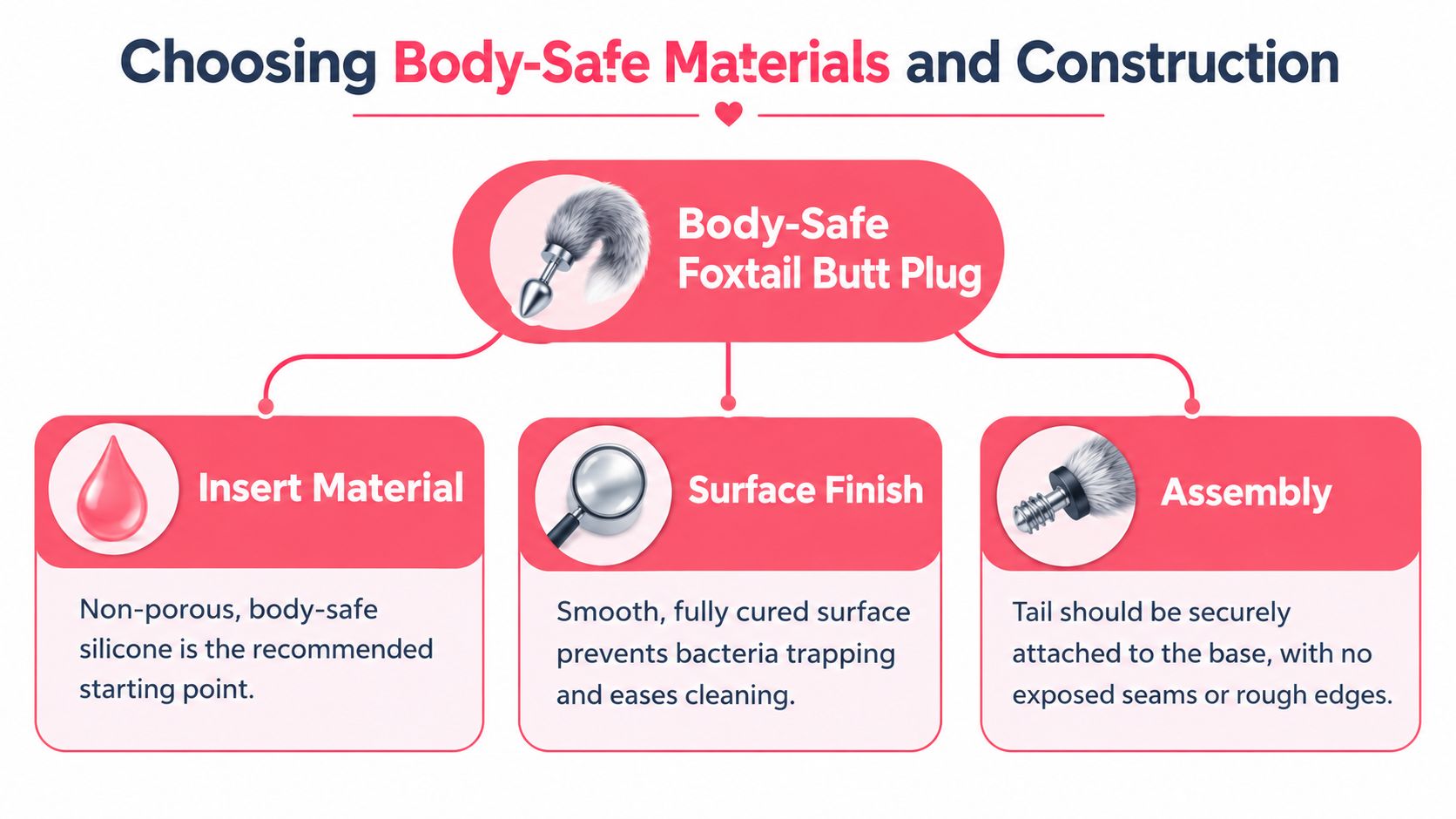
A non-porous, body-safe silicone insert with a smooth, fully cured surface is a useful starting point. Compared with porous jelly rubber or unverified TPE, it supports more thorough washing and limits fluid absorption. However, “medical-grade” is a supplier claim that needs documentation, not something you can confirm from colour, softness or a photograph.
The material and hygiene principles behind this approach are reflected in CNWL's guidance on anal sex and toy hygiene. A material description should help you choose and maintain the product, not merely make the listing sound reassuring.
The following diagram groups the main construction checks.
Ask about the assembly, not just the insert
A useful enquiry to a retailer should cover:
- Complete composition: What are the insert, base, attachment hardware and tail made from?
- Joint design: Is the tail fixed or intentionally detachable, and how should the connection be checked?
- Surface finish: Are there exposed seams, rough edges or accessible adhesive near contact surfaces?
- Care requirements: Which cleaning method applies to each component?
- Compatibility: Which lubricants does the manufacturer permit?
These questions distinguish a disclosed mixed-material product from one whose construction is unknown. A detachable design is not automatically preferable, and a permanently attached design is not automatically secure. What matters is whether the connection is suitable for its intended use and comes with clear instructions.
Read reassuring language critically
“Soft”, “premium” and “skin-friendly” don't answer the same question as a complete material declaration. Likewise, identifying the insert doesn't establish how a porous decorative section should be maintained.
For help interpreting these terms, the guide to understanding materials and choosing safe intimate products offers further context.
Before buying, try explaining the construction in your own words. If you can name the insert material but can't explain what connects it to the tail, you still have an information gap. Ask the seller to resolve it rather than treating vague wording as confirmation.
Finding the Right Size and Flared Base
Fit is a sequence of decisions, not a size label. “Small” and “beginner-friendly” don't tell you enough to assess an unfamiliar shape. Published measurements give you something concrete to consider.
Think of dimensions as measurements on a map. They help you understand the route, but they don't tell you exactly how the journey will feel. Your experience, mobility and personal comfort still matter.
Read the dimensions as a set
Request these details together:
- Maximum insertion diameter: The widest part of the insertable section.
- Usable length: The portion intended to enter the body.
- Total length: The complete measurement, with clarification about whether it includes the tail.
- Base dimensions and shape: Enough detail to assess its external footprint.
- Mass: Useful context when considering the item's overall handling.
Don't substitute one measurement for another. A total-length figure doesn't establish usable length, and a photograph beside a hand isn't a dependable replacement for a specification.
Choose a size and shape that feel manageable for your experience. There's no need to work towards a larger item or follow an arbitrary progression chart. If you're unsure, keep the decision conservative and leave room to reassess.
Check whether you can control the base
The broad-base principle described earlier also has a practical side: you need to be able to reach and hold the base comfortably. Consider your hand movement and position rather than assuming that an attractive shape will be easy to handle.
Look for a stable external base and a clear retrieval feature. Assess whether the decorative tail might obstruct your grip or catch during movement. Don't plan to use the tail as a handle or as the only means to get the item out.
A suitable fit includes being able to control and remove the item, not simply being able to insert it.
If the listing omits usable length, hides the base or leaves the dimensions ambiguous, request a specification sheet or clearer photographs. Guessing is unnecessary when the seller should be able to explain the product.
Preparing for Comfortable and Responsible Use
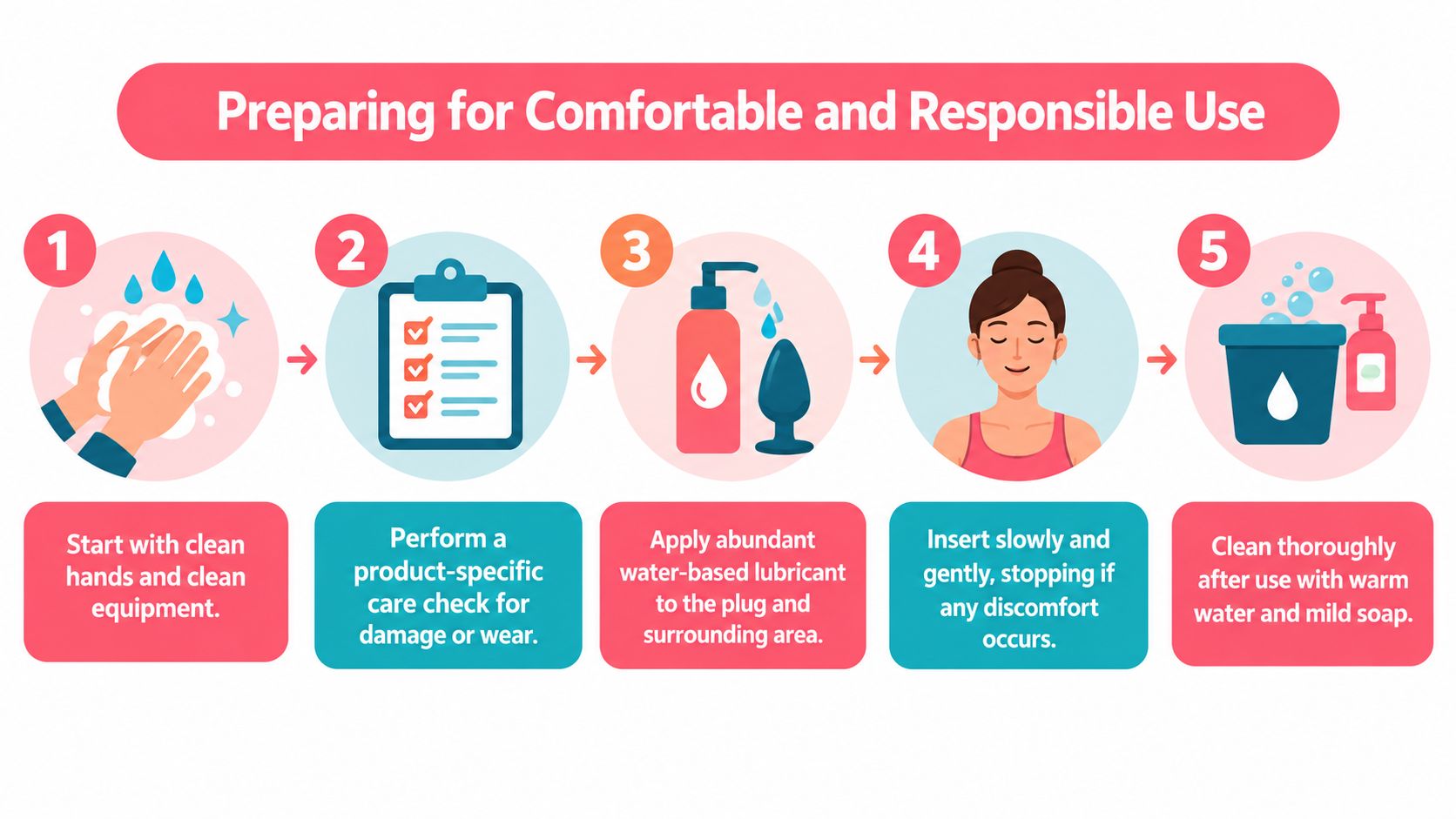
Preparation should feel calm, not like a performance you have to complete. Start with clean hands, clean equipment and the manufacturer's care instructions. Check the surface and attachment before use, even if the item is new.
The illustrated sequence is a reminder, not a replacement for product-specific instructions. In particular, any washing advice applies only where the manufacturer permits it for that component.
Choose compatible lubrication and barriers
Use abundant water-based lubricant for anal penetration. Don't assume a different lubricant is suitable because it works with another item you own. Wirral Community Health and Care's sexual-health guidance explains that silicone-based lubricant can damage silicone toys and advises checking compatibility.
A condom fitted over the plug can reduce direct contamination and simplify cleaning. Replace it between partners and whenever moving between anal and vaginal or oral contact. Avoid oil-based lubricants with latex barriers because they can cause condom failure.
A barrier doesn't make an unsuitable product suitable, and it doesn't replace the cleaning routine. Keep the decorative section away from contact it isn't designed for.
Keep control and respond to discomfort
Proceed gradually, without forcing movement. Use the base for control, and hold it when repositioning so the tail doesn't become a lever. If another person is involved, agree that either of you can pause immediately, without explanation or pressure.
Stop if you notice:
- Sharp pain or bleeding: Don't continue to see whether it settles.
- Surface damage: Set the item aside rather than covering up a defect.
- A loosening attachment: Don't attempt an improvised repair during use.
- Uncomfortable pulling: Pause and reassess the position of the tail and base.
The guide to using anal toys provides broader educational context, but your product's instructions still govern its operation. Careful preparation reduces avoidable risks; it doesn't eliminate the possibility of injury or STI transmission.
If you choose to watch supplementary material, keep the written safety checks beside you.
You don't need to continue because you've prepared everything. Stopping comfortably and reassessing is a responsible outcome, not a failed attempt.
Cleaning, Drying and Storing Every Component
The most useful cleaning question isn't “Can I wash it?” It's “How do I clean each part without damaging another?” A washable insert attached to a textile tail needs a more specific answer than a single instruction to rinse the toy.
For compatible non-porous surfaces, follow the manufacturer's directions, using soap and warm water where permitted. Dry the item completely before storing it separately to help prevent surface damage.
Separate the care requirements
Treat the components according to their declared construction:
- Insert and base: Use the approved washing method, paying attention to accessible joins and residue.
- Textile or fur-like tail: Follow its own care instructions rather than assuming the insert's method applies.
- Attachment and hardware: Check whether these may get wet and whether the manufacturer permits disassembly.
- Adhesives or coatings: Don't improvise treatments when their compatibility is unknown.
Immersion, heat, bleach and harsh disinfectants shouldn't be assumed suitable for fabric, faux fur or mixed-material joints. Equally, don't unscrew or pull apart a connection unless it's designed for that purpose.
Inspect after drying
Use the maintenance routine to check for changes. Look for damaged surfaces, residue, loose fibres or a weakened connection. If something has changed and you can't establish whether it remains suitable, set the item aside and contact the supplier.
Sharing requires a fresh barrier and a validated cleaning method. If the decorative section has been contaminated and the seller can't explain how to clean it appropriately, don't assume that washing the insert resolves the problem.
Care checkpoint: Unknown materials call for a care-instruction request, not a stronger cleaner.
The hygiene measures discussed earlier reduce contamination but don't eliminate STI risk. Barrier use, testing and avoiding use over sores or active bleeding remain relevant. Store only when completely dry, and keep the instructions available for future checks.
Selecting a Discreet UK Purchase
Privacy and product information should come together. You shouldn't have to accept an unclear specification just because a retailer promises plain packaging. A private transaction still needs to be an informed one.
Retailers have responsibilities too. Business Companion's product-safety guidance explains that safety extends to packaging, instructions, labelling and interactions with other products, and that retailers can face liability for unsafe goods. Novelty-item sellers should provide appropriate instructions and pass on supplied user guidance.
Foxtail Butt Plug Selection Checklist
| Check | What to look for | Why it matters |
|---|---|---|
| Product identity | Model or batch reference and responsible business details | Helps you identify the item and raise a concern |
| Fit information | Published insertable dimensions, base details and mass | Lets you assess suitability without guessing |
| Construction | Component materials and an explanation of the tail joint | Makes the whole assembly understandable |
| Care instructions | Separate guidance where components need different treatment | Helps you judge whether maintenance is practical |
| Lubricant guidance | Clear compatibility information | Avoids relying on assumptions |
| Packaging and billing | Explicit external-packaging and statement-descriptor policies | Clarifies what others might see |
| Checkout and privacy | Secure checkout, age checks and readable data-handling policies | Supports a considered, adult purchase |
| Delivery and support | Tracking, contact details and returns information | Establishes what happens after ordering |
Read policies rather than inferring them from a discreet-looking website. Plain external packaging doesn't automatically mean discreet billing, and a dispatch confirmation doesn't explain the delivery process.
The discreet-delivery information is a useful place to check the publisher's arrangements. Confirm the terms relevant to your order rather than assuming that a general policy answers every product-specific question.
Ask one clear pre-purchase question
A practical message might ask the seller to confirm the insert material, attachment design and component-specific cleaning instructions for the exact model you're considering. Request a written reply so you can refer to it later.
If the response repeats marketing language without answering, leave the purchase on hold. A seller's willingness to explain basic specifications is more useful to your decision than another attractive photograph.
A Final Check Before You Buy and Use
A thoughtful choice brings together design, fit, handling, care and privacy. None of these needs to be complicated, but they do need to make sense as a whole. An appealing tail isn't enough if you can't maintain the joint or comfortably reach the base.
Make the decision away from the checkout
Before committing, ask yourself:
- Material: Can I clearly identify what the insertable section is made from?
- Base: Is it broad and stable, with an accessible way to control removal?
- Attachment: Is the tail securely connected, without rough contact points?
- Dimensions: Are the relevant measurements and usable length clear?
- Care: Do I understand cleaning and lubricant compatibility?
- Purchase: Have I checked privacy, adult-only fulfilment and support arrangements?
You don't need to turn these questions into a score. An unanswered safety question is a reason to pause. Save the listing, request clarification and decide when you have enough information.
The tail gives a foxtail butt plug its distinctive appearance, but it also makes the connection between parts especially important. Your decision should account for what happens before, during and after use, not just how the item looks when unpacked.
Choose with clear information, use only while comfortable, and stop if something feels wrong. You don't owe a product a second chance at your expense.
Keep the instructions with the item and make a brief inspection part of your routine. Feeling prepared should mean you're free to proceed, postpone or decide it isn't for you.
Immerse Creations offers adult intimate products alongside material, care and discreet-purchasing information. Visit Immerse Creations to review product specifications and delivery policies, and ask for clarification before ordering if an attachment, dimension or cleaning instruction isn't clear.