Anal Bondage Hook: A Practical UK Safety and Buying Guide
You've watched a few bondage demonstrations, saved an anal bondage hook to your basket, and then opened the reviews to find completely different advice. One person talks about rope, another talks about metal, and almost nobody explains what happens if the hook shifts, the furniture moves, or the wearer can't communicate clearly. That uncertainty is sensible. This is advanced equipment, and the hook is only one part of the setup.
In the UK, buyers also need to make decisions in a market without a dedicated pre-sale approval system for adult sex toys. Design, material disclosure, retailer transparency, consent and careful use carry much of the safety burden. The most useful starting point is simple: if the wearer can withdraw the hook with gentle, unforced movement, it must not be loaded with rope, restraints or weight.
Table of Contents
- First-Time Buyer Scenario and the One Safety Rule That Matters
- What an Anal Bondage Hook Actually Is and the Main Design Types
- Body-Safe Materials Versus Porous Alternatives
- Compatibility With Restraints, Rope, Furniture and Other BDSM Kit
- Consent, Positioning and a Scene-Day Safety Workflow
- How to Read a UK Retailer for Discretion, Trust and Body-Safe Claims
- Cleaning, Sterilising, Storage and Pre-Use Inspection
- Quick Pre-Purchase and Pre-Scene Checklist
First-Time Buyer Scenario and the One Safety Rule That Matters
A couple in a Bristol flat might begin with a harmless question: “Could this be fun with rope?” After watching a YouTube video, they search for a first anal bondage hook and find listings that use words such as secure, heavy duty and professional, while the reviews disagree about comfort and fit. The important details, such as the retrieval base, the finish and how the hook connects to the rest of the scene, may be missing.
Start with the body, not the product description. An insertable item needs a flared or wider retrieval base so it can't pass beyond the anal sphincter. UK sexual-health guidance also warns that the anus can draw objects inward, which is why a cord, flared end or plug-style base matters. You can read a beginner-friendly explanation of gradual preparation in this guide to anal toys for beginners, but don't let a beginner label persuade you that a hook is automatically beginner equipment.
The gentle withdrawal check
Before attaching anything, the wearer should be supported in a comfortable position. Insert the clean, lubricated hook slowly, without force, and allow the body to settle. The wearer should then be able to test whether the hook stays in place during small, relaxed movements.
If the hook slides out, shifts sharply or creates sudden pain, stop. Don't try to solve the problem by adding a tighter knot, a cuff, a heavier attachment or more force. The body has already shown that the hook isn't secure enough for loading.
Practical rule: A tether can control movement, but it can't turn an unsuitable retrieval design into a safe anchor.
The same check applies every time, even if the hook worked well in an earlier scene. Bodies change, lubrication changes, and a different position can alter the direction of pull. Keep the wearer supported, keep the release accessible, and treat pain, bleeding, numbness or panic as reasons to stop and remove the hook gently.
What an Anal Bondage Hook Actually Is and the Main Design Types
An anal bondage hook is an insertable device with a smooth internal section and an external point for attachment. Unlike an ordinary plug, its purpose is usually to connect internal sensation with a restraint or posture. Unlike a dildo, it isn't designed for thrusting. Retention should come from a suitable flared or wider base and the body's fit, not from tightening something outside the body.
The category includes several shapes, although product listings don't always use consistent names. A short T-bar with one fixed ring is often easier to understand because the connection point is obvious and there are fewer moving components. A longer, tapered barbell spreads its shape along more of the insertable section, but length alone doesn't make it safer or more suitable.
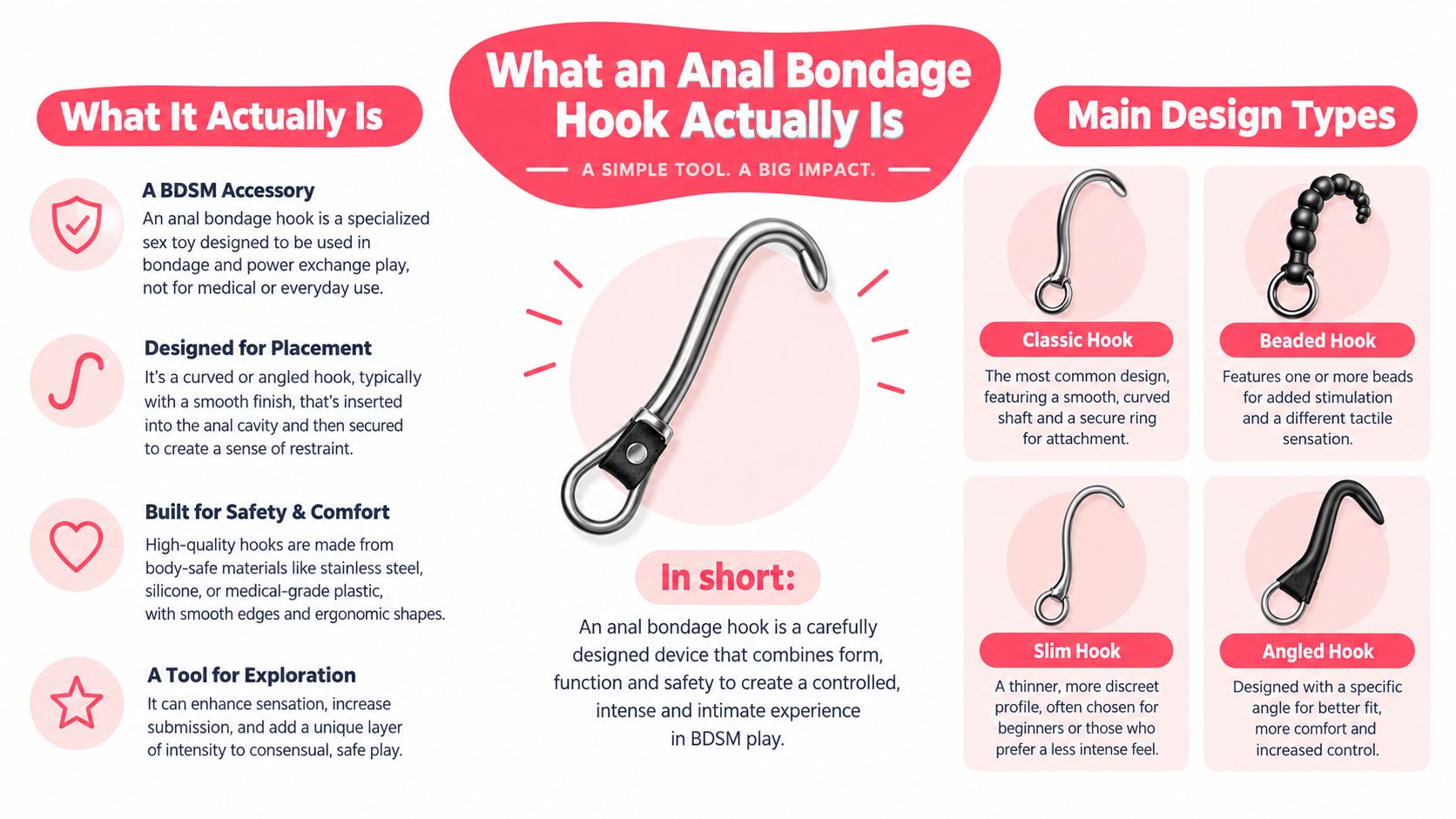
Reading the shape without the jargon
A solid probe-style design may have a flat or rounded external base and can look clinical. A magnetic or screw-lock base may appear convenient, but every detachable connection introduces another point to inspect. A true hook shouldn't rely on a moving catch inside the body. The external ring, eye or loop is for the tether, while the internal section must remain smooth and free from sharp transitions.
| Design feature | What it means in practice | What to check |
|---|---|---|
| Fixed eye or ring | One permanent attachment point | Smooth welds and a rounded opening |
| Swivel eye | May change the direction of the tether | Smooth rotation and no pinch points |
| Split ring | Can accept compatible connectors | The ring must not open or distort under ordinary handling |
| Screw-lock component | A removable connection | Threads must close fully and remain easy to inspect |
Don't confuse an anal hook with a prostate massager. The Anal Prostate Massager with Penis Ring for Men is described as a flexible vibrating device with a curved shaft, penis ring, telescoping motion, dual motors, 9 vibration modes and 9 thrusting speeds. That makes it a different category, focused on targeted stimulation and movement rather than acting as a rigid bondage anchor.
Before buying, look for a clear description of the insertable part, the retrieval base, the attachment point and the material. If the listing only shows a dramatic photograph, it hasn't answered the questions that matter most.
Body-Safe Materials Versus Porous Alternatives
Material is one of the clearest buying decisions because the surface stays in contact with delicate tissue and bodily fluids. UK guidance highlights non-porous, body-safe materials such as silicone, stainless steel, glass and ABS as easier to clean. Porous materials, including TPR, PVC and jelly-style materials, can retain bacteria and cannot be fully sterilised, creating more concern when a toy is shared or moved between body areas. The material certification guide is useful when a retailer uses broad marketing language without giving a meaningful specification.
Use the table as a screening tool, not as a substitute for the manufacturer's exact material information.
Body-safe vs porous material comparison
| Material | Porous? | Sterilisable? | Safe with silicone lube? |
|---|---|---|---|
| Silicone | Generally treated as non-porous when properly made | Follow the manufacturer's care instructions | Verify the product guidance before use |
| Stainless steel | Non-porous | Easier to clean and suitable for sterilisation when non-motorised | Check the manufacturer's instructions |
| Glass | Non-porous | Easier to clean and suitable for sterilisation when non-motorised | Check the manufacturer's instructions |
| ABS | Listed in UK guidance among easier-to-clean body-safe materials | Follow the manufacturer's instructions | Verify the surface and care guidance |
| TPR, PVC or jelly | Porous or difficult to fully sanitise | Not fully sterilised | Treat compatibility and hygiene claims cautiously |
| Unknown alloy or mixed coating | Unverified | Can't be assumed | Can't be assumed |
A retailer may write “body-safe” across a whole product range while the specific item contains a soft coating, plated metal or an unnamed blend. That phrase doesn't tell you enough. Ask for the exact alloy or silicone type, and check whether the care instructions match the material.
Silicone lubricant needs particular care because compatibility can depend on the surface and the manufacturer's formulation guidance. If the listing doesn't identify the material clearly, don't guess. Choose a product with a documented surface and use a small compatibility test only where the manufacturer recommends one, never on the body.
A polished photograph is not material verification. If the exact material isn't named, treat the claim as unconfirmed.
Porous isn't automatically a reason to panic, but it is a reason to limit sharing and be much more cautious about cleaning. For internal anal use, a clearly identified non-porous material gives you a more manageable hygiene starting point.
Compatibility With Restraints, Rope, Furniture and Other BDSM Kit
An anal bondage hook is one node in a rigging system. The hook, connector, rope, restraint, furniture and anchor all share the consequences of movement, so checking only the hook leaves a serious gap. The bondage rope tying guide can help with general rope handling, but ordinary rope knowledge doesn't make an internal anchor suitable for suspension.
Match the connector to the direction
A fixed eye keeps the pull in one direction. That can work with a carefully placed rope hitch or a compatible cuff D-ring, provided the direction of force stays predictable. A swivel eye can reduce twisting as the wearer changes position, but it also changes how the load travels. A split ring may accept a connector, yet it must stay closed and shouldn't be forced onto hardware with a mismatched gate.
A cleat-style bed or wall point, a door-top strap and an overhead anchor don't behave the same way. A fixed point may pull the body forwards. A rope routed through a pulley or door strap can redirect force, creating a new angle that the wearer may not feel until they move. Never assume that a familiar anchor creates a familiar load path.
Protect the body as well as the hardware
Natural-fibre rope such as cotton, hemp or jute can compress into skin when tension increases. Use broad contact, a sleeve, a wrap or a rounded spreader bar where the rope bears against the body. A narrow line that looks tidy can create concentrated pressure around the hips, thighs or chest.
Avoid these common pairings:
- Thin suspension rope: Don't clip a hook directly to rope that wasn't selected for the connector and intended direction of force.
- Mismatched snap hooks: Metal and plastic hardware may have different gate openings, tolerances and closing behaviour.
- Stacked rings: Don't pile rings together on furniture or an anchor without a connector that is suitable for the combined arrangement.
- Neck attachments: A hook connected to a tightening collar creates a breath and neck risk if the wearer shifts or slips.
Before insertion, test the entire rig off-body. Look for pinch points, sharp edges and rope paths that could tighten unexpectedly. Each gate should close by itself, each link should stay connected when handled, and the wearer must remain supported by the floor, bed or stable furniture. The hook must never become the sole support for a person's body.
Consent, Positioning and a Scene-Day Safety Workflow
Consent needs to cover more than “Are you happy to try the hook?” Discuss insertion, depth, the type of attachment, the permitted force, the position, the possibility of rope or restraints and the signal that ends everything. Agree a spoken safeword and a non-verbal signal, especially if the wearer might be face-down, gagged or unable to speak clearly.
A good workflow keeps the same order each time. Prepare the equipment before the scene, not while the wearer is already restrained. Keep the hook, lubricant, cleaning supplies, release tools and aftercare items within reach, and make sure nobody is intoxicated or too tired to make decisions.
Begin with a supported position
Prone, face-down positioning on a stable, padded surface is a sensible starting point because it supports the spine and leaves the wearer visible. Standing, bent-over furniture and spread-eagle positions add balance and attachment complications, so they aren't appropriate as a first experiment.
A Sex Position Enhancer Chair is described as a folding position-enhancer chair made from high-strength TPU with sturdy nylon and armrests. If furniture is used near an anal hook, its listed features don't replace a physical stability check. The chair, bed or bench must remain stable, and the wearer must never be placed where a slip transfers their weight into the hook.
Insert slowly and monitor continuously
The wearer should control the early insertion wherever possible. Use generous, body-safe lubricant on the hook and the body, relax gradually and stop at any sharp or tearing sensation. Rushing, forcing or using a numbing product removes useful warning signals and turns a communication problem into a physical risk.
Once inserted, attach the tether only after the body has settled and the gentle withdrawal check has passed. Start without meaningful tension. Watch breathing, skin colour, facial expression, verbal responses and changes in movement. A quiet wearer isn't automatically comfortable, and a previously enthusiastic “yes” doesn't cancel a later “stop”.
At the first stop signal, remove tension before attempting removal. Support the body, release the connector, and take the hook out slowly rather than pulling against a knot. Afterward, rinse the hook, check the skin, offer water and warmth, and talk about what felt good, difficult or different from the plan. If reinsertion happens in the same session, clean and re-lubricate first.
How to Read a UK Retailer for Discretion, Trust and Body-Safe Claims
The UK doesn't have a specific sex-toy regulation framework, and adult novelty products aren't covered by the child-toy rules described in the UK overview of sex-toy law and safety. That doesn't mean every retailer is careless. It means buyers should treat the product page and the shop's policies as evidence to assess, rather than assuming a dedicated approval process has checked the item.
Check privacy without sacrificing transparency
A discreet retailer should explain how orders arrive and how billing appears. Look for plain external packaging, a neutral billing descriptor and a privacy policy that explains data retention. Courier delivery may offer more privacy than collection from a public counter, depending on your circumstances and the options available at checkout.
Discretion shouldn't mean anonymity from the business itself. A credible shop should provide company details, accessible customer-service channels and a clear returns policy for unused products. Read the hygiene exclusions carefully, because intimate items may have different return conditions once opened.
Look for product evidence
A useful listing names the exact material, describes the retrieval base and gives care instructions that match the material. It should also identify the country of manufacture where available and explain any country or third-party laboratory testing it references. “Hypoallergenic” without supporting information is a weak signal, as is “medical grade” silicone with no material documentation.
Be wary when one listing calls a product silicone, metal and TPE while applying one blanket body-safe statement to all components. Ask what touches the body, what forms the attachment point and how each part should be cleaned.
Use a quick three-question test before buying:
- Material: Can you identify the exact body-contact material?
- Manufacture: Does the retailer explain where and how the product is made?
- Testing: Is any testing information specific enough to check?
If the listing can't answer those questions in one or two clicks, leave it. A low price, dramatic photograph or confident adjective doesn't compensate for missing material information.
Cleaning, Sterilising, Storage and Pre-Use Inspection
Cleaning begins as soon as the scene ends. Rinse the hook with warm water and use a fragrance-free toy wash that suits the material. If the hook has detachable parts, separate them where the manufacturer allows and clean threads, joins and attachment areas rather than wiping only the visible surface.
UK sexual-health guidance recommends cleaning toys with warm soapy water before and after use, using a fresh condom on a shared toy and avoiding any item that causes pain or has damage. Non-porous silicone, stainless steel, glass and ABS are easier to clean than porous alternatives, but “easy to clean” doesn't mean every product can tolerate boiling, bleach or an autoclave.
Match care to the surface
Follow the manufacturer's instructions for sterilisation. A non-motorised stainless-steel item may tolerate more intensive cleaning than a coated, plated or mixed-material item. Do not put an unknown finish into boiling water or a disinfectant solution merely because the core looks like metal.
Dry every part fully on a clean, lint-free cloth. Store each hook in a clean pouch or container, separately from other metal items so surfaces don't rub together. Keep it away from direct sunlight, damp areas and sharp temperature changes.
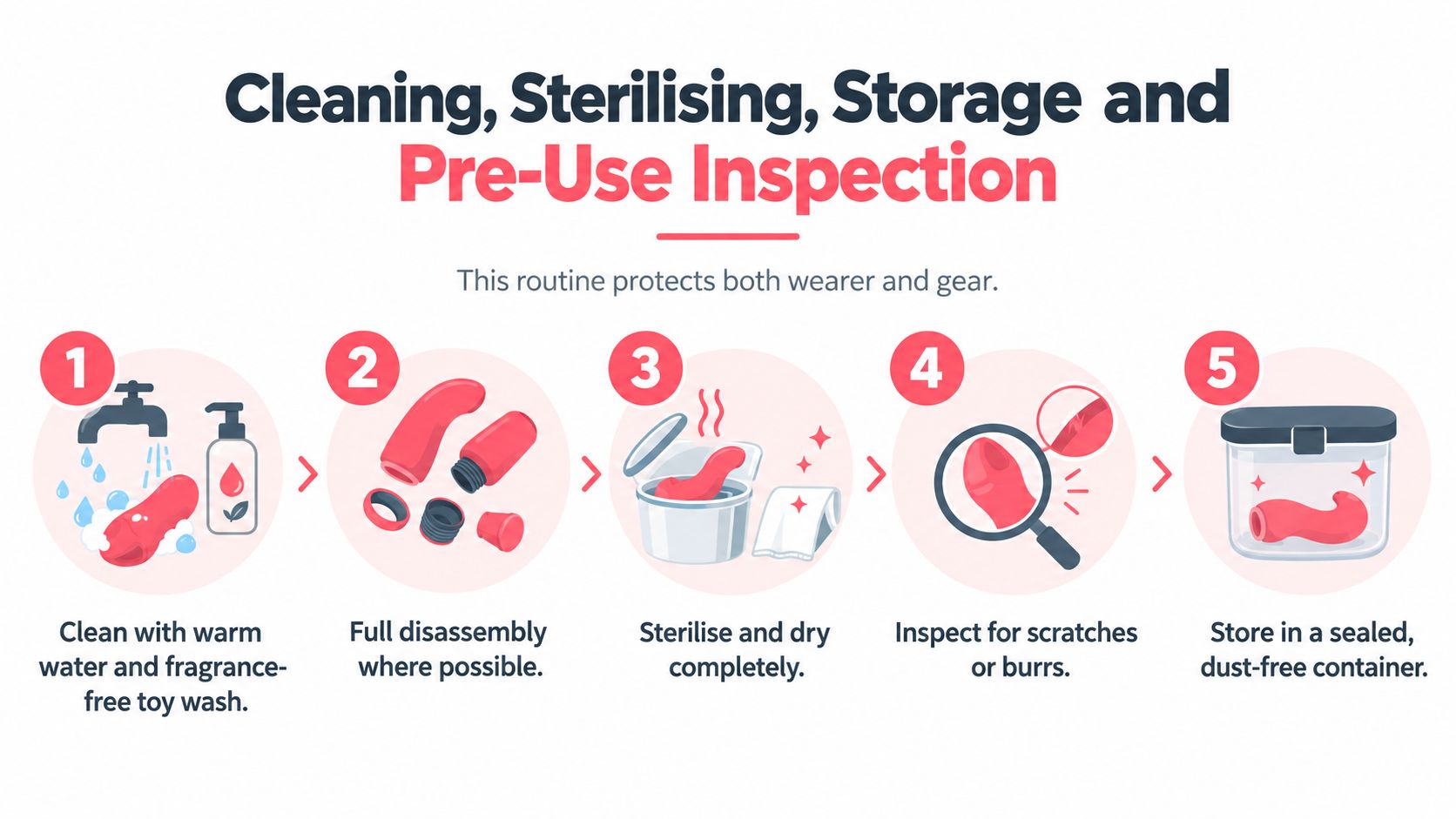
Inspect before every scene
Run your fingers and eyes over the entire item before it touches the body:
- Surface: Look for pitting, flaking, cracks or rough patches.
- Edges: Check every point, join and thread for burrs or sharp ends.
- Welds: Inspect welded eyes and rings for weakness or distortion.
- Fastenings: Confirm that screw connections close fully and that split rings remain intact.
- Finish: Retire anything that feels different from the last inspection.
Don't sand, glue or improvise a repair on an internal item. A flaw means the hook is benched until the manufacturer or a qualified professional can confirm that it is safe. When in doubt, replacing the item is safer than testing a questionable repair inside the body.
Quick Pre-Purchase and Pre-Scene Checklist
Save this checklist to your phone and work through it without rushing. The first half protects the purchase, while the second half protects the scene. If any answer is unclear, pause rather than letting excitement turn uncertainty into pressure.
Before you buy
- Material disclosure: The listing names the exact body-contact material, not just “premium” or “body-safe”.
- Retrieval design: The hook has a flared or wider base that can't pass fully inside.
- Attachment point: The eye, ring or loop is clearly shown and has no sharp edges.
- Retailer identity: You can find company details, customer support and a usable returns policy.
- Privacy: Packaging and billing practices are explained in plain language.
- Care instructions: The shop explains cleaning and lubricant compatibility for this specific material.
- Testing information: Any testing or compliance statement identifies what was tested and by whom.
- No unexplained coating: Plating, soft coatings and mixed materials are identified rather than hidden behind one general claim.
Before the scene
- Consent: Everyone has agreed to the hook, insertion, position, attachment and force level.
- Signals: A spoken safeword and a non-verbal stop signal are understood.
- Body check: The wearer has no current pain, cuts, irritation or unexplained bleeding.
- Lubrication: The lubricant suits the hook's documented material, and more is within reach.
- Equipment test: Rope, cuffs, connectors, furniture and anchor points have been checked off-body.
- Release plan: Safety shears or another immediate release method is accessible.
- Support: The wearer's body remains supported independently of the hook.
- Monitoring: A sober, attentive partner knows what changes require an immediate stop.
- Aftercare: Clean towels, water, cleaning supplies and a comfortable recovery space are ready.
A final disposal rule matters as much as the purchase checklist. Don't lend a porous hook, retire any item with wear or damage, and don't keep using a silicone item indefinitely just because it still looks clean. If you can't verify the material, the finish or the retrieval design, choose a different product rather than trying to compensate with tighter restraints.
Immerse Creations offers adult sex toys, intimate accessories, prostate-focused devices and sex furniture through its UK online shop, with product specifications and cleaning guidance to support comparison. Visit Immerse Creations to review the available options discreetly, then choose equipment that fits your consent plan, material requirements and wider safety system.