Silent Sex Toy Guide: What Quiet Really Means
You're in bed, flat quiet, housemate's door just down the hall, and you're doing that quick mental maths. Will they hear this through the wall, or through the bed frame, or was that buzz louder than you thought? If that worry sounds familiar, you're not looking for a magic label. You're looking for a silent sex toy setup that stays private in your home, at the time you use it, on the surface you use it on.
Table of Contents
- Why Noise Matters When Choosing a Sex Toy
- What Makes a Sex Toy Silent in the First Place
- How to Read Decibel Claims Honestly
- Design Differences Between Quiet and Loud Toys
- Testing a Toy's Real Noise Before You Commit
- Why the Same Toy Sounds Different in Different Rooms
- Practical Tips to Reduce Operational Sound
- Choosing Your Setup and Common Questions
Why Noise Matters When Choosing a Sex Toy
It's late in a terraced house and the bedroom wall feels paper thin. You can hear your neighbour's TV murmur, so you assume they can hear everything from your side too. In a flat share it's a housemate making tea. In a family home it might be kids down the hall or a partner trying to sleep beside you.
That anxiety isn't really about volume in isolation. It's about being overheard, feeling exposed, and not being able to relax. Once you're listening for footsteps outside the door, the moment's gone, however good the toy felt in a shop demo or a video review.
Quiet in the room is not the same as quiet next door
A toy can sound soft held in your hand and still send a low thrum through a mattress, headboard, or floorboards. That second kind of noise, vibration travelling through solid objects, is often what a person in the next room notices first. It's also the part a single number on a box rarely describes.
Practical rule: Judge discretion by what travels through your bed and walls, not just by what you hear in the air beside you.
Privacy also starts before you switch anything on. Lighting, locking a door, and not rushing all affect how exposed you feel, which is why thinking about how to create the perfect atmosphere for better intimate experiences belongs in the same conversation as motor noise.
You're not unusual for caring about this. TENGA's 2020 UK Self-Pleasure Report found more than half of UK adults aged 18 to 54 had used sex toys, with nearly two-thirds of women and LGBTQIA+ respondents reporting use, according to the TENGA 2018 UK Full Report. That report is commercial survey evidence, not official national statistics, and it doesn't isolate silent models. It does show you're shopping in a mainstream market where shared homes and ordinary privacy worries are normal.
So the useful questions aren't just "how many decibels?" They're what makes sound, how that sound travels, how claims are measured, and what you can change tonight.
What Makes a Sex Toy Silent in the First Place
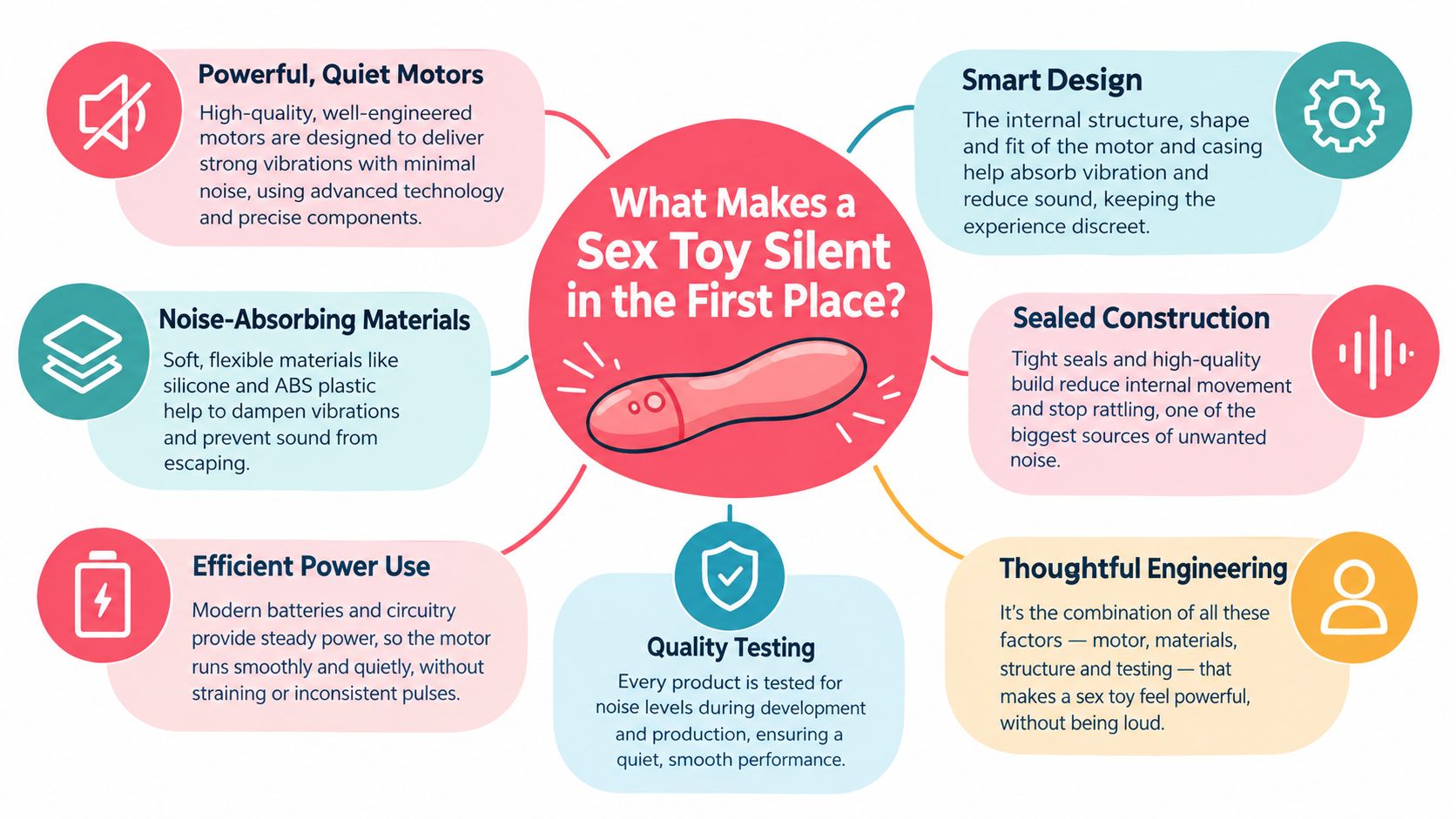
Start with the simplest case. A toy with no motor makes no motor noise. Non-powered dildos, sleeves, and similar products don't hum, whine, or rattle, which is why they're often the most discreet option if vibration isn't essential for you.
That isn't a niche workaround. A 2023 academic study of 265 vaginally insertable products listed by Lovehoney found 199, or 75.1%, did not vibrate, while 66, or 24.9%, did, in the Johns and Bushnell 2023 catalogue study.pdf). The study measured catalogue design, not ownership or decibel levels, but it shows non-powered options make up much of the UK market.
From motor to sound you can hear
A powered toy contains a small motor with an off-centre weight. As it spins, it shakes the motor housing. That shake passes into the toy's body, and the body pushes air, which your ear picks up as buzz or hum.
Think of a phone on vibrate. In your palm it's a soft pulse. Put that same phone in an empty glass or on a wooden table and it suddenly clatters. The motor hasn't changed. The surface is now helping it make noise.
Two routes for noise to escape
- Airborne noise: Sound travels through air to your ear, through a door gap, or across a room. This is what most decibel claims try to describe.
- Structure-borne vibration: Vibration travels through a mattress, bed frame, floor, or wall, then that surface radiates sound on the other side. You might feel this as a thrum before you hear it.
That distinction explains the common confusion. A toy can measure in free air and still be obvious through a lightweight bed. Silent is a chain, motor to body to surface to building, and the weakest link decides how discreet you are.
How to Read Decibel Claims Honestly
A decibel figure looks reassuringly precise. In practice, it's only useful if you know how it was measured. Distance from the microphone, speed setting, surface underneath, and whether the toy was pressed against something all change the result.
The Health and Safety Executive explains sound measurement in its guide to noise at work, INDG362, which sets workplace action values at 80 dB(A) for lower exposure and 85 dB(A) for upper exposure, with peak values of 135 and 137 dB(C). Those are safety limits for workplaces, not bedroom targets. They matter here because they show why weighting and measurement type need stating clearly.
Why small numbers are not small differences
Decibels use a logarithmic scale. UK public-sector acoustic guidance notes a 3 dB change is commonly just detectable, while a 10 dB change is subjectively about twice or half as loud, as set out in HSE noise guidance for the motor vehicle repair industry. So a model rated at 30 dB(A) isn't slightly quieter than one at 40 dB(A) under comparable conditions. It may sound about half as loud.
| Sound Source | Approximate Level | What It Means for a Toy |
|---|---|---|
| Bedroom planning target at night | About 30 dB LAeq | A room benchmark, not a promise a neighbour hears nothing |
| Individual night-time event guideline | Below 45 dB LAFmax | Peaks matter, not just average hum |
| HSE lower workplace action value | 80 dB(A) | A safety reference, far above discreet bedroom use |
Those bedroom figures come from planning guidance covered later, and they describe room noise rather than a product test. Don't treat them as a pass or fail sticker for a toy.
What to check before you trust a claim
- Test distance stated: Closer microphones produce higher readings.
- Speed stated: A lowest-setting figure won't tell you about maximum power.
- Load stated: Pressing a toy against your body changes motor load and sound.
- Surface stated: Soft bedding and hard floors give different results.
- Average or peak stated: Averages can hide short, noticeable bursts.
If a page just says "whisper quiet" with none of that detail, treat it as marketing language. You can't compare it fairly with another product.
Design Differences Between Quiet and Loud Toys
You can often predict noise from a product description before you hear the toy. You're looking for clues about how much energy the motor creates, how tightly it's held, and what material surrounds it.
Motors, mounts, and moving parts
A single, well-fitted motor usually gives you fewer rattles than multiple motors working together. Loose internal parts add clicking or buzzing on top of the intended vibration. Compliant mounts and soft internal spacing help because they stop the motor shaking the outer shell quite so directly.
Thrusting designs add another layer. As a concrete catalogue example, the Sex Machine with 5 Dildo Attachments is described as operating at a 50dB noise level, with 4 automatic and adjustable speeds, up to 450 thrusts per minute, rotation up to 85 degrees, and 4 suction cups for placement on flat, smooth surfaces. That figure still needs the same questions about distance, speed, and surface, and suction cups on a hard floor may transmit vibration differently from a machine isolated on a mat.
Materials and shell construction
- Thick silicone over the motor: Soft, dense material can absorb some vibration before it reaches the air.
- Hard, thin plastic shells: Rigid casings tend to radiate buzz and can rattle if parts fit loosely.
- One-piece outer bodies: Fewer seams and caps mean fewer parts free to vibrate against each other.
- Soft-touch controls: Clicky buttons and twisting battery caps add small mechanical sounds people forget to consider.
Pitch matters too. A low rumble and a high-frequency buzz can feel very different through a wall even before you discuss volume. Higher settings and greater movement generally increase vibration energy, so a toy that's discreet at a gentle pace may not stay discreet at full power.
Rechargeable designs can also sound more consistent when power delivery stays steady, but the battery doesn't make a toy silent by itself. Motor fit, shell material, and how you place it still do most of the work.
Testing a Toy's Real Noise Before You Commit
Don't test a toy only in your hand in a bright, noisy room. Test it where and how you'll use it, ideally when the house is at its usual evening quiet.
A simple three-position check
- Free-air listening: Hold the toy at arm's length, then listen from about one metre away on each setting you realistically use.
- Closed-door listening: Leave it running safely on bedding, step outside, close the door, and listen without pressing your ear to it.
- Surface comparison: Try it on a mattress or folded blanket, then briefly near the hard surface you're worried about. Feel the frame or floor for vibration as well as listening.
You're listening for character, not just loudness. A thin whine can stand out in a quiet hall. A low thump through a headboard can be obvious even when the airborne sound seems modest.
If you can feel vibration clearly in the bed frame with your hand, someone touching that frame or floor may notice it too.
A free smartphone sound meter app can help you compare settings and surfaces in the same room. It isn't a calibrated instrument, so don't treat its number as proof against a manufacturer's figure. Use it for before and after comparisons, which is where it's helpful.
Reading detailed sex machine reviews can also help you spot whether reviewers mention placement and vibration, not just a headline decibel claim. If a review never says what surface the product sat on, it's missing a key part of the test.
Why the Same Toy Sounds Different in Different Rooms
Take one wand and use it on a duvet. The bedding absorbs energy, your body covers part of the toy, and the sound stays fairly local. Put the same wand down on laminate flooring while it is still running and the floor becomes a sounding board. The product hasn't become louder by design. Your setup has changed its audience.
UK planning guidance targets about 30 dB LAeq in bedrooms at night and recommends individual events stay below 45 dB LAFmax no more than 10 times per night, according to the Bracknell Forest noise guidance note for planning applications. Those are room-noise benchmarks, not guarantees of neighbour silence, especially where vibration travels through the structure.
Variables that change the result
- Speed setting: The lowest setting may blend into bedding while the highest is clearly audible outside the door.
- Attachment size and weight: Larger or firmer attachments change how the motor's energy couples into the toy and whatever it touches.
- Pressure against your body: Pressing harder loads the motor and can change its pitch, while close body contact may also muffle airborne sound.
- Bed construction: A rigid frame against a shared wall gives vibration a direct path. A softer, upholstered base interrupts it.
- Flooring and room contents: Bare floors and sparse rooms reflect sound. Rugs, curtains, and bedding absorb some of it.
- Position in the room: Corners and shared walls concentrate problems. Moving away from the party wall can help more than turning the toy down one notch.
This is why two owners can disagree about the same product. One uses it in a carpeted detached bedroom. The other uses it on a metal frame in a converted flat. Silent is the outcome of a setup, and your building is part of that setup whether you chose it or not.
Practical Tips to Reduce Operational Sound
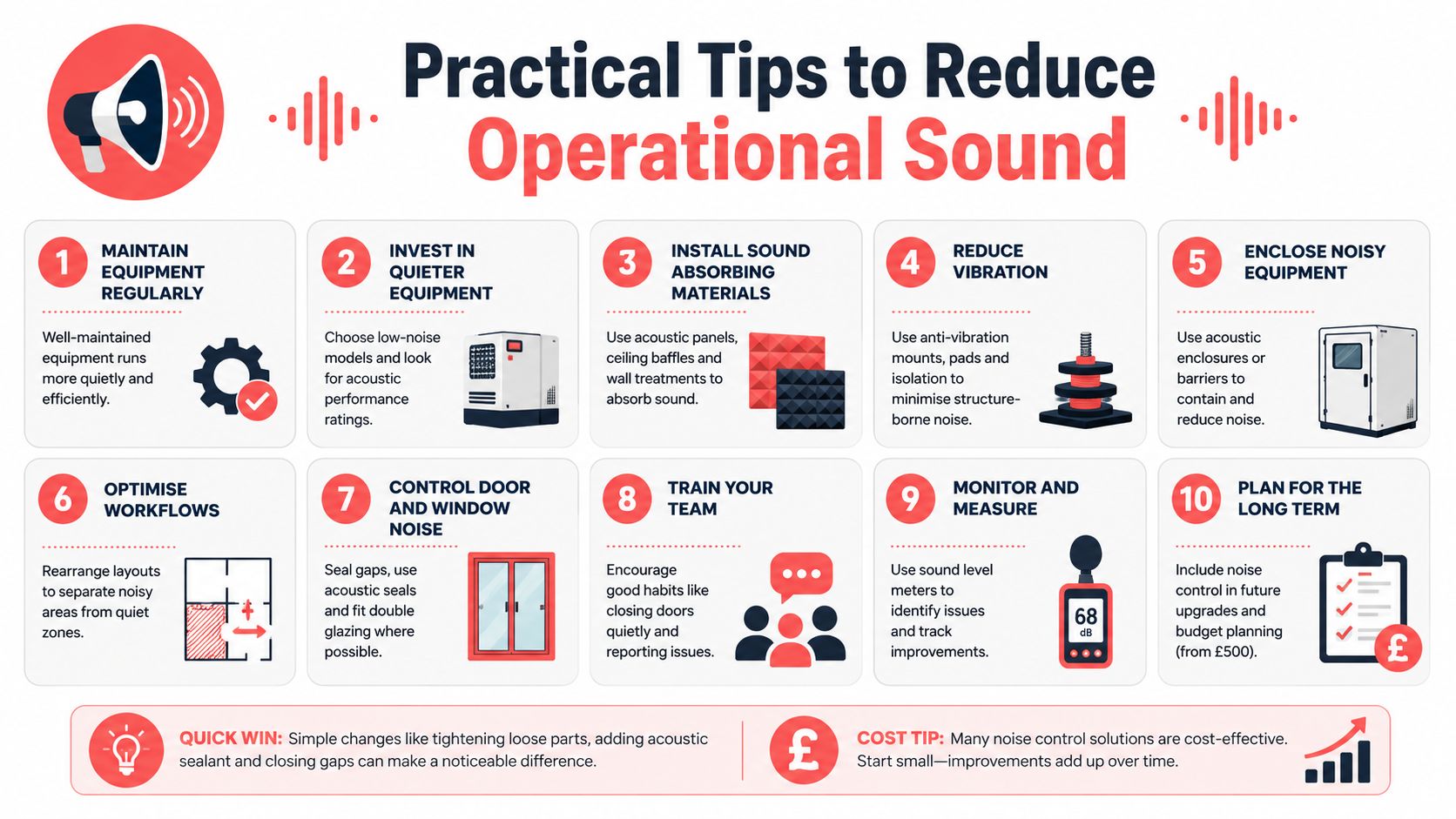
You don't need to rebuild your bedroom. Small changes to placement and timing often make a bigger difference than swapping one "whisper quiet" label for another.
Surface and isolation first
- Use soft layers underneath: A folded towel, blanket, or mat can break the direct path into a floor or frame. Learning about vibration dampening materials helps you choose padding that does not just compress flat.
- Move away from shared structures: Keep machines and wands off party walls, headboards fixed to those walls, and bare floors above another bedroom.
- Check for stray contact: A toy touching a bedside table, radiator, or metal frame can create a secondary rattle louder than the motor.
- Use the lowest effective setting: Start low and increase only as needed. You're managing both airborne sound and vibration energy.
Timing and device choice
Late at night, background noise drops and small sounds stand out. If privacy is fragile, choose a time when ordinary household sounds provide some cover, and keep sessions away from the thinnest shared wall. Music or a fan can mask airborne hum, but they won't stop vibration through a floor, so don't rely on them alone.
When stealth matters most, a non-motorised toy removes the problem at source. When you want vibration, a smaller, well-padded design held against your body and used on soft furnishings gives you more control than a powerful device left running on furniture.
Battery care: Stop using a rechargeable toy if you notice swelling, casing damage, unusual heat, hissing, or charging problems, and use the charger the manufacturer specifies. Don't put a damaged lithium-ion battery in household rubbish.
Physical privacy counts too. Plain packaging and discreet billing stop the delivery becoming the part everyone notices, even if the toy itself stays quiet.
Choosing Your Setup and Common Questions
A silent sex toy isn't a separate species of product. It's a toy, setting, surface, and room combination that stays below the level where you feel overheard. Once you choose for your actual home, the marketing label matters much less.
Questions readers ask most
- Is any vibrator silent? No powered vibrator is soundless while running. The real goal is sound and vibration that don't carry noticeably beyond your space.
- What gives you away more, buzz or vibration? It depends on your building. In many flats, vibration through a bed or floor is the bigger risk because doors block airborne sound better than frames block a thrum.
- Can you trust a phone sound meter app? Trust it for comparing settings in your room, not as a certified measurement. Keep the phone in the same place for each test so the comparison means something.
- Should you choose non-powered instead? If being overheard would stop you relaxing, yes, it is the most dependable quiet option. If vibration is important, choose a well-padded powered toy and put your effort into isolation and placement.
Your next checks after noise are body-safe materials, clear sizing, cleaning instructions, and specifications. A toy that is quiet but uncomfortable, hard to clean, or vague about materials isn't a good buy. Start with your walls and bed in mind, test, and you'll make a calmer choice than anyone chasing the lowest number on a box.
Browse Immerse Creations for body-safe toys, machines, and accessories with clear specifications, discreet UK delivery, and plain packaging. Compare speeds, materials, and attachments against your room and surfaces, then choose the setup that lets you relax without worrying who might hear.