Paddles for Sex: A Practical UK Buyer's Guide
You've talked about trying a paddle. You've probably even looked at a few online, compared the shapes, and then closed the tab because the product photos answered almost none of your real questions. How hard will it feel? Which materials are comfortable and hygienic? Where can it safely land, and what happens if one of you wants to stop?
That hesitation is sensible. Paddles for sex aren't just decorative accessories, and a safe first experience depends as much on communication, construction and recovery as it does on the paddle itself. This guide focuses on those decisions, so you can choose an implement that matches your comfort level and use it with more confidence. For broader intimate-product selection principles, this beginner's guide to choosing the right intimate product offers useful context.
Table of Contents
- Why a First Paddle Feels Different From What You Imagined
- What a Paddle Actually Is in Impact Play
- Materials, Finishes and What Body-Safe Really Means
- Shapes, Sizes and the Sensations They Create
- Consent, Technique and Safer Play in Practice
- Cleaning, Storage and Long-Term Care
- Buying Paddles in the UK Without the Stress
- Your First Paddle Checklist
Why a First Paddle Feels Different From What You Imagined
The couple has agreed in principle. They've discussed spanking before, laughed about it, and perhaps saved a few product pages. One evening, one of them brings up the paddle again. The conversation is easy until the paddle is in their hands. Suddenly, “a little impact” feels less like a fantasy and more like a decision with texture, weight and consequences.
That gap between imagining and doing is common. A picture can show a heart-shaped face or a polished handle, but it can't show whether the impact feels like a warm pressure, a sharp sting or an unpleasant jolt. It also can't tell you whether the receiving partner will feel secure enough to relax, or whether the person holding it can control the landing accurately.
A useful starting point: Choose the experience first, then choose the object that can deliver it.
A beginner-friendly paddle should make communication easier, not create pressure to perform. That means a manageable size, a secure grip, a clearly described surface and a shape that lets the giver control force. It also means agreeing that either person can pause or end the scene without needing to justify the decision.
Safety begins before the first strike. Discuss the intended body areas, the approximate intensity, whether marks are acceptable, and what aftercare might look like. If either partner has a health condition, takes medication that affects bleeding or bruising, or has an old injury, personalised medical advice is sensible before impact play.
The rest of the choice follows from that conversation. Consent, body-safe construction and aftercare are purchase criteria, not details to investigate after the parcel arrives.
What a Paddle Actually Is in Impact Play
Impact play means deliberately creating physical sensation through controlled contact with the body. That contact can be light and playful or more intense, but the important distinction is that the partners agree on it and can change their minds at any point.
A paddle is a flat striking implement with a handle. Its broad face spreads contact over more skin than a narrow crop, while its material, thickness and flexibility alter how the force arrives. Think of kitchen utensils. A wooden spoon, a silicone spatula and a metal whisk all move differently because their weight, edges and flexibility differ. Paddles work in much the same way.
A hand usually gives the giver excellent feedback and a familiar, variable sensation. A crop concentrates contact into a smaller area and often feels sharper. A flogger distributes sensation through several tails, producing movement and texture rather than one broad slap. A paddle sits between these options, offering a visible target and repeatable contact.
Impact tools at a glance
| Tool | Typical sensation | Best for |
|---|---|---|
| Hand | Adjustable pressure with direct feedback | First experiments and close control |
| Paddle | Broad pressure, slap or thud depending on construction | Controlled spanking and consistent contact |
| Crop | Concentrated, sharper sensation | Experienced users who want precision |
| Flogger | Layered movement and varied texture | Sensory play and flowing rhythms |
| Whip | Narrow, focused impact with greater technique demands | Experienced players with dedicated practice |
A wide, flexible paddle can feel more forgiving because the face spreads contact. A small rigid paddle can feel more pointed, especially if its edge lands first. Neither is automatically safer. A poorly finished handle, an unpredictable flex or an overly heavy face can make control harder.
That's why the product page matters. Look for the material, dimensions, face thickness, handle construction and cleaning instructions. These details tell you much more than colour or novelty shape.
Materials, Finishes and What Body-Safe Really Means
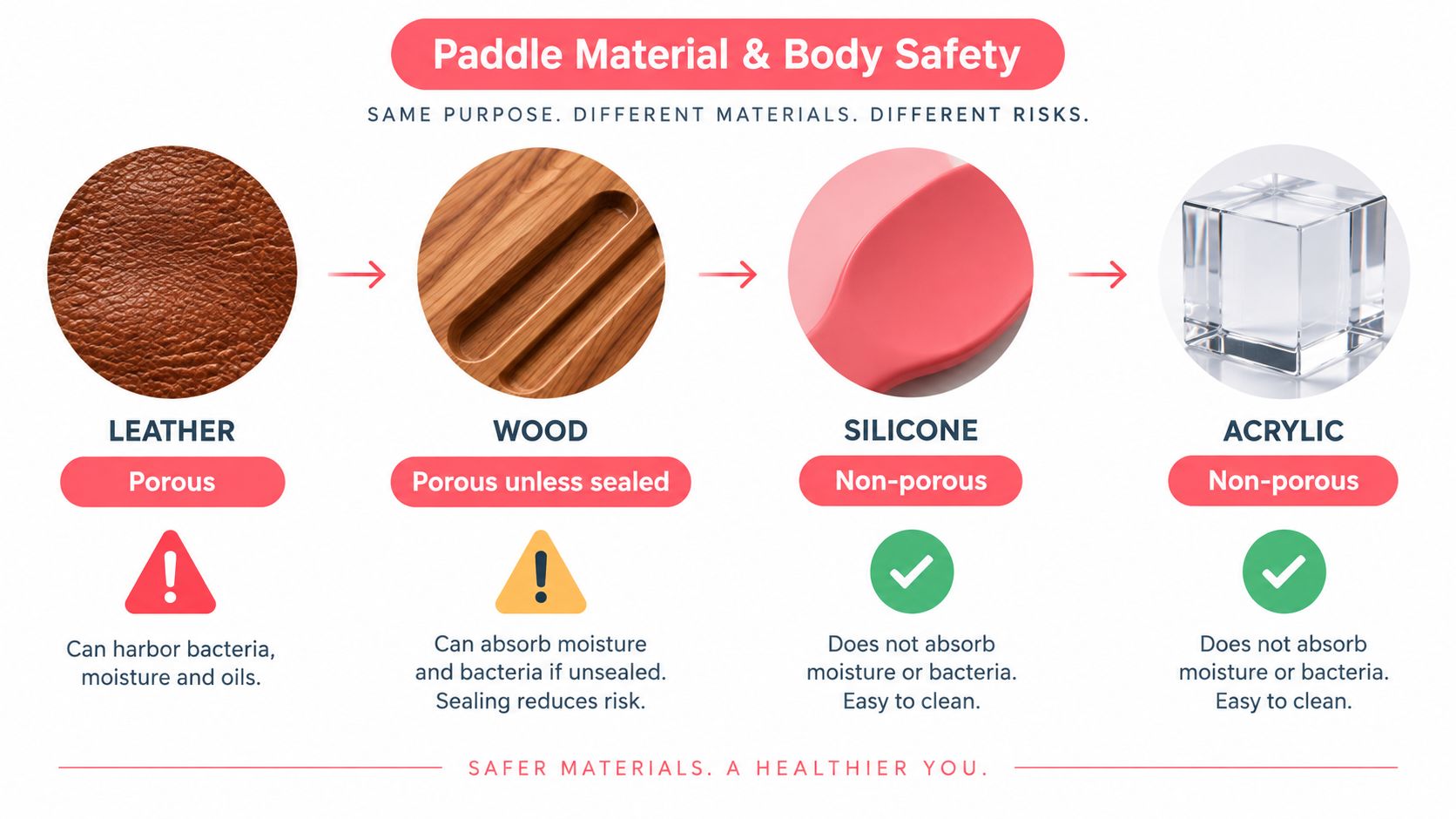
“Body-safe” should lead to a specific explanation, not end the conversation. UK guidance on intimate products commonly favours non-porous materials, including platinum-cure silicone, borosilicate glass, 304 or 316 stainless steel and uncoated ABS, because they don't retain fluids microscopically and can be cleaned or sterilised more reliably than porous rubbers such as jelly PVC. The same reasoning helps you assess a paddle's striking surface, handle and grip inserts. Read the material certification guidance before treating a vague label as proof of quality.
Leather can be durable and tactile, but its care depends on the finish and construction. Unsealed or absorbent leather can retain moisture and odours, so a porous leather paddle is better treated as a single-user item. A sealed surface may be easier to wipe, but you still need the retailer to explain what coating has been applied and how it should be maintained.
Wood needs the same scrutiny. Finished hardwood with an intact, smooth seal is easier to clean than raw wood, which can absorb moisture and develop rough areas. A product described only as “wood effect” might be printed plastic, laminate or an unspecified composite, so don't assume the phrase tells you anything about hygiene.
Silicone and acrylic are generally easier to evaluate when the listing identifies the material clearly and the surface is smooth, intact and free from cracks. Silicone should be described accurately, and acrylic should have no sharp edges or chips. “Faux leather” is a finish description, not a complete material specification.
A quick vetting process
- Read the full specification: Find the base material, surface finish and any glued, stitched or inserted components.
- Inspect the finish: Reject splinters, peeling coating, exposed staples, sharp corners and sticky or oily residue.
- Use your senses carefully: A strong chemical smell, uneven colouring or a finish that transfers to a clean cloth deserves a retailer question.
- Check the care instructions: A trustworthy listing should explain how to clean and dry the paddle, not just call it body-safe.
The safest practical choice is often the one with the clearest construction information. Material transparency beats attractive wording, especially when the paddle will contact skin repeatedly.
Shapes, Sizes and the Sensations They Create
A paddle's shape changes how easily you can control the landing. Its size changes coverage. Its weight and flexibility change whether the sensation arrives as a light sting, a firm slap or a deeper thud. Buying by appearance alone is risky because two paddles with similar silhouettes can behave very differently.
Small, rigid faces tend to concentrate force. Broad faces spread it across a larger area, while padded or flexible designs may soften the initial contact. A long handle can add reach but may also increase the force applied, so a shorter handle often feels easier to manage at close range.
Paddle shape vs sensation
| Paddle style | Typical sensation | Best for |
|---|---|---|
| Oval | Even, broad contact with fewer corners | Beginners who want predictable coverage |
| Rectangular | Clear face and defined edges | Players who want consistent placement |
| Heart-shaped | Broad central contact with a shaped outline | Decorative design without abandoning coverage |
| Tennis-racket style | Larger face and accessible handle | Gentle, broad impact when control is maintained |
| Slotted | More flex and a lighter, sometimes sharper response | Players who understand how flex changes contact |
Weight deserves an honest conversation. A heavier paddle can create more momentum even when the giver doesn't swing hard, while a light paddle usually demands more direct effort for the same audible slap. Neither is gentle by default. The recipient's sensitivity, the landing area and the giver's control matter more than the label.
The handle should stay secure without forcing the wrist into an awkward angle. Check whether you can hold it firmly with one hand, reach the intended area without twisting, and stop the movement cleanly. A smooth face is essential, but so is a grip that won't slip if your hand becomes warm or lubricated.
If you're comparing impact play with other forms of stimulation, the Rechargeable Wand Vibrator is a separate kind of device, offering vibration rather than impact. Its listing describes body-safe silicone, waterproof construction, twenty modes and seven speed levels, so it should be assessed by different criteria from a paddle.
Consent, Technique and Safer Play in Practice
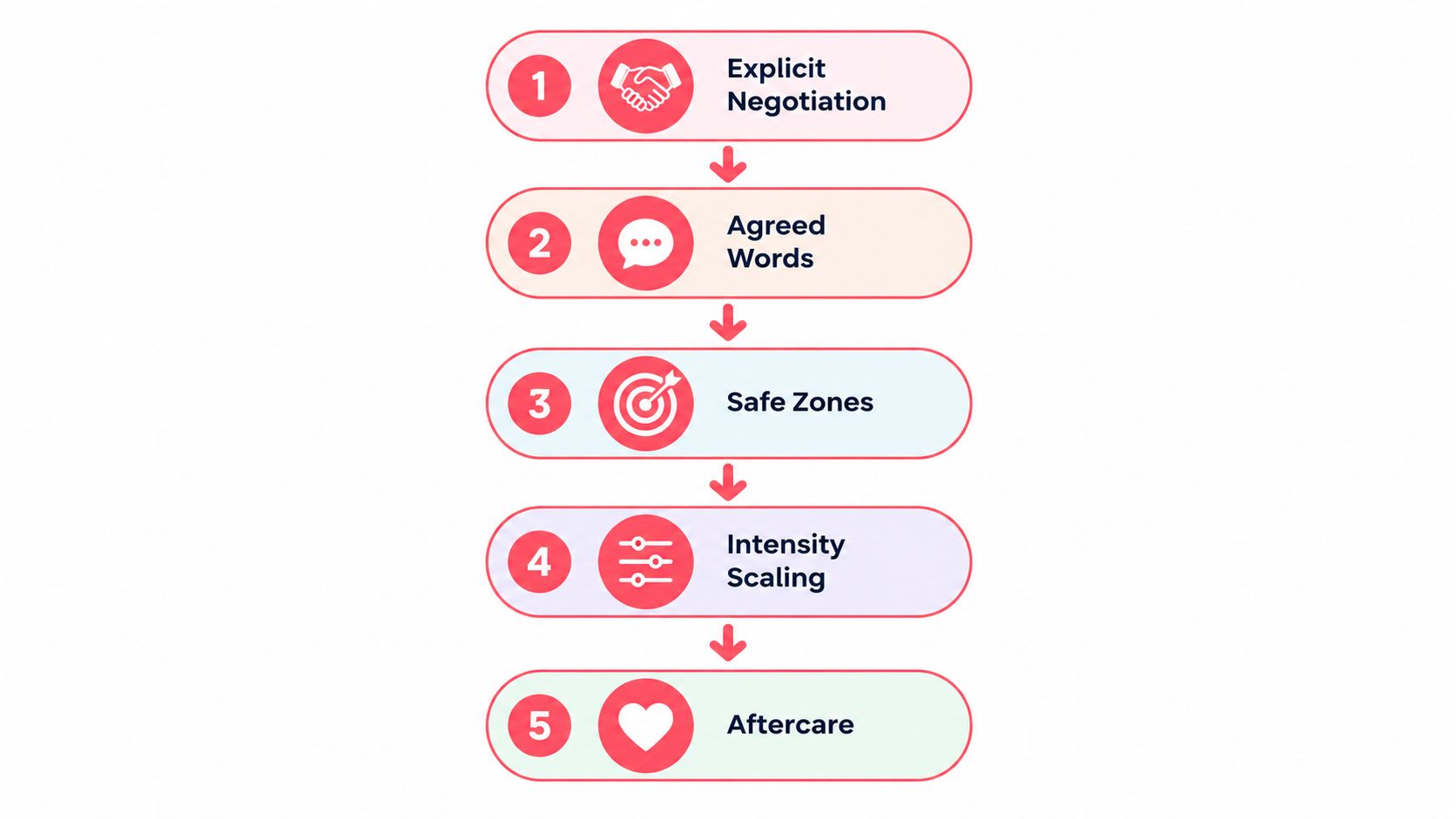
A safer scene is a progression, not a single conversation. Start when nobody is aroused or rushed, and agree on what you're trying, where contact can happen, how intensity will change, and what either person can say or do to pause. Consent must be voluntary, specific and reversible. It also needs to remain active during the scene.
Use an unmistakable stop signal. Some partners choose a clear “stop” plus a second word that means “slow down” or “check in”. If speech may become difficult, agree on a hand signal or another physical signal. Never interpret silence, stillness or endurance as automatic permission.
Build intensity gradually
Begin with contact that doesn't involve striking. Place the paddle against the skin, use your hand, or make very light taps so both partners can notice the sound, pressure and emotional response. The giver should ask focused questions, such as whether the sensation is warm, sharp, numb, too much or comfortable.
For impact, stay with fleshy areas such as the buttocks and the upper, outer thighs. Avoid the spine, kidneys, joints, neck, head, face, stomach and areas where bone sits close to the surface. Do not strike over bruises, broken skin, rashes, varicose veins or a known injury.
Intensity can change in several ways:
- Force: Increase gradually rather than jumping from a tap to a full swing.
- Surface area: A broad face usually distributes contact differently from a narrow edge.
- Pace: Leave space between impacts so the receiver can answer and the giver can observe.
- Placement: Keep checking that contact stays within the agreed zones.
Medication, circulation problems, disability, skin sensitivity and previous injuries can alter how someone responds. A UK kink safety guide notes that bruising or tissue injury can depend on these personal factors, and advises stopping if pain worsens or symptoms such as numbness, dizziness or weakness appear. Consent reduces the risk of unwanted activity, but consent alone doesn't remove the possibility of physical harm.
Aftercare brings the body and emotions back down. Put the paddle away, offer water, use a comfortable temperature, and ask what felt good or needs changing. Check the skin later if marks were expected, and seek medical advice if pain, swelling, numbness, weakness or other concerning symptoms persist.
An Anal Prostate Massager with Penis Ring for Men belongs to a separate category and shouldn't be confused with impact equipment. Its listing describes an anatomically curved shaft, a supportive ring, soft flexible materials, nine vibration modes and nine thrusting speeds. Any internal product requires its own consent, lubrication, hygiene and flared-base considerations.
Cleaning, Storage and Long-Term Care
Cleaning starts with the material, not a universal routine. Follow the manufacturer's instructions, and don't soak a paddle unless the construction is explicitly designed for it. Water can enter seams, damage finishes or weaken glued components.
For sealed wood, use a dry or lightly damp cloth and dry the paddle immediately. Avoid saturating it. A suitable conditioning product may help maintain some finished wooden surfaces, but only use one compatible with the manufacturer's finish.
Sealed leather usually needs a lightly damp cloth followed by complete air-drying. Leather conditioner can protect the finish, but excess product may leave residue on skin. Unsealed leather, raw wood, fabric and suede are harder to disinfect reliably, so keep them for one user and avoid sharing them between partners.
Silicone and ABS can generally be washed with warm water and mild soap when the product allows it. Some guidance also discusses a 10% bleach solution for compatible non-porous items, but check the manufacturer's instructions first, rinse thoroughly and never apply bleach to leather, wood, fabric, electronics or an unknown coating.
Storage prevents avoidable damage
Let the paddle dry fully before putting it away. Store it in a breathable bag or clean drawer, away from direct sunlight, radiators and excessive heat. Keep separate paddles from sticky finishes, dyes and porous toys so materials don't transfer residue or colour.
Inspect the surface before every use. A cracked coating, loose handle, rough edge, exposed fastener or changed smell is a reason to retire the paddle or contact the retailer. Cleaning can't repair structural damage.
A waterproof product such as the 8.6" Thrusting Realistic Dildo has different care requirements from a paddle. Its listing describes a suction base, waterproof construction, magnetic USB charging and a total length stated as 8.4 inches, with 6.1 inches insertable and 1.1 inches of telescopic thrust. Keep charging ports dry and follow the product's own cleaning instructions rather than applying paddle-care assumptions.
Buying Paddles in the UK Without the Stress
The UK sexual wellness market gives buyers plenty of choice, but more listings can create more uncertainty. A UK survey summarised by idealo's sex-toy purchasing report found that around half of the population owns at least one sex toy, and that the vibrator was the most common category, with over nine million owners. The same survey reported dildo ownership at 30%, cock rings at 21%, anal beads at 19% and anal toys at 12%. It also found that 32% of men and women spend £40 to £80 on a sex toy, a useful mainstream benchmark for intimate accessories, though a paddle is only one part of that wider category.
A separate TENGA UK self-pleasure report found that more than half of UK adults aged 18 to 54 had used sex toys. Nearly two in three women and LGBTQIA+ respondents reported usage, while three-quarters of UK sex-toy users said they used them less than once a week. That pattern matters for paddle buyers because occasional users still need clear care instructions and reliable material information.
PwC forecasts the sexual wellness devices market to grow at about 7% annually through 2026, as stated in its sexual wellness devices market report. Yet a UK market analysis reported that organic search visibility for sexual wellness brands fell 2.6% between early 2025 and early 2026, equal to 108,570 lost visits across tracked brands, according to Salience's market performance report. For shoppers, the practical lesson is simple. Don't assume a prominent search result has better specifications than a smaller specialist retailer.
UK retailer trust signals at a glance
| Signal | Trust indicator | Red flag |
|---|---|---|
| Material disclosure | Named material, finish and care instructions | “Body-safe” with no construction details |
| Product photography | Images match the actual shape and surface | Reused stock images or inconsistent dimensions |
| Shipping | Plain packaging and clear delivery terms | No explanation of external packaging |
| Checkout | Secure payment and understandable billing information | Unclear business identity or unexpected descriptor |
| Returns | Visible policy with hygiene exclusions explained | Missing or contradictory returns information |
| Reviews | Specific comments about durability and handling | Only generic praise with no product detail |
Compare the paddle's dimensions with your hand size and intended reach. Read reviews for loose handles, peeling surfaces and unexpected stiffness rather than focusing only on whether buyers liked the appearance. Check age restrictions, UK delivery terms, billing privacy and returns before paying. This guide to discreet shopping and delivery covers the privacy questions many buyers forget.
For example, a Sex Machine with 5 Dildo Attachments is a powered device, not an impact tool, and its listing describes rotating positioning, four adjustable speeds, up to 450 thrusts per minute, four suction cups and five attachments. Its relevant buying checks are stability, noise, attachment compatibility and a suitable smooth surface, not paddle weight or striking-face finish.
Use three filters for any paddle listing: verified materials, transparent retailer information and discreet fulfilment. If one is missing, keep comparing.
Your First Paddle Checklist
A first purchase becomes easier when you make each decision in order. You don't need to predict every sensation perfectly. You need enough information to choose a controllable object, agree on how to use it and create an easy way to stop.
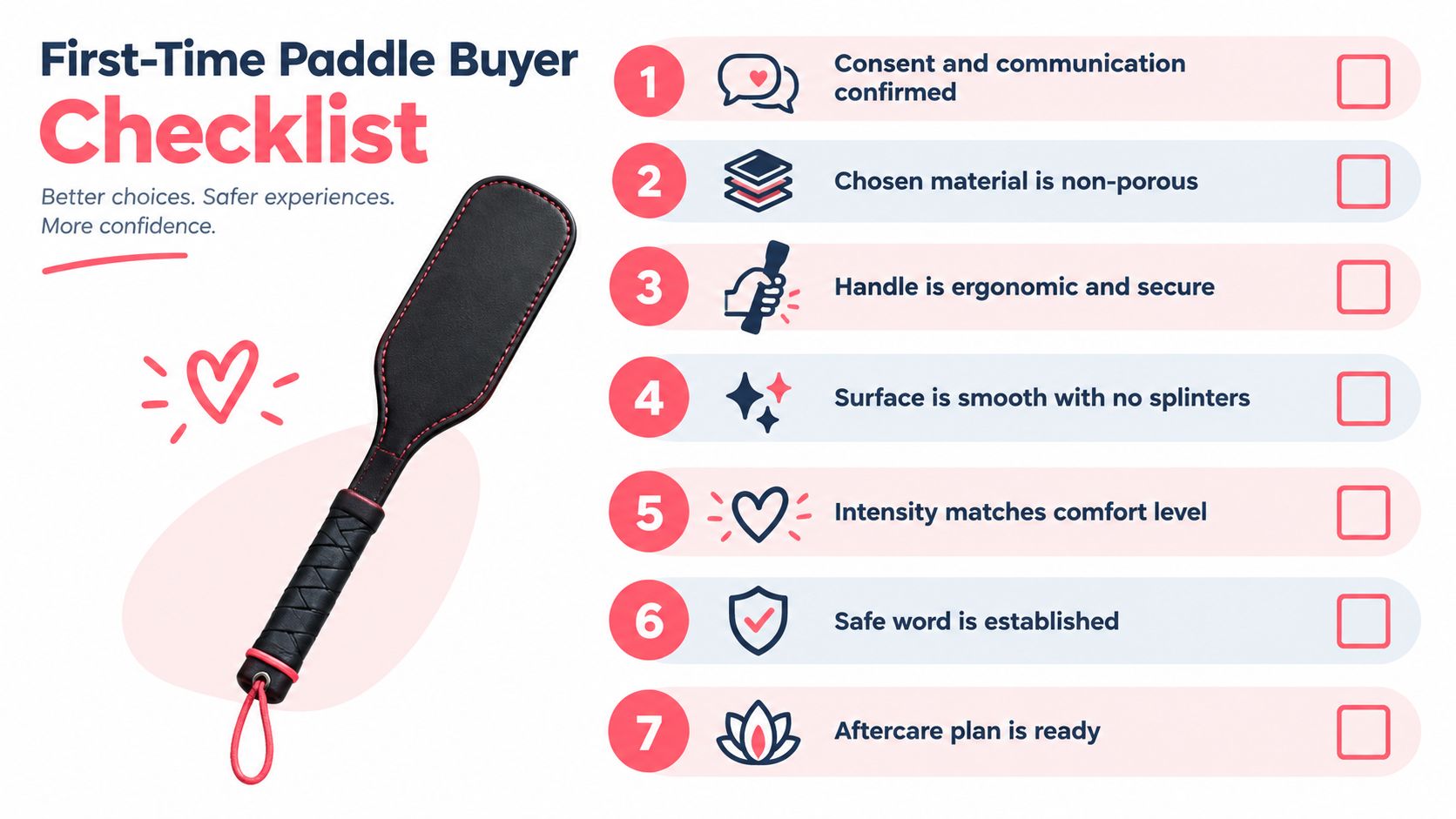
Start with the conversation
- Consent is confirmed: Both partners want to try impact play freely, and either person can withdraw agreement.
- Boundaries are specific: Decide which areas are allowed, whether marks are acceptable and what activities are outside the plan.
- A stop signal is ready: Choose a word and, where useful, a non-verbal signal.
Match the object to the experience
Choose broad, flexible contact if you want a more distributed sensation. Choose a smaller or firmer face only when both partners understand that concentration can make impact feel sharper. For a first paddle, prioritise a secure handle and predictable control over ornate styling.
Check the surface carefully. The material should be named, the finish should be smooth, and there shouldn't be splinters, cracks, sharp edges or peeling coating. Non-porous construction is easier to clean, while porous materials require stricter single-user boundaries and more cautious care.
Prepare the scene
Clear the landing area and agree on a pace. Keep water nearby, allow time for warm-up and decide what aftercare will involve. A short first scene is easier to assess than an ambitious one, because both partners can notice how the body and emotions respond.
A couple might agree on the buttocks and outer upper thighs, choose a medium-weight silicone paddle from a retailer with clear specifications, confirm plain packaging, and practise the stop signal before starting. They could begin with hand contact and very light taps, pause for feedback, then stop while the experience still feels manageable. That process is more useful than choosing the most dramatic-looking paddle on the page.
Run the same checks each time:
- Consent and communication are current.
- The material and finish are clearly identified.
- The handle stays secure in the giver's hand.
- The surface has no damage or roughness.
- The intended sensation matches the paddle's weight, face and flexibility.
- Safe zones and stop signals are understood.
- Aftercare and cleaning are ready before play begins.
The right first paddle isn't the one with the boldest appearance. It's the one that lets both partners stay informed, comfortable and in control from the first conversation through the final clean-up.
Immerse Creations offers UK shoppers adult toys and intimate accessories with product specifications, body-safe material information and discreet delivery options. Visit Immerse Creations to compare intimate products privately, then use the safety and care criteria in this guide before choosing your next purchase.