Masturbation with Machines: A Practical Safety Guide
You've unboxed the machine, cleared some space on the bed, and now you're staring at the controls like they might bite. Good. That hesitation means you're thinking like someone about to use equipment that moves fast, touches tissue, and deserves respect.
Treat masturbation with machines as equipment first, sex toy second. That mindset keeps you focused on fit, friction, hygiene, and control instead of chasing whatever the product video promised.
Table of Contents
- What a First Session Actually Feels Like
- Inspecting and Setting Up Your Machine Safely
- Positioning Yourself for Comfort and Control
- Choosing Body-Safe Attachments and Lubricants
- Cleaning, Hygiene, and Aftercare Routine
- Pacing Intensity and Knowing When to Stop
- Troubleshooting the Most Common Machine Faults
What a First Session Actually Feels Like
The first thing you notice isn't intensity, it's how mechanical the whole setup feels at the start. You've got a powered base, an attachment, a control panel, maybe a remote, and a body that's still deciding whether this is awkward, exciting, or both. That's normal.
A first session should feel like a test run, not a performance. Start at the lowest setting, keep your expectations low, and give yourself permission to stop and reset if the angle feels wrong or the motion feels too sharp. The device is there to do a job, not to overpower you.
Practical rule: if the machine feels too much in the first minute, turn it down or stop. Don't bargain with your own body.
Marketing makes these things look effortless. Real use is more like finding the right chair height, the right angle, the right amount of lubrication, and the right speed without overdoing any one of them. That's why the smartest first session is short, quiet, and curious.
Inspecting and Setting Up Your Machine Safely
Start with the hardware, not your body. Check the attachment for cracks, sticky seams, split edges, or any surface damage that could irritate tissue or trap debris. Then look at the machine body, the control buttons, the power lead, and any locking point on the thrusting arm so you're not discovering a loose part halfway through.
If the base uses suction cups, they need a clean, flat, smooth surface. Bedding is soft and shifts around, so it's usually the wrong place for the machine itself. Put the unit on a hard floor, a sturdy table, or another surface that won't flex under full thrust.
A dry-run matters because it tells you what the machine does before your body is involved. Turn it on at the lowest setting with no attachment or with a dry attachment, listen to the noise, feel the stroke length, and check whether the unit walks, rocks, or drifts.
The Sex Machine with 5 Dildo Attachments is a good example of why setup matters. Its listing describes up to 85 degrees of rotation, 4 adjustable speeds, up to 450 thrusts per minute, and 4 suction cups, so the question isn't just what it can do, it's whether your surface and position can handle that movement safely.
- Check the attachment first: no cracks, no rough seams, no looseness at the connector.
- Check the base second: suction cups, cables, and controls all need a clean, stable place.
- Check the surroundings last: keep cables away from feet, bedding, and anything you could trip over.
If you're setting up near a bed, keep the machine itself off the soft edge and the cable out of the path you'll move through. A five-minute ritual here saves you from fighting wobble, misalignment, and accidental yanks on the cord later.
Positioning Yourself for Comfort and Control
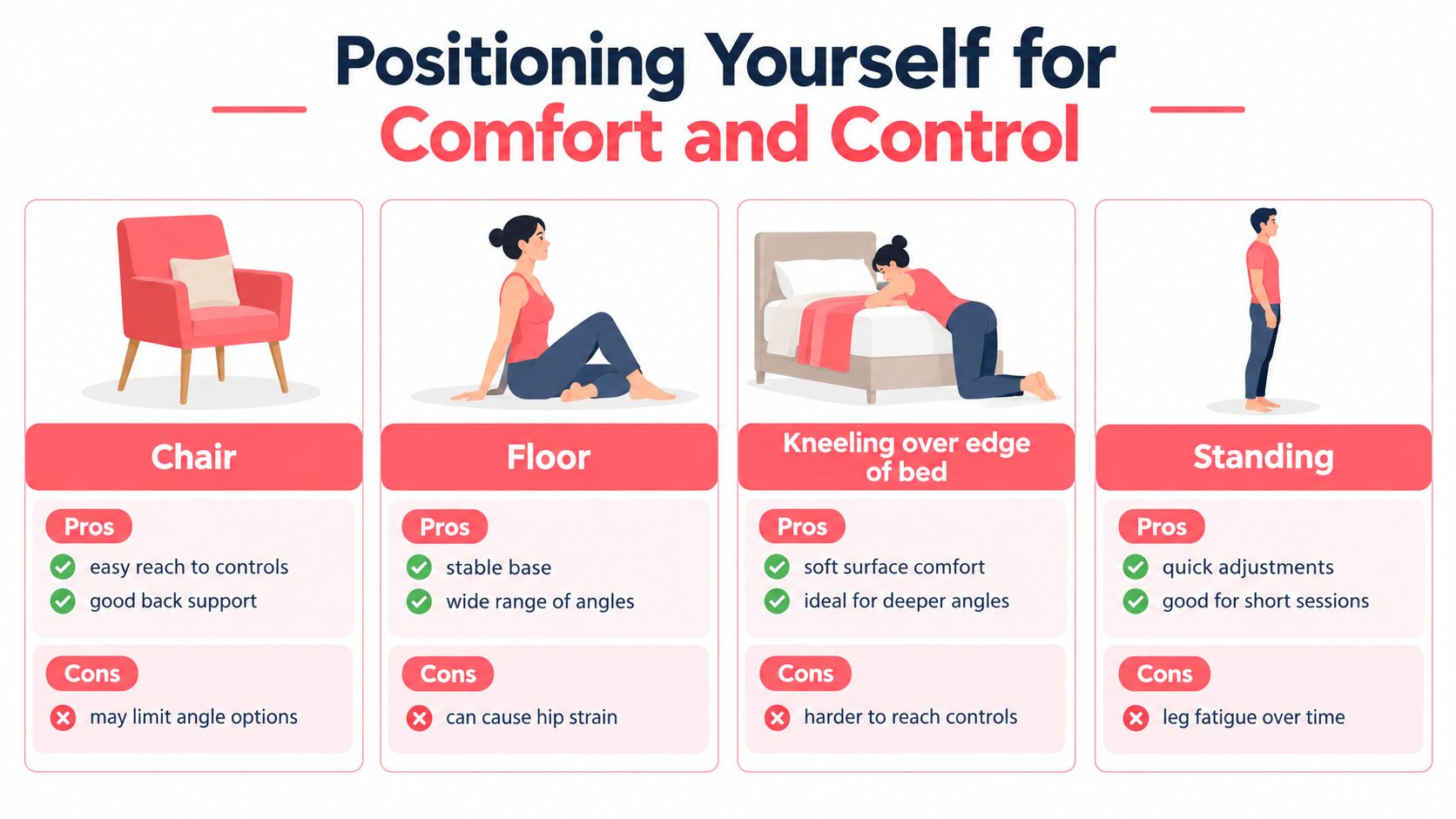
Your body position decides how deep the stroke feels, how much control you keep, and how tired you'll be after ten minutes. If the machine is set up properly and it still hurts, the problem is usually your angle, your support, or the distance between your body and the attachment.
Choose the setup that matches your control needs
A chair is the easiest option when you want quick access to the controls and a stable backrest. It suits shorter sessions and people who want to make small adjustments without scrambling around on the floor.
The floor gives you the most stable base. It works well if you want to anchor the machine solidly and move your hips around it, but it can strain hips and knees if you don't use padding.
Kneeling over the edge of a bed gives you softness and a better angle for deeper movement, but the control panel may be harder to reach. If you go this route, keep the remote in your hand or within arm's reach before you start.
Standing is the most demanding option physically and the easiest to misjudge. It's better for short, quick sessions than for anything where you need to stay relaxed and still.
Set your body before you switch on
Use a cushion, knee pad, or non-slip mat if the surface is hard or slippery. Line up your centre line with the attachment before you start the thrusting motion, because a slight offset at the beginning can turn into a jerky pull once the machine is moving.
If you need a simple decision rule, use this:
- Choose a chair if you want the controls close and your back supported.
- Choose the floor if stability matters more than comfort.
- Choose the bed edge if you want softness and a deeper angle.
- Skip standing unless you know you can stay balanced and relaxed.
Keep the remote, dial, or control panel within easy reach. The early-session whip-snap that catches beginners is usually just bad alignment combined with a setup you can't adjust fast enough.
Learn more about vibration-dampening materials
Choosing Body-Safe Attachments and Lubricants
“Body-safe” gets thrown around like it means something official. In the UK, it doesn't, at least not as a mandatory, independently defined certification claim for sex toys. That means you need to read the spec sheet like a sceptic, not a romantic.
What to look for on the product page
Favour non-porous materials such as medical-grade silicone, ABS plastic, glass, or stainless steel when the attachment is going to press, rub, or move against tissue. Be much more cautious with vague labels like silicone blend, TPE, jelly rubber, or PVC, because those terms often tell you less about maintenance, cleaning, and porosity.
Porosity matters more in machine play than in a smaller hand-held toy because the motion creates heat and repeated friction. That combination makes any surface flaw, seam, or porous finish more annoying, and potentially harder to keep clean, than it would be in a toy that just sits still.
Ask yourself three blunt questions before you buy:
- What exactly is the material?
- Can I clean it properly after every use?
- Will my lubricant play nicely with it?
Water-based lubricant is the safest default for most users. If the attachment is pure silicone, avoid silicone lube on that surface unless the maker explicitly says it's compatible, because it can degrade the finish over time. For a machine attachment, compatibility matters more than brand hype.
Read the attachment guidance for machine users
Cleaning, Hygiene, and Aftercare Routine
Clean it like it's been in contact with skin, fluids, and friction, because it has. UK sexual-health guidance says to check the device before use, clean it after every use, avoid sharing, and use condoms where appropriate, and it also makes clear that sex toys aren't generally regulated as medical devices in the UK, so “body-safe” isn't a mandatory certification claim (SH24 guidance on cleaning sex toys).
The routine that actually works
Remove the attachment first. Wash compatible non-electronic parts with warm water and mild, unscented soap, then rinse thoroughly and dry them completely with a lint-free cloth. Keep the motor housing dry unless the manufacturer has explicitly rated it for immersion, because a water-resistant unit is not the same thing as a waterproof one.
Use a fresh condom over the attachment for each session if you want cleaner handling, especially if the device might be used across body sites or shared with a partner. Change the condom before switching from one area to another, and bin it as soon as the session ends.
A clean storage routine matters too. Put the dried attachment in a separate, clean, dry place, not loose in a drawer with dust, fabric lint, and stray residue. If the surface has cracked or worn down, stop using it until you replace it.
After the session, check your skin. A bit of warmth is one thing, but persistent redness, bleeding, irritation, or pain means you need to slow down and give the tissue time to recover. If symptoms don't settle, get clinical advice instead of trying to “push through”.
See the silicone cleaning guide for material-specific care
Pacing Intensity and Knowing When to Stop
The fastest way to turn a good machine into a bad experience is to crank the speed too soon. Start low, use enough compatible lubricant, and change only one variable at a time, speed, pressure, angle, or position, so you can tell what feels good.

The British National Survey of Sexual Attitudes and Lifestyles shows that masturbation is common in the UK population, but it doesn't measure machine-specific outcomes (Kinsey Institute summary of Natsal findings). That matters because you're not trying to match a benchmark, you're trying to find a setting that suits your body today.
Stop for these signs
- Numbness: sensation dropping off is a warning, not a challenge.
- Sharp or burning pain: stop immediately.
- Bleeding or skin discoloration: end the session and let the tissue recover.
- Persistent irritation: don't keep going just because the machine still works.
- The urge to override discomfort: that's your cue to back off, not push harder.
If you like the feeling, resist the urge to lock into one narrow pattern forever. Varying pressure, speed, and position helps you avoid getting dependent on a single stimulation style, and it gives your tissue a break from one repetitive load. If use starts to feel compulsive, treat that as a behaviour issue, not a hardware problem.
Troubleshooting the Most Common Machine Faults
If the machine misbehaves, pause it and check the obvious before you get frustrated. Most problems are simple, and pushing harder usually makes them worse.
No movement usually means power, pairing, or charge. Check the plug, the switch, the remote battery, and whether the unit has enough charge before you assume the motor is dead.
Weak suction or slipping suction cups usually means air is trapped underneath or the surface is wrong. Clear the base, press it down on a flat smooth surface, and don't expect strong hold on fabric, textured wood, or uneven bedding.
Attachment wobble usually comes from a connector that hasn't been seated properly. Refit it firmly, make sure the 3XLR or equivalent connector is locked in place, and stop if the fit still feels loose.
Odd noise changes, overheating, cracked housings, exposed cabling, or a burning smell are not DIY problems. That's retailer or manufacturer territory, and water should stay far away from the motor while you sort it out. For discretion, UK purchases are typically handled with plain packaging and the IC Wellness billing descriptor, so the privacy side is usually calmer than the mechanical side.
If you want a practical place to buy with UK-friendly product details, discreet fulfilment, and clear specs, visit Immerse Creations and compare the machine, attachment, and cleaning guidance before you order. Pick the setup that fits your body, not the loudest feature list, and you'll have a safer first session and a better one after that.