BDSM Riding Crop: A Practical Guide to Safer Impact Play
You're browsing a UK adult boutique late at night, trying to work out whether a bdsm riding crop is a beginner-friendly toy or something better left to experienced players. The product photos look simple, but the descriptions often skip the details that matter most: where the crop comes from, how sharply it concentrates sensation, whether it's likely to leave marks, and how to buy one without advertising the contents of your parcel.
A riding crop can be a precise, manageable impact tool when adults choose it freely, communicate clearly and understand basic anatomy. It isn't automatically “safer” because it's small, and it isn't automatically extreme because it has an equestrian appearance. The right choice depends on construction, target area, intensity, technique and the agreement between the people using it.
Table of Contents
- What a BDSM Riding Crop Actually Is
- Anatomy and Common Types of Riding Crops
- Consent, Limits and Safer Impact Play Fundamentals
- How a Crop Compares to Other Impact Tools
- Choosing the Right Crop for Your Play Style
- Cleaning, Storage and Discreet UK Buying
- Putting It All Together Before Your First Scene
What a BDSM Riding Crop Actually Is
A couple sits in bed, laptop open, scrolling through an online shop. One partner pauses on the word "crop." They associate it with horses, or maybe with BDSM scenes, but neither is sure whether the product is closer to a whip, a cane, or a paddle.
A bdsm riding crop is a short impact tool with a firm handle, a relatively rigid shaft, a flexible connection near the end, and a small flat tip often called a fall or popper. Its design descends from British equestrian crops, not from the long, multi-tailed bullwhips seen in films. The crop's original purpose was controlled communication from the saddle, which explains why its shape remains compact and easy to direct.

Its British equestrian background
In the UK, the riding crop's historical roots are tied to equestrian and fox-hunting culture rather than BDSM alone. English fox hunting expanded strongly in the 18th and 19th centuries, and the modern crop evolved from a shorter hunting whip used for precise control in the saddle. By the late 1800s, British equestrian practice had standardised the crop as a compact, rigid aid, while cavalry traditions reinforced its association with authority and disciplined riding. Historical background on the British riding crop
That lineage matters because BDSM later borrowed an object that was already culturally legible in Britain as a symbol of control, rank, and targeted correction. British racing rules also show how whip-like implements became part of public life well before modern adult-product contexts. Racing authorities introduced suspensions for misuse in 1988, reduced riders to five strikes in 1993, and later moved to a seven-strike rule in England.
What makes it different
A crop has short reach, a narrow contact point, and a noticeable sting. It can create a clear sound and a focused sensation without the broad sweep of a flogger. That precision makes it useful for warm-ups, rhythmic play, and carefully chosen areas such as the buttocks or upper thighs.
It isn't a universal beginner tool, though. A small tip concentrates force, so a misplaced strike can be more consequential than a broad, lighter touch from a paddle. A crop works like a precision instrument: it rewards control and practice, not guesswork.
Anatomy and Common Types of Riding Crops
Understanding the construction makes online descriptions easier to judge. Hold a crop in your hand and work from the part you control towards the part that meets the body.
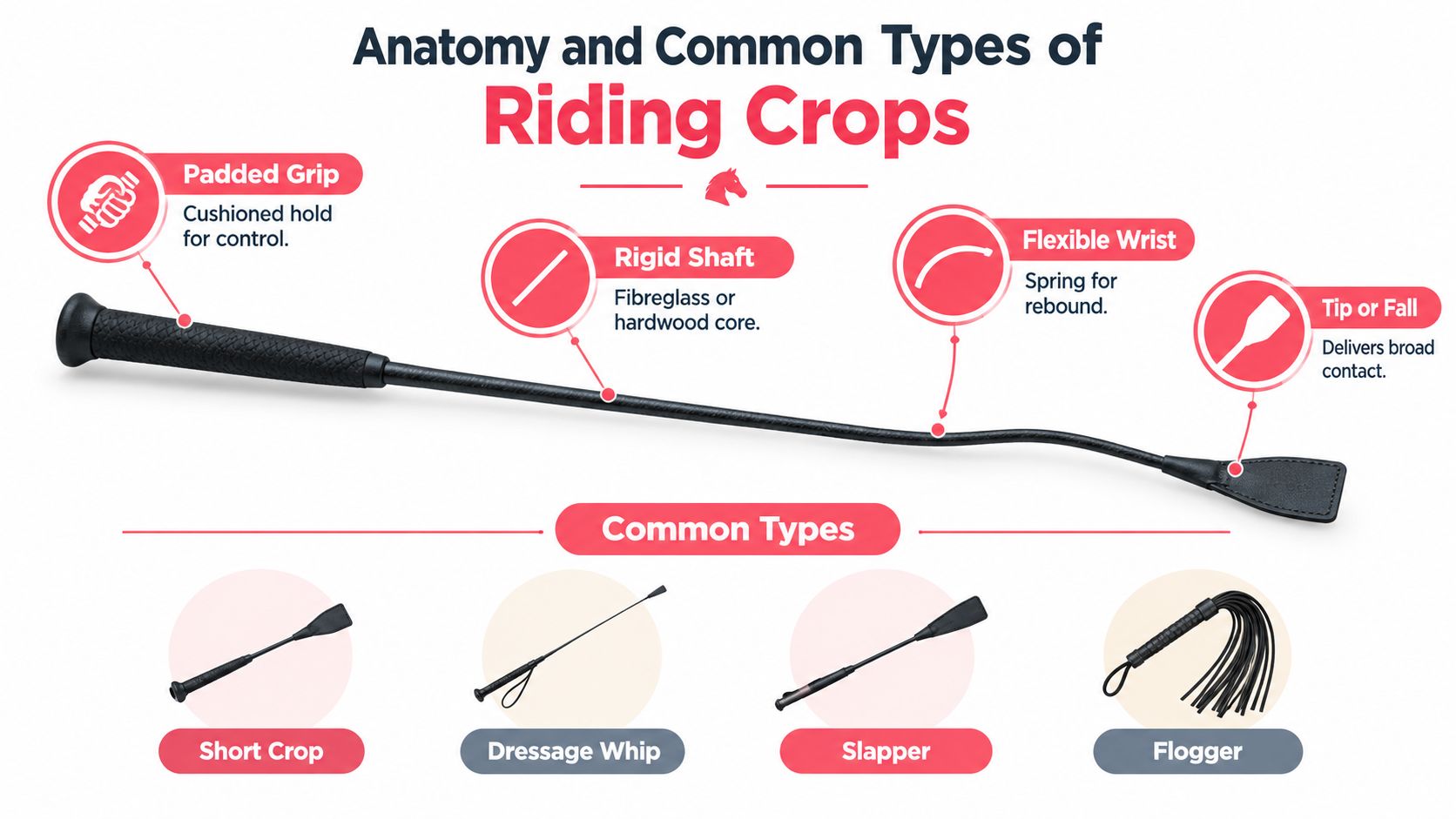
Four functional parts
- Grip or handle: The handle should sit securely in the hand without forcing the wrist into an awkward angle. Padding can improve comfort, while a wrist loop may help prevent accidental drops. A loop isn't a substitute for a relaxed grip, because trapping the wrist can make a release harder if something goes wrong.
- Rigid shaft: The shaft gives the crop its directional control. Fibreglass often produces a lively, springy response, while hardwood feels firmer and may transmit a heavier sensation. The material alone doesn't determine intensity. Diameter, covering, balance and the flexibility of the joint all matter.
- Flexible wrist: This is the short section where the shaft meets the fall. It allows rebound and contributes to the crop's characteristic snap. A flexible joint can make a light movement feel more responsive, but it also demands better control than a completely rigid tool.
- Tip or fall: The fall is the small flat tab that contacts the body. Its width, thickness and material alter the experience. A wider, softer fall usually spreads contact slightly, while a narrow or firm one feels more concentrated.
For equestrian use, British Horse Society dress guidance sets show-jumping and cross-country whips at 17 to 30 inches, or 45 to 75 centimetres, with a padded, smooth, shock-absorbing end free from protrusions. Other BHS assessment guidance allows a short whip between 14 and 30 inches, or 35 to 76 centimetres, while flatwork whips must not exceed 39 inches, or 99 centimetres. Those rules concern horses and competition, not sexual use, but they demonstrate how padding, length and controlled construction shape the object.
Types you're likely to see
- Classic leather crop: An equestrian-style option with a firm shaft and leather fall. It often feels direct and gives the strongest visual connection to the traditional crop.
- Vegan PU or rubber crop: These materials are easy to wipe down and can produce a consistent finish. Check that the covering is smooth and securely attached.
- Suede or soft-fabric crop: A softer fall can reduce the sharpness of contact, although softness doesn't remove the need for careful placement or communication.
- Short crop: Designed for close, controlled movements with little reach. It can suit partners who want the person giving impact to stay physically close.
- Dressage-style whip: Longer and more flexible, with a different balance from a compact crop. A longer tool changes the distance and swing, so it may not be the easiest first purchase.
- Shaft-only cane: A riding cane has no broad fall and offers a more direct, narrow sensation. It belongs in a separate category for buyers specifically seeking a cane-like experience.
Some couples also use other intimate accessories in the same session. For example, the Anal Prostate Massager with Penis Ring for Men combines a curved shaft, a cock ring, vibration and telescoping motion, so it serves targeted internal and external stimulation rather than impact play.
Consent, Limits and Safer Impact Play Fundamentals
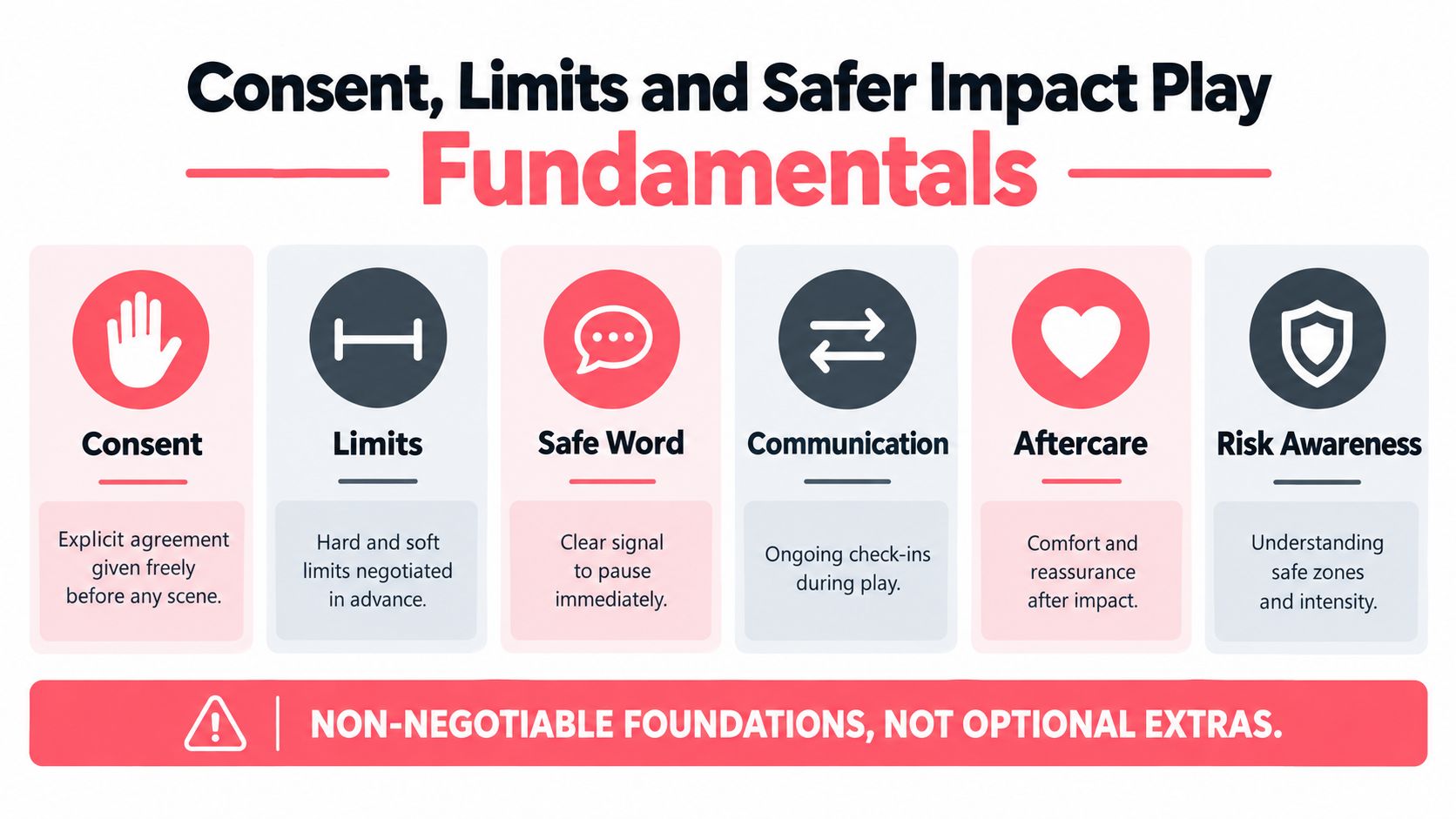
A crop scene starts with a conversation, not a swing. Both adults need to understand what may happen, what is excluded and how either person will stop the activity. Consent should be explicit, informed and freely given before play begins, then checked during the scene rather than treated as a one-time permission slip.
Agree on language that works under pressure. Traffic-light words are familiar to many people, but a simple “pause” and “stop” can work just as well. If speech may become difficult, choose a hand gesture, tap or dropped object. A hard limit is off-limits, while a soft limit describes something that might be possible only under specific conditions or not today.
Practical rule: If the person receiving impact can't communicate clearly, the scene needs a different plan or should wait.
Start with calibration
A first tap on a large, muscular area can help the receiver understand the crop's sound and sensation. Keep the first contact deliberately mild, pause and ask specific questions: Was the location comfortable? Was the sting expected? Would they prefer less force, more time between strikes or no further impact?
Safer starting zones commonly include the buttocks, upper thighs and some shoulder or upper-back muscle, depending on the person's anatomy and agreement. Avoid the spine, lower back, kidneys, joints, face, neck, head and genitals. The UK-facing guidance on impact play and changing interest highlights the importance of warm-up, pacing and watching for redness, blanching or dark bruising, while also noting that crops concentrate force more than paddles or floggers.
The same source reports that UK search interest in impact play rose by just over 140%, but popularity doesn't make a technique safe by itself. A practical guide to bondage in bed can provide broader context on negotiation and restraint, but crop-specific decisions still need their own discussion.
Aftercare is part of the scene
Aftercare can be simple. Check how the receiver feels physically and emotionally, offer water, provide warmth and look at any marks without treating them as proof of success. Some people want quiet contact, while others need space and a clear debrief later.
Don't use a crop when either person is affected by alcohol or drugs. Intoxication can impair judgement, dull pain signals and make it harder to give or interpret consent. Anyone can stop at any moment, including the person holding the crop, and stopping doesn't require a justification.
How a Crop Compares to Other Impact Tools
The easiest way to decide whether a crop suits you is to compare the sensation you want with the amount of force concentrated in one place. A crop's narrow fall creates a focused, stingy impact. A paddle spreads contact over a wider area and usually feels more like a dull thump. A flogger distributes sensation across multiple tails, while a hand gives the person striking immediate tactile feedback.
A cane tends to be stiffer and more direct than a crop. It may sit between a crop and a more rigid striking tool in how sharply it communicates contact, depending on its material and diameter. Beginners who dislike sting may prefer a paddle or soft flogger, while someone seeking precise, rhythmic contact may find a crop easier to understand.
Impact tools at a glance
| Tool | Sensation | Force concentration | Marking risk | Skill level |
|---|---|---|---|---|
| Riding crop | Focused sting with a small thud | High at the fall | Localised redness or bruising is possible | Moderate control needed |
| Paddle | Broad, duller thump | Lower across each contact | Spread marks are possible | Accessible with careful pacing |
| Flogger | Variable, wrapping sensation | Depends on the tails and technique | Uneven, especially with heavier falls | Technique develops with practice |
| Bare hand | Warm, intimate and responsive | Moderate, depending on contact | Usually easier to monitor in real time | Familiar, but not risk-free |
| Cane | Sharp, direct and narrow | High | Marking can be more pronounced | Higher precision needed |
Crops work well for partners who want a clear rhythm and a defined contact point. They may be a poor fit for someone who finds sharp sensations overwhelming, especially if the person holding the crop has little experience judging distance and force. The guide to sex toys, whips and related accessories offers a wider product context, but the decision still comes down to the individual body and negotiated limits.
Body position matters too. A stable, supported position can make communication easier, but furniture doesn't make impact automatically safer. A Sex Position Enhancer Chair is designed to support different intimate positions and can be folded for storage, but it shouldn't be used to force a partner into a position they can't comfortably leave.
Choosing the Right Crop for Your Play Style
Buying decisions become clearer when you translate “I want a crop” into a specific sensation and setup. Do not begin with colour or appearance. Begin with who will hold it, where it will be used, and how much sting the receiver enjoys.
Length and balance
A short crop in the 40 to 50 centimetre range is suited to close, accurate contact. A longer crop around 60 to 75 centimetres gives more reach and changes the swing. Those ranges are purchasing guidance, not a promise of a particular intensity. A longer shaft can increase force and may make distance harder to judge.
Balance affects accuracy more than many first-time buyers expect. A front-heavy crop can tire the wrist and make repeated movements less consistent. A lighter tool may be easier to control during a slow scene, while a heavier one can become tiring sooner.
Shaft, flexibility and fall
Fibreglass tends to feel lively and springy. Hardwood offers a firmer structure and a more substantial response. A leather-wrapped shaft or leather fall may feel warmer and less synthetic, but inspect the finish for rough edges, loose stitching or exposed fasteners.
Tip shape changes the contact area:
- Flat fall: A sensible starting point for people who want a defined but less needle-like contact.
- Rounded tip: More localised and precise, so it calls for careful target selection.
- Paddle-shaped fall: Spreads the sensation more than a narrow tab, though it remains different from a full paddle.
A compliant equestrian-style construction prioritises a padded, smooth and shock-absorbing end. The British Horseracing Authority's explanation of foam-padded racing whips describes a composite spine with a polymer surround and thick foam padding, alongside standardised construction through a single accredited supplier. Racing rules and BDSM products serve different purposes, but the underlying design lesson is useful: padding and energy absorption matter.
Grip and material checks
Choose a padded handle if the crop will be held for longer periods. A wrist loop can reduce drops, and a balanced pommel can make the handle easier to orient without looking. The grip should remain secure without requiring a tight, fatiguing squeeze.
Look for nickel-free metalwork if metal fasteners touch the skin, sealed wood that won't splinter and leather described clearly enough for you to assess its finish. Vegetable-tanned or bonded leather free from harsh dyes may be preferable for buyers concerned about surface treatment. Avoid any product with a rattling shaft, sharp seams, protruding fixings or a fall that pulls away from the joint.
If you want to pair impact play with vibration rather than another impact tool, the Rechargeable Wand Vibrator has a smooth body-safe silicone surface, is waterproof and offers 20 modes and seven speed levels, according to its product information. It's a separate type of stimulation, so keep its cleaning and use instructions distinct from those for a crop.
A useful final question is: Do I need close accuracy, longer reach, a softer fall or a sharper point of contact? Match the answer to your experience, the intended body area and the receiver's stated limits. If you can't describe those three things, wait before adding the crop to your basket.
Cleaning, Storage and Discreet UK Buying
A crop needs care after the scene, even when it hasn't touched bodily fluids. Sweat, lubricant, dust and damp can affect leather, wood, fabric coverings and metal fittings. Cleaning also gives you a chance to inspect the tool before it returns to storage.
Use the method that matches the material:
- Leather: Wipe with a slightly damp cloth and mild soap, then dry naturally. Use leather conditioner occasionally if the maker permits it. Don't soak leather, and don't immerse a crop with a leather-wrapped handle.
- Sealed wood and fibreglass: Wipe the surface with a suitable antibacterial spray, then dry it thoroughly. Don't assume untreated wood is non-porous or suitable for sharing.
- PU, rubber and synthetic coverings: Follow the product instructions, checking for peeling, cracks or tackiness as you clean. Replace a crop if the surface has degraded.
Hang the crop or lay it flat in a cool, dry place. A cotton bag can protect the finish from dust, while a cupboard keeps it away from curious visitors. Radiators can dry or distort some materials, and damp storage can encourage deterioration or unpleasant odours.
What discreet buying should include
UK adult retailers should clearly state that purchases are for adults and use an age-verification process at checkout. Privacy also depends on the parcel and payment record. Look for plain outer packaging, a label without product descriptions and a billing descriptor that doesn't identify an adult retailer.
Returns policies need to explain hygiene seals and opened intimate products in plain language. Tracked delivery can help you monitor a parcel without repeated delivery attempts, while insured options may be useful for higher-value orders. Policies change, so read the retailer's current terms rather than relying on a general promise.
Immerse Creations' guide to discreet shopping and delivery is relevant for buyers comparing UK fulfilment practices. A retailer such as Immerse Creations should also provide material details, body-safe information, cleaning guidance, responsive support and clear dispatch terms.
Before paying, ask:
- What is the shaft and fall made from?
- Are the fittings smooth, secure and free from sharp edges?
- How is the parcel labelled externally?
- What appears on the bank or card statement?
- Which returns are excluded after hygiene seals are opened?
- Can the retailer explain cleaning and storage for this exact material?
A seller who can't answer basic construction and privacy questions is giving you a reason to pause.
Putting It All Together Before Your First Scene
A first scene doesn't need elaborate staging. It needs a clear agreement, a sober conversation and a crop that both people understand. Revisit boundaries shortly before play, confirm the stop signal and agree on what “slower”, “lighter” and “pause” mean in practice.
Inspect the crop under good light. Check the grip, shaft, joint, fall, seams and fasteners. Clean it according to its material, prepare water and warmth for aftercare, and remove anything from the room that could make a sudden stop difficult.
A practical pre-play checklist
- Communication: Confirm enthusiastic consent and identify the person who can stop the scene immediately.
- Limits: Name hard limits, preferred areas and the intensity range for this occasion.
- Environment: Choose a stable position with enough space to move away from the crop.
- Tool condition: Check for cracks, rattles, loose parts, rough surfaces or a damaged fall.
- Warm-up: Begin with touch and low-intensity contact on an agreed large-muscle area.
- Monitoring: Pause regularly and watch for unusual pain, blanching, swelling or dark bruising.
- Aftercare: Keep water, warmth and time for emotional reassurance available before starting.
A crop chosen for close control may suit a cautious first session better than a long, flexible tool. A padded fall can be preferable to a narrow, hard tip when marking is a concern. A comfortable grip may help the person giving impact stay attentive instead of focusing on wrist fatigue.
UK buying considerations belong in the same plan. Discreet packaging protects privacy, clear material information supports a sensible choice, and a transparent returns policy reduces uncertainty before the parcel arrives. None of those details replaces consent or anatomy knowledge, but together they make it easier to approach impact play deliberately.
After the scene, check in again rather than judging success by visible marks. Ask what felt good, what felt too sharp, where communication became difficult and what should change next time. That short debrief turns one experience into better information for the next decision.
Immerse Creations offers UK adults discreet online access to intimate accessories and products with published specifications, including tools that can complement a carefully negotiated scene. Visit Immerse Creations to compare options privately, review material and care information, and choose with consent and comfort in mind.